 Newsletters
 Risk Central
 Digital Edition
Commercial P&C Insurance Rates Fall for Ninth Straight Quarter as Property Softens Further

Global commercial insurance rates fell 5% in the third quarter of 2026, marking the ninth consecutive quarterly decline, according to Marsh.
Property rates drove the overall decrease, falling 10%, while casualty rates posted the only global increase among major lines, rising 1%. Marsh attributed the broad softening to ample capacity across nearly all regions and lines of coverage, along with a benign U.S. hurricane season that supported favorable underwriting results. Improved reinsurance conditions, including strong insurer results and more favorable terms, further added to available capacity, the report said.
John Donnelly, Marsh’s president of global placement, said geopolitical uncertainty and broader economic concerns remain part of the operating environment, and many buyers were more inclined to retain premium savings rather than reinvest them in additional coverage. He added that the current environment “continues to present opportunities for insureds to enhance their program structures.”
Property Declines Ease Slightly as Casualty Pressure Persists in the U.S.
Global property rates fell 10% in the third quarter, compared with a 12% decrease in the second quarter, according to Marsh. Ample capacity and lower reinsurance costs affected both pricing and terms, including catastrophe deductible caps, higher sub-limits, and the availability of long-term agreements, though underwriting appetite for catastrophe-exposed and loss-affected risks was generally lower. The timing of catastrophe-exposed renewals, with limited activity among major wind-exposed accounts, tempered the pace of declines, the report said.
Global casualty rates rose 1%, compared with a 2% increase in the second quarter, driven largely by the U.S., the only region where casualty rates increased, according to Marsh. U.S. exposure remained the key differentiator worldwide, with higher attachments, smaller line sizes, and less rate relief even for non-U.S. programs. Social inflation, nuclear verdicts, PFAS liabilities, and other emerging exposures saw selective underwriting even where capacity appeared available, the report said. Conditions elsewhere remained steady, Marsh said.
Global financial and professional lines rates fell 3%, marking the 17th consecutive quarterly decline, with all regions posting moderate decreases except the U.S., where rates rose 1%, unchanged from the second quarter. Global cyber rates declined 4%, matching the prior quarter’s pace, with U.S. rates flat after an extended run of reductions while other regions continued to see declines, according to Marsh.
U.S. Rates Show Divergence Between Property and Liability Lines
In the U.S., the composite commercial lines rate fell 1% in the third quarter, with a 10% property decline offset by increases in casualty and financial and professional lines, while cyber held flat, Marsh found.
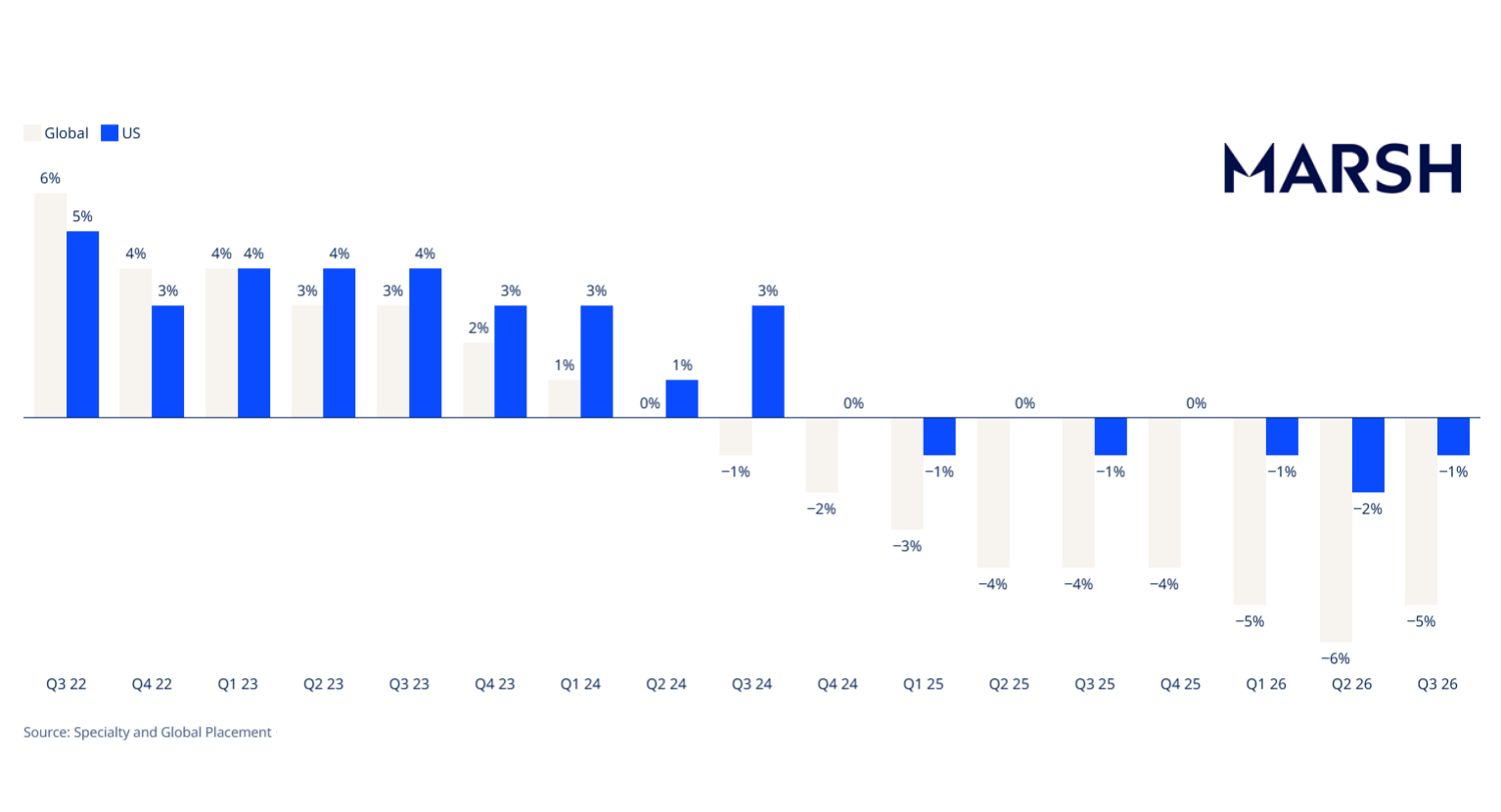
U.S. property rates declined 10%, following a 13% drop in the second quarter. Catastrophe-driven programs, typically carrying more than $1 million in premium, saw average year-over-year declines of 13%, compared with 9% for non-catastrophe programs. Insurers offered catastrophe deductible caps, higher limits, and revised policy terms, and valuation and submission thresholds eased amid greater reliance on historical data, according to the report.
Insured losses through the first three quarters of 2026 trended below 10-year averages, though Marsh noted that a major event, or multiple events, materially above expectations could slow or reverse current dynamics.
U.S. casualty rates increased 6%, compared with a 7% rise in the second quarter, led by auto and umbrella/excess lines. Excluding workers’ compensation, rates rose 9%. Auto insurers continued to face profitability challenges, with loss ratios above 100% for more than a decade, and high single-digit increases were common, according to Marsh.
Risk-adjusted umbrella/excess rates rose 13%, down from 15% in the second quarter, with volatility persisting in trucking, habitational, and hospitality segments.
U.S. Financial Lines and Cyber Show Signs of Stabilization
U.S. financial and professional lines rates rose 1%, matching the second quarter, with D&O liability rates up 1% even as insurers generally reduced capacity. Flat renewals remained the norm absent claims activity or recent transactions, and high excess layers remained difficult to place, according to Marsh. Fiduciary liability rates rose 1%, compared with a 4% increase in the prior quarter, with ERISA 401(k) litigation continuing to drive defense and settlement costs.
U.S. cyber rates were flat following 13 straight quarters of decreases, Marsh found. New insurtech managing general agents using A.I. for underwriting added capacity for small businesses, while third-party software and vendor risk remained a top concern following high-profile incidents. Music copyright infringement claims continued to affect cyber loss ratios, and non-breach privacy claims continued to rise as expanded privacy rights were applied to newer uses such as website tracking, according to the report.
Obtain the full report here. &