Piloting artificial intelligence in claims management is no longer the barrier, operational integration is. Here’s how claims organizations can move beyond proof of concept to realize the full value of AI.
Leadership skill gaps act as a “cascade trigger” for downstream workforce risks, while employee financial insecurity emerges as a top-five concern, according to Marsh’s People Risk 2026 report.
Nearly three-quarters of organizations have deployed or are piloting AI, but only 18% have seen a majority of their workforce participate in reskilling programs, according to Aon.
Ron Morrison, Chief Claims Officer at MSIG USA, discusses how AI is reshaping claims operations, why change management matters as much as technology, and how insurers can use data and collaboration to improve outcomes across complex claims environments.
A global survey of C-suite leaders found that 87% expect commercial insurance to become increasingly strategic over the next three years, according to a report from the Worldwide Broker Network and MarshBerry.
The share of C-level leaders who feel their organizations lack sufficient cyber protection has risen steadily to 89%, up from 81% in 2021, according to Munich Re’s Global Cyber Risk and Insurance Survey 2026.
A majority of insurance companies anticipate significant AI-driven change within three years, yet few have reached advanced implementation, according to AM Best.
AI in claims is no longer about insight alone — it’s about embedding intelligence into everyday workflows to drive faster decisions, stronger outcomes, and more human-centered care.
Gallagher survey found that while nearly two-thirds of businesses have delivered AI training to employees, more than two-fifths still lack formal AI risk management frameworks.
Chubb’s 2026 Cyber Claims Report finds that autonomous AI attacks, expanding privacy litigation, and supply chain interdependence are driving divergent trends in cyber claim frequency and severity.
Construction costs for a single data center location can exceed $20 billion — double once technology is installed — creating concentration exposures in catastrophe-prone areas, according to Swiss Re Institute.
Ransomware losses, AI-driven exposures and nuclear verdicts threaten to disrupt the currently stable executive lines insurance market, according to Risk Placement Services.
AI has become the top priority for insurance industry leaders heading into 2026, according to the International Insurance Society’s Global Priorities Report.
A growing category of AI-native risks — including hallucinations, algorithmic bias and model drift — falls outside the scope of standard insurance policies, according to Gallagher Re report.
Drowsiness, distraction and aggressive driving consistently precede incidents, and near-collisions are becoming the leading safety metric for fleet risk management, according to Motive’s 2026 road safety report.
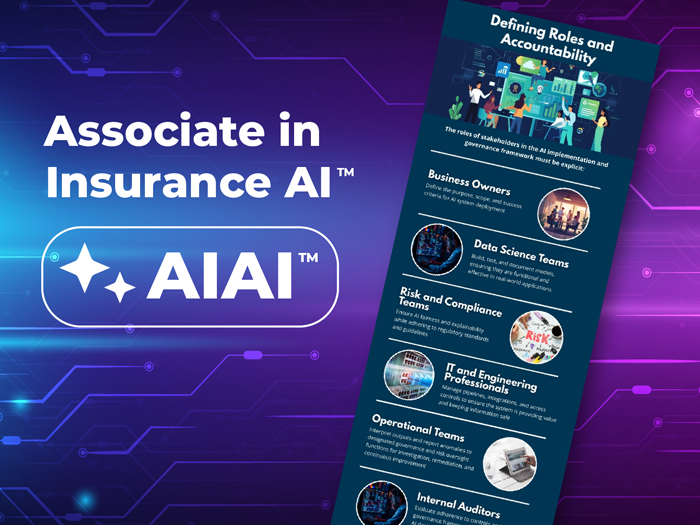
As AI rapidly transforms underwriting, claims, and operations, the Associate in Insurance AI™ provides practical skills to evaluate and apply this technology across the insurance value chain.
Insurance risk leaders face near-term economic pressures while bracing for AI-driven risks, according to Emerging Risk Survey by Casualty Actuarial Society and Society of Actuaries.