Newsletters
 Risk Central
 Digital Edition
Everything You Need to Know about The Institutes’ Associate in Insurance AI Designation
In the ever-growing world of artificial intelligence, risk management and insurance professionals need to be future ready and find new ways to stay on top of trends and understand the nuances of this technology as it grows.
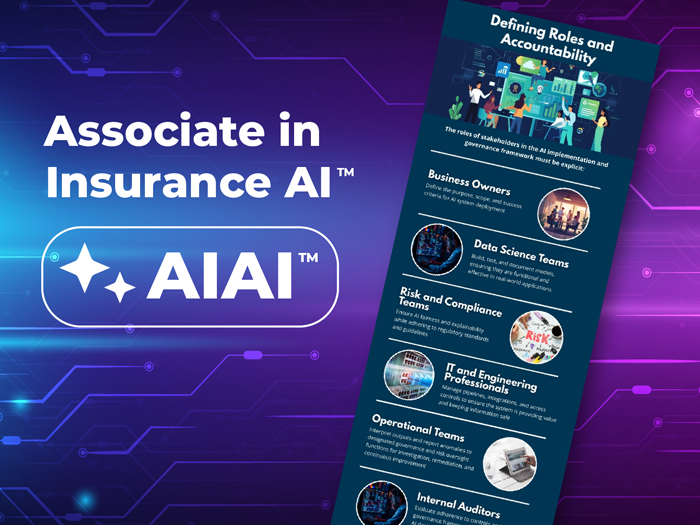
That’s why The Institutes, of which Risk & Insurance is an affiliate, launched its Associate in Insurance AI™ designation. The AIAI™ will give professionals a better understanding of the use of artificial intelligence as a whole, its role in claims and underwriting, and the thought process behind using AI appropriately and ethically.
“When we think about using AI within the insurance space, knowing when not to use AI is just as important as knowing when and how to use it effectively,” said Adam Carmichael, CPCU, president of The Institutes Knowledge Group.
“AI can certainly help bring about efficiencies across the insurance value chain, but we also want to make sure that it does not do things like introduce unintentional bias or create data privacy risks.”
Carmichael and team kept this top of mind in the AIAI’s design so that learners have the chance to develop top critical thinking skills that go along with using a tool like AI. Below, Carmichael shares more about the ins and outs of this Institutes designation and the key learning goals for future designees.
Risk & Insurance: What makes this a good designation in today’s world? How is it fitted to benefit professionals in their career?
Adam Carmichael: As technology continues to impact and change, AI is moving from experimentation to a core organizational capability, with risk and insurance professionals facing the need to understand how AI influences decisions, workflows, and accountability. AIAI helps professionals build the practical skills and judgment needed to evaluate AI-driven decisions and operate effectively.
R&I: Which professionals in the insurance landscape would be good candidates to earn this designation?

Adam Carmichael, CPCU, president, The Institutes Knowledge Group
AC: Thinking about AI and the ways it can be used within risk and insurance, AIAI can be beneficial for a range of RMI professionals, from early career professionals who are looking to build future-ready skills to experienced leaders who are seeking to lead effectively in an AI-enabled workplace and empower a team to use and adopt AI appropriately and ethically.
It also can empower learners who are looking to be change agents within their organization, as far as using the technology and how to advocate for responsible innovation.
R&I: Can you tell us a little bit about the genesis of this designation? What did those initial brainstorming meetings look like and how did the AIAI come to be?
AC: One of the things we do when creating any designation is work with a variety of subject matter experts within risk management and insurance.
This new AIAI program is part of an ongoing collaboration we have with those RMI experts, which is focused on the cutting-edge topics impacting risk and insurance, what skills people need or are going to need in the near future, and how we can put together programs that develop those skills.
R&I: You mentioned subject matter experts. How do you go about partnering with them?
AC: We consult with a number of people who work directly within risk management and insurance, everything from those working in learning and development to those in different fields like claims, underwriting, or analytics.
As part of that, we include videos of some of those subject matter experts right within the courses as well.
R&I: Speaking of the coursework, are there limits to how long someone can take to complete the designation?
AC: When someone signs up for one of the online courses, they get 12-months access to the course. What we’ve seen is most people will go through each course in about a month or so.
The program is designed for self study, so learners can go at their own pace. Each assignment is broken up into smaller chunks that are five to 10 minutes each. Most students will spend a few hours per week over a four to six week period, studying and preparing for the exam at the end.
R&I: Beyond the learning format, what are some of the practical AI skills students will walk away with after completing the AIAI courses?
AC: These courses are designed to give professionals practical AI literacy skills that they can immediately apply in their work. Students will also build a working understanding of AI concepts and terminology so they can confidently participate in AI-driven discussions, decisions, and initiatives within their organizations.
R&I: Are there any specific courses you’d like to highlight?
AC: The AIAI program has three new courses.
The first one is Mastering AI Fundamentals, which looks specifically at building learners’ AI skill set. It also begins to look at how to make sure we’re using AI ethically and being able to apply what is being learned.
The next course is Enhancing the Insurance Value Chain with AI, which gets specific towards how AI can be used in claims, in underwriting or in marketing, and other different aspects across the insurance value chain.
The last course is called Leading Effectively in an AI Culture. So, how to make sure you’re managing AI adoption across teams, leading that implementation, and, again, building an ethical AI culture, as ethics are such an important piece of risk and insurance. We want to make sure that remains a core part of the program. &