Newsletters
 Risk Central
 Digital Edition
Wildfire Insurance Needs Physics-Based Risk Assessment, Not Just Ignition Probability
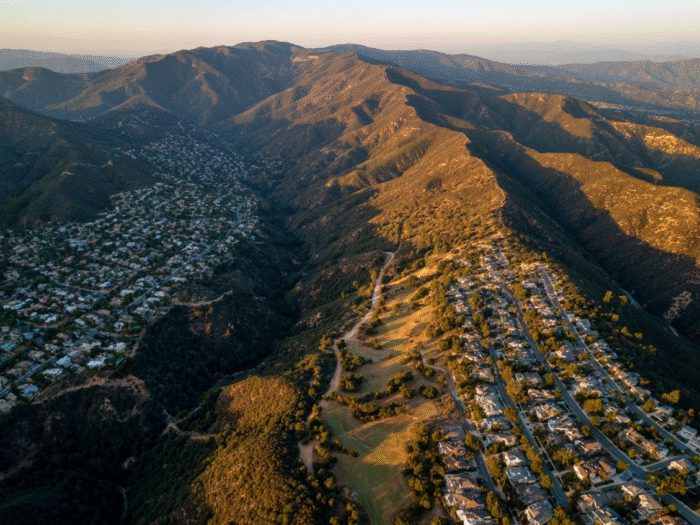
The January 2025 Los Angeles fires offered an unexpected laboratory for rethinking how the insurance industry assesses wildfire risk, according to analysis by Delos insurance Solutions.
While the Palisades and Eaton fires destroyed more than 16,000 structures combined during severe Santa Ana winds, a third fire—Sunset—ignited nearby under nearly identical regional conditions yet burned only about 40 acres and was contained within hours.
The divergence wasn’t random, according to Delos. According to its analysis, the critical difference lay not in weather alone, but in the underlying physics of fire behavior. The Palisades and Eaton fires emerged from large, continuous fuel blocks in steep terrain that hadn’t burned for decades. They were characterized by high ember production from mature vegetation, compounded by suppression challenges from difficult access and rapid perimeter expansion.
By contrast, the Sunset fire encountered fragmented fuel patches, greater road density for firefighter access, and lower wind speeds—conditions that prevented the fire from building sustained momentum.
“These fires made it painfully clear that wildfire risk isn’t about whether a fire starts — it’s about whether the landscape allows it to become unstoppable,” said Kevin Stein, CEO of Delos Insurance Solutions. “The Sunset fire never found momentum. Palisades and Eaton did. Our wildlife risk model is designed to distinguish between those outcomes, and that distinction matters for communities, insurers, and access to coverage.”
Rather than focusing on ignition probability or isolated parcel characteristics, modern risk assessment should center on whether a landscape can support fires that spiral beyond initial attack into uncontrollable urban conflagrations, according to Delos.
Two additional Los Angeles County fires—Kenneth and Hurst—reinforced this principle. Both ignited under challenging conditions with no structure losses, primarily because they burned in landscapes already scarred by multiple fires within the past two decades. These prior burns had reduced shrub height and tree cover, materially limiting ember generation and enabling suppression resources to contain the fires before they reached communities.
Rethinking Insurance Models and Market Access
The performance of fires across the Los Angeles region exposed meaningful gaps in how different wildfire models interpret risk, according to Delos. Traditional approaches often emphasize historical burn patterns or localized structure features, but Delos said these proxies may miss the operational fundamentals that determine fire outcomes: fuel structure, ember dynamics, wind alignment, firefighter access, and suppression feasibility.
This distinction matters beyond individual insurer portfolios, according to the report. Analysis suggests that roughly 50% of properties currently insured through California’s FAIR Plan may qualify for private market coverage under more precise risk assessment.
Building Resilience Through Precision
The structure-hardening lessons from the January 2025 fires reveal that mitigation effectiveness depends critically on context and application, according to Delos. In communities along the wildland–urban interface — adjacent to large, continuous fuel blocks — once a fire reaches sufficient scale, structure-to-structure spread becomes the dominant loss driver, reducing the protective value of individual parcel-level actions.
Edge properties play a disproportionate role in these settings: well-hardened homes can interrupt ember-driven ignition and delay fire spread into interior neighborhoods, while unprotected edge properties often become initial ignition sources that trigger inward-propagating loss.
Conversely, comprehensive structure-level ember mitigation—including screened vents, guarded gutters, enclosed eaves, and noncombustible ground coverings—shows the greatest return on investment in moderate baseline risk environments and lower-density developments, the report said.
“As wildfire behavior continues to evolve, distinguishing between fires that are dangerous and fires that are catastrophic will remain central to sustainable underwriting,” the report’s authors said. “The experience of 2025 demonstrates that models capable of capturing fuel continuity, ember dynamics, access, and suppression feasibility can do more than avoid insurance losses, they can expand availability, reduce reliance on public backstops, and help restore function to an insurance market under strain.”
Obtain the report here. &