Newsletters
 Risk Central
 Digital Edition
Rising Hail Risk Poses Growing Threat to Solar Farm Insurability
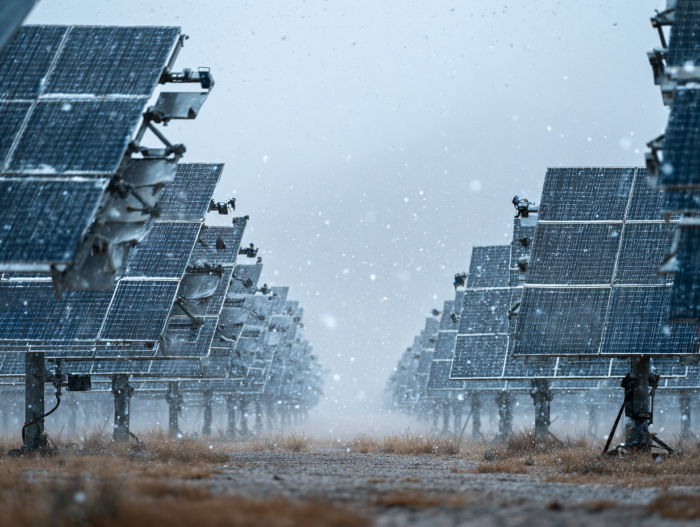
The global expansion of solar photovoltaic farms is on a collision course with severe convective storm risk, as many of the regions best suited for solar development are also among the most exposed to damaging hail, according to a new white paper from Gallagher Re and AXIS.
Severe convective storms accounted for at least 47% of global insured catastrophe losses in 2025, totaling $60 billion, and hail damage to solar infrastructure is a fast-growing segment of that exposure. When analyzing closed solar PV claims reported between 2019 and 2025, AXIS found that hail accounted for 27% of natural catastrophe and extreme weather losses globally by total claim amount, with more than a million PV modules damaged and $342 million in accumulated gross claims.
Solar Growth Meets Hail Exposure
Global renewable power capacity is expected to double between now and 2030, with solar PV accounting for about 80% of that growth, according to the International Energy Agency. Yet many of the areas where solar farms are being built — Texas, parts of South America, Australia and South Africa — sit squarely in hail-prone corridors, the report said.
Texas illustrates the tension clearly. The state is the fastest-growing in the U.S. for solar generation and second only to California in total installed capacity, but its open landscapes and proximity to mountain ranges create ideal conditions for hail-producing storms, the report said. AXIS found that Texas has the highest total gross claim amount for solar PV hail losses in the U.S., an order of magnitude greater than Nebraska, the second-highest state.
Recent advancements in PV module technology have inadvertently increased vulnerability, according to the report. Most projects now use larger modules with thinner, heat-strengthened glass for weight and cost savings. However, claims involving heat-strengthened glass modules are $50,000 per megawatt higher on average than those with thicker, fully tempered glass, AXIS found.
Modeling and Mitigation Offer a Path Forward
To address the underwriting challenge, Gallagher Re has developed a proprietary probabilistic hail model for South Africa — one of the most hail-exposed regions globally — that quantifies risk at two-kilometer resolution across more than 390,000 cells.
The model uses NASA satellite observations of “overshooting tops,” a meteorological feature most likely to produce damaging hail, to map exceedance probabilities and return periods for a range of hail sizes, the report said. The firm has also created hail risk score maps that classify locations from very low to extreme exposure, combining hazard intensity and vulnerability to estimate relative financial risk.
On the mitigation side, AXIS identified three pillars of risk reduction for solar PV farms: accurate weather forecasts, appropriate hail-resistant technology and a well-informed operational strategy, the report said.
One of the most effective protective measures is high-tilt stow — rotating panels to 60 degrees or above during hailstorms so that hailstones glance off at an angle rather than striking directly. Testing cited in the report found that breakage probability could be reduced by 83% by moving from a 30-degree angle to a 75-degree stow angle. AXIS claims data showed that the average cost of a solar PV hail claim is roughly halved when panels successfully stow compared to claims where stow failed or was not attempted.
Climate Change Expected to Intensify Risk
Looking ahead, changing weather patterns are expected to increase both the frequency and intensity of severe convective storms globally, the report said. Research suggests that warmer near-surface temperatures and higher humidity will create more days with conditions favorable for SCS formation.
In regions like South Africa, stronger convective updrafts in an environment of enhanced moisture may produce larger hailstones that resist melting, according to the report. While significant uncertainty remains in modeling future SCS risk, scientists generally agree that the potential for more frequent large hail reaching the ground is increasing worldwide.
Obtain the full report here. &