 Newsletters
 Risk Central
 Digital Edition
Power Sector’s Breakneck Growth Is Outpacing Risk Management, FM Finds
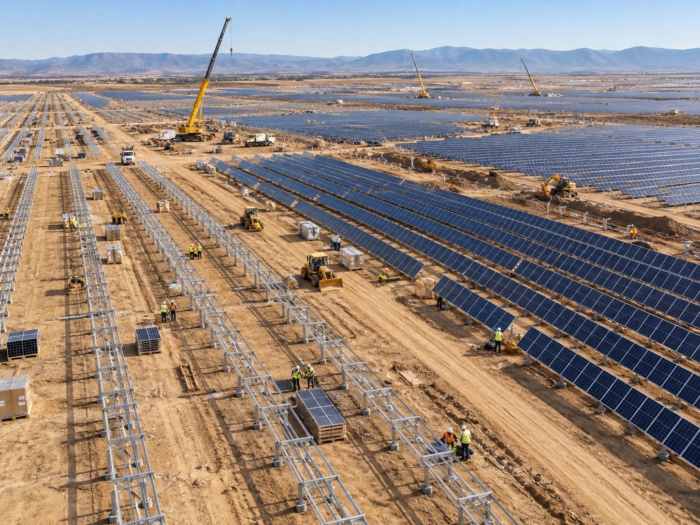
The power generation sector is expanding at extraordinary speed to meet surging electricity demand, but risk is accumulating faster than operators can manage it, according to insurer FM.
In a global survey of 750 power generation sector risk decision-makers, 150 insurance brokers and 150 financiers, FM found that developers now have an average of 2.3 gigawatts of capacity in development, with 78% of power companies saying site selection decisions frequently create downstream exposure that was not anticipated at the time.
Extreme weather, including flooding, hail, wildfire and severe convective storms, was cited by 27% of operators and developers as the top site-related risk, rising to 33% among renewable energy providers.
Risk Accumulates From Site Selection Through Operations
FM’s survey found that risk builds at every stage of a project’s lifecycle. New technology adoption was identified by 59% of power companies as their leading cost-of-risk driver, contributing more than 10% of total cost of risk, or TCOR, more than any other factor. Among operators that have adopted grid-scale power electronics and inverter-based resources, 43% ranked them as the most common cause of unanticipated disruption, the highest share among the technologies surveyed.
Construction brought its own strains, with power operators and developers citing supply chain strain (62%) and schedule overruns (62%) as primary concerns, and more than 60% citing contractor capability gaps.
Robert Colver, AGRC Industry Lead for Natural Resources at Aon, said in the report that “the pace of growth, ambition, and Capex doesn’t line up with the availability of parts.”
Handover from construction to operations emerged as another weak point, with 45% of power operators and developers saying that phase accounts for more than 10% of TCOR, driven largely by fragmented governance, cited by 62%, and incomplete commissioning or documentation, cited by 61%. A further 77% of respondents cited operations and maintenance models that have not been adapted to new technologies as a significant contributor to lifecycle risk.
Michael Perron, Renewable Energy Market Lead at FM, said “one of the biggest risks in the industry is operating new technology using old assumptions,” noting that “many O&M programs were developed for a different generation of assets.”
Insurance Gaps Threaten Project Economics
Although 78% of power companies and 85% of brokers said coverage for energy infrastructure assets remains available, FM’s survey found widespread doubt that insurance alone delivers resilience. More than half of respondents, 56%, believe insurers prioritize risk transfer over risk prevention, and 61% said business interruption terms are misaligned with real-world recovery timelines, a concern shared by 73% of brokers vs. 59% of energy providers.
Coverage for new technology was flagged as a particular weak spot, with 65% of power companies and 75% of brokers saying new and hybrid technologies are underinsured or inconsistently treated.
Sandy Calvert, senior vice president at broker Moore-McNeil, said lead times for critical equipment such as transformers and turbines now stretch up to five years, while “90% of the market is for 12 months” of business interruption coverage. “Insurance isn’t going to cover that gap when the policy itself indemnifies at a maximum of 24 months,” she said.
These gaps carry financial consequences: power providers linked resilience uncertainty to increased construction costs (51%), higher insurance costs (46%), reduced return on investment (40%) and reduced appeal to investors (39%). Financiers consistently estimated TCOR impacts higher than power companies did across all five risk drivers measured, including site selection, technology adoption, construction, handover and lifecycle management gaps.
FM’s Michael Perron said financiers “often lack direct operational visibility,” and “as a result, they see uncertainty and they price it.”
Engineering Insight Seen as a Path to Resilience
Despite these gaps, FM’s survey found broad agreement, 85% of respondents, that applying engineering insight early to identify hidden vulnerabilities makes projects more stable, insurable and financeable. Yet only a third of power companies currently use engineering risk data to assess emerging exposures.
Brokers said insurer-provided engineering is most valuable for new technology or first-of-their-kind projects (71%), construction-phase risk management (67%) and projects in severe catastrophe hazard regions (67%).
Cassian Walker, FM’s Renewables Engineering Manager, said it is “vital that clients evaluate evolving risks” such as hail, flood and wildfire exposure “before they become permanent features of the project.”
Obtain the full report here. &