Newsletters
 Risk Central
 Digital Edition
US Flood Insurance Gap Could Reach $1 Trillion in Extreme Scenarios, Moody’s Finds
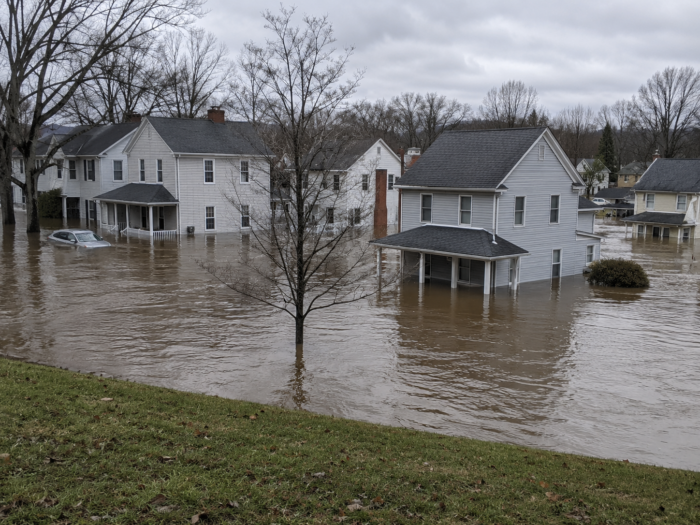
U.S. counties face aggregate uninsured residential flood loss exposure exceeding $375 billion under a 1-in-100-year flood scenario, with a nationwide insurance protection gap of more than 65%, a structural shortfall that Moody’s Ratings warns in a new report poses significant and growing credit risk for state and local governments.
The findings draw on Moody’s RMS US Inland Flood HD model and examine flood exposure at the county level under three scenarios, including a more extreme 1-in-500-year event and a future climate stress test.
A Protection Gap That Widens With Severity
The range of potential uninsured loss is stark. In a 1-in-100-year flood scenario, aggregate uninsured loss exposure nationwide would exceed $375 billion. Under a more extreme 1-in-500-year event, that figure could triple to more than $1 trillion, with the protection gap widening to above 70%, the report found.
The geographic concentration of risk is notable. In the 1-in-100-year scenario, fewer than 2% of counties — spread across 11 states — account for 65% of total uninsured loss exposure, each carrying potential losses above $1 billion. Counties with losses above $5 billion are clustered in Florida, Louisiana, South Carolina and Texas.
As the flood footprint expands in the 1-in-500-year scenario, counties with potential losses above $5 billion extend beyond the Gulf and Atlantic coasts to 11 states, including inland states such as Pennsylvania and Illinois that carry low physical climate risk exposure.
Under an intermediate-emissions scenario by 2050, uninsured losses could rise approximately 25% on average relative to the 1-in-100-year baseline, reaching roughly $472 billion, with a similar protection gap of about 65%. Counties with potential uninsured losses above $5 billion would expand to include New Jersey in addition to the four coastal states, according to Moody’s.
Flood insurance take-up remains low even in the highest-risk areas, the report said. Along the Gulf Coast and Eastern Seaboard, flood insurance uptake rates range from only 10% to 30%, the report noted.
While the number of private flood insurance policies has roughly doubled since 2020, the overall protection gap has not materially narrowed. Private policies still represent approximately 10% of total policies in force, and the number of National Flood Insurance Program policies has declined by a comparable amount.
FEMA Maps Leave Significant Exposure Unaddressed
A central driver of the protection gap is the regulatory framework governing flood insurance requirements, Moody’s said. Federally regulated or backed mortgage lenders rely on FEMA’s Special Flood Hazard Area maps, which use a 1-in-100-year threshold, to determine where borrowers must carry flood insurance. But Moody’s noted that these maps are primarily based on riverine flooding and do not fully capture risk from extreme precipitation, greater storm surges or sea-level rise.
Because flood hazard extends well beyond FEMA-mapped boundaries in practice, a meaningful portion of losses occur outside zones where insurance is mandated or expected. This mismatch between regulatory mapping and actual flood behavior means that many property owners face uninsured losses without necessarily recognizing their exposure, transferring recovery costs to households, state and local governments and federal disaster aid programs.
The Asheville Case Illustrates Tail Risk in Practice
The catastrophic flooding caused by Hurricane Helene in September 2024 provides a real-world illustration of these dynamics, Moody’s said. Rainfall near Asheville, N.C., during the storm exceeded the 1-in-1,000-year rainfall threshold, with one station recording 24.2 inches over three days. Moody’s RMS modeling indicates a flood insurance protection gap of approximately 88% in Buncombe County, N.C., across a range of event severities from 1-in-100 to 1-in-500 loss events.
Moody’s Ratings revised the outlook on Buncombe County’s Aaa rating to negative in March 2025, citing expected decreases in fund balances partly related to Hurricane Helene losses. The outlook was revised back to stable in April 2026 following balanced general fund operations, though the case underscores how extreme events can strain even highly rated local governments when insurance coverage is thin and losses are severe.
View the full report here. &