Newsletters
 Risk Central
 Digital Edition
Cyber Insurance at a Crossroads: AI Reshapes Risk as Market Growth Stays Steady

Global cyber insurance premium is on track to reach $16.4 billion in 2026, growing at a steady 5% annual clip since 2022, even as artificial intelligence reshapes the threat landscape and exposes gaps in coverage among the market’s largest buyers, according to Swiss Re’s latest cyber reinsurance report.
Rather than creating entirely new categories of loss, AI is amplifying cyber risks insurers already know well, according to the report. Threat actors are using the technology to accelerate vulnerability discovery, automate attacks and craft more convincing phishing campaigns, while organizations deploy AI to strengthen threat detection and incident response.
Because AI models often fall within existing policy definitions of computer systems, many AI-driven incidents may already be covered under standard commercial cyber wordings, the report said.
Still, Swiss Re cautions that insurers and insureds need a shared understanding of how policies respond as exposures evolve. AI-related claims remain limited for now, but the report urges close monitoring of technology, regulation and loss trends to keep coverage intent clear.
Rate Declines Persist as Supply Outpaces Demand
Cyber rates fell for a fourth consecutive year, though the size of rate declines eased from roughly -13% in 2025 to -5% in 2026 globally, driven by pricing stabilization in the U.S. as carriers respond to profitability pressure. Europe, by contrast, continues to see sharper price competition.
North America still commands about two-thirds of global premium at $10.7 billion, while Europe is gaining ground with 21% of the global share ($3.42 billion), fueled by global carriers and cyber-focused MGAs investing in the region’s untapped potential. APAC ranks third at 10% ($1.7 billion), with LatAm and MEA each holding roughly 2% of the global market.
With supply still outweighing demand, Swiss Re argues the industry’s priority should be growing the overall market rather than competing purely on price.
Protection Gaps Create Growth Opportunity — and Underinsurance Risk
The report identifies a substantial protection gap across segments. Micro-SMEs and SMEs remain largely uninsured, with penetration of just 5-10% and 10-20%, respectively, yet these businesses are still expected to generate $4.9 billion in premium in 2026 — the market’s largest growth avenue. Mid-market penetration sits at 40-50%, with room to grow both in new buyers and higher limits, contributing an estimated $4.1 billion.
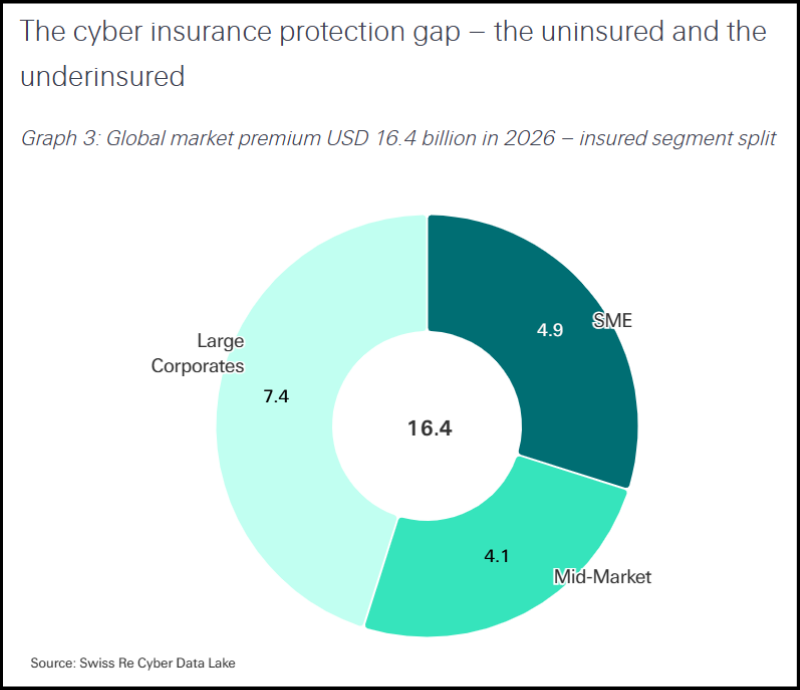
Large corporates, meanwhile, dominate with 60-70% penetration and $7.4 billion in premium, but face a limit-adequacy problem: average purchased limits are about $120 million in the U.S. and $90 million in Europe, yet Swiss Re’s Cyber Claims Database shows an average of 10 losses per year exceed the U.S. benchmark. Given accelerating AI adoption and expanding digital dependency, the report suggests some large corporates may need to double their current limits.
Reinsurance capacity, Swiss Re notes, will play a growing role in helping insurers manage volatility as portfolios and limits expand — provided the market maintains disciplined underwriting and avoids the abrupt pricing swings that have characterized cyber insurance’s earlier growth cycles.
Read the full report here. &