Newsletters
 Risk Central
 Digital Edition
Beyond Hail: The New Risks Reshaping Insuring Solar Power
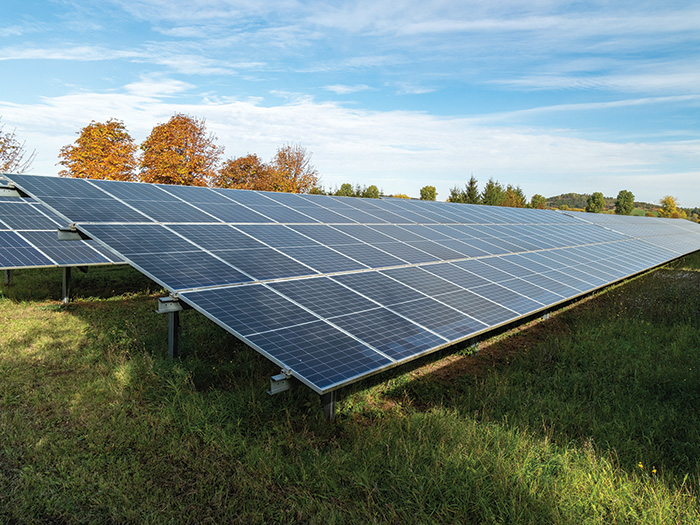
While hail is still the most expensive type of insured loss in solar energy, the industry is starting to turn its attention to fire risk. According to the 2026 Solar Risk Assessment published by kWh Analytics, 84% of photovoltaic (PV) fire events are equipment-driven brushfires.
“We are identifying ever more nuanced operational risks,” the report stated, “which are now measurable drags on revenue and useful life. Tracker twist, fungal soiling, junction-box fires and substantial anomalies are cropping up as unexpected yet impactful issues.”
Across the solar-power sector, financing and compliance terms are tightening, the report noted. Only 38% of developers feel fully prepared for the new prohibited foreign entity rules taking effect in 2026, and non-compliance with heightened regulatory standards can trigger penalties for renewable energy developers.
After a few years when underwriters were being cautious writing solar coverage following a few incidents, “today the market is balanced, with strong global capacity to sustain development,” said Priscilla Pazmino-Vitela, head of natural resources in the Americas for Allianz Commercial.
“Solar is a strategic sector for us globally, except in China. We support the entire lifecycle with a focus on resilience from design to construction.”
Even though weather perils are local or regional, the underwriting challenges for solar have become more global, Pazmino-Vitela noted. There were supply-chain disruptions in the pandemic and those have continued to wax and wane through tariffs and logistical bottlenecks.
“We have been making great use of sophisticated analytics and cat modeling,” said Pazmino-Vitela.“Beyond the modeling we are analyzing individual assets. Technology and operations are advancing rapidly, especially in tracking and stow angle to withstand severe weather. There is much deeper understanding of these projects from development through operations.”
Insurers are also paying close attention to power purchase agreements (PPA). Pazmino-Vitela explained that after a loss there tends to be a focus on the business-interruption (BI) aspect of the supply chain for replacement, but the costs and possible penalties in the PPA are a factor as well. The emphasis is on a comprehensive plan for resuming operations.
Katherine Gerber, head of energy for the Americas, AXA XL
Comprehensive is also the watchword for designing coverage. “In addition to nat-cat, BI and climate-change, there is also cyber coverage,” said Pazmino-Vitela. “Parametric cover is a complement, especially for cat perils. We have an alternative risk transfer team that can advise if parametric insurance may be appropriate. We always take a multi-line approach.”
Risk Transfer Market Conditions
The market for insuring solar projects in North America is soft, but not as soft as other parts of the property and casualty sector.
“At the start of the year the market became more competitive, especially for clean accounts with not a lot of nat-cat exposure,” said Jason Kaminsky, CEO of kWh Analytics, a subsidiary of Beazley which the insurer acquired in March of this year.
“We tend to work at the more technical end of the market where we develop partnerships with vendors to pull in data to support underwriting. Underwriting for solar has come a long way in the U.S. from the 2019 hail event,” said Kaminsky.
“That was the first major loss for the industry. At the time there was not a lot of understanding of how to underwrite or mitigate exposure. Now the U.S. has taken the lead in solar underwriting and mitigation, and that knowledge and technology are spreading to Europe and elsewhere.”
The learning curve was rapid after the 2019 losses, Kaminsky noted. “By 2021 to ’23 there had been a lot of research on storm tracking technology. Then we started seeing research into glass as well. It’s more common now for panels to have more robust glass, and for automatic stow angles of 70 degrees or even more.”
The progression in solar risk management has not been seamless. Software integration can be one challenge. There were, for example, instances of panels being stowed for a storm but then redeploying before the all clear was given.
With those types of complications sorted and hail-alert providers including satellite data, “our advice to owners is: stow early, stow often,” said Kaminsky. “Whatever incremental loss of generation is not worth the potential loss to hail or wind. The pace of change in adopting mitigation technology has been pretty fast.”
Most insurance markets are eager to take advantage of the growth in renewable energy, said Katherine Gerber, head of energy for the Americas at AXA XL.
“There is plenty of current capacity, including several newer MGAs. We approach solar as a cat risk, so underwriting the models and the risk engineering that the clients have implemented are essential for us to be comfortable with the risk.”
“The sooner that risk engineering is involved in the development the better,” said Kimberly Rafuse, senior risk consultant for energy at AXA XL
For example, design of the panels, especially the thickness and resilience of the glass, should be appropriate to the specific site’s hail risk. Operating and stow angles should take into account not just hail but also prevailing wind speeds and direction at the site.
“Panel size is increasing,” said Rafuse. “Those are naturally heavier, so are often designed to be thinner. Which means they are more susceptible to damage.”
Geographic Shifts
The locations where solar installations might be established is also evolving. “We are watching as states approach data centers, and how FERC approves interconnections,” said Gerber, referring to where data center builders might be using renewable energy as a power source.
Some solar development has taken place, or is planned, “not just in areas that are nat-cat exposed, but in places where there has not been anything else,” said Daniel Vetter, head of Americas for Descartes Underwriting, an MGA a firm that specializes in parametrics.
“The traditional sector has retreated from or restricted some of those and as a result retentions and deductibles have increased. In some cases that has left some projects short of coverage, which has slowed timing or caused a relocation.”
Improvements in sensor technology are helping to address the perennial challenge of basis risk, said Vetter.
“Basis risk, the difference between the model and actual events, is inherent to insurance. We’ve been able to narrow basis risk thanks to harvesting sensor, radar, and satellite data. We’re getting data matching historic hailstone versus panel impact.”
Parametrics usually complement traditional coverage,” said Vetter. “It’s an opportunity for insureds to reduce high deductibles and retentions.
Descartes is also active in model design. “Clients make their engineering information available to us, which enables us to design coverage in line with their exposures,” he said. &