 Newsletters
 Risk Central
 Digital Edition
Natalie Burns of The Hartford on the Evolution of Carrier-Broker Relationships
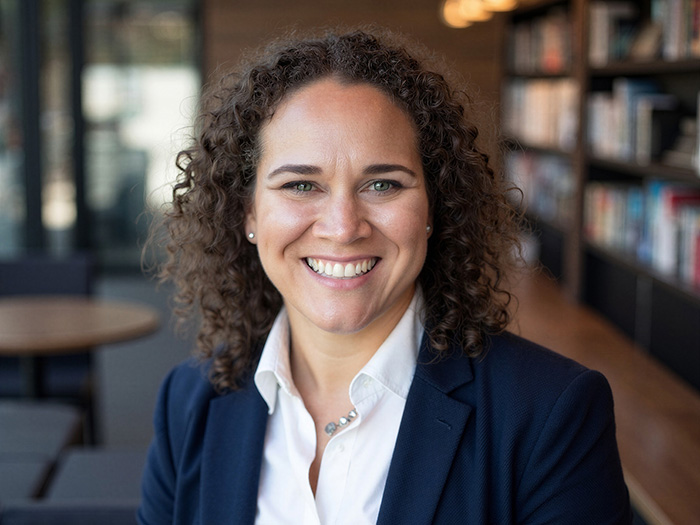
In October of 2026, Dan Reynolds, editor in chief of Risk & Insurance®, caught up with Natalie Burns, Head of Enterprise Sales & Distribution, The Hartford. What follows is a transcript of that discussion, edited for length and clarity.
Risk & Insurance: Thanks for meeting with us, Natalie. What trends are emerging in how commercial property-casualty carriers interact with their distribution partners?
Natalie Burns: There’s always a lot of change in the insurance marketplace. Historically, the carrier-distribution relationship has been straightforward. Distribution partners look to carriers for capacity, pricing, and appetite.
More and more, especially on the heels of A.I. and technology, it’s becoming a more holistic conversation. Today, discussions center around actual risk and how we help our customers with solutions to emerging risks, things they’re starting to see and feel, and market dynamics and challenges.
I think those needs from the brokers, driven by what we’re seeing in the marketplace, are really driving a lot of the change in our industry right now.
R&I: Are the conversations becoming more nuanced and extensive?
NB: Absolutely. That’s a great way to frame it. It’s beyond just “Do you have capacity?” and “Can you put up terms and conditions for my insured?”
Now it’s really, “What risk engineering services can you help with? What are the industry trends that you as a carrier are starting to see that impact this specific customer? How can we collectively bring greater value to this customer and help them face this risk today?” It’s very different than anything they may have seen in the past.
R&I: Is there increased demand from brokers for risk engineering services, particularly regarding emerging technologies?
NB: We do see our distribution partners asking more about services across the spectrum. At The Hartford, we’re hearing questions about telematics and wearables — how can these technologies help our insureds?
Our partners want to understand how we can bring insights from that technology and utilize it effectively. The goal is to deliver better insights that can prevent risk in the first place.
R&I: In a competitive marketplace with numerous carriers vying for broker relationships, how can The Hartford differentiate itself through the quality of its communication and dialogue with distribution partners?
NB: I think that conversation around speed, ease, and accuracy is hugely important. When you talk about differentiation, conversations are elevated now. It’s no longer centered around “get me the information,” or “where did you find this, how do we validate?” But really, it’s about “what is the information telling us and how quickly can we come to a solution together.”
Brokers want to bring a breadth of solutions to their customers. In the past, a broker could go to multiple different markets and get what they needed. Now, in this world of speed, they want to go to one carrier, maybe just a few carriers, and find the solutions for their customers.
They want to know that through the length of the relationship, from acquisition through the third or fourth renewal, their clients are going to be taken care of from a claims standpoint, service standpoint, and being able to get those certificates of insurance, auto ID cards, and any other service they’re going to need.
Speed, ease, accuracy, and transparency are all very important. When we’re having those conversations, it’s not just about whether a carrier can differentiate itself by being fast. Are you fast with quality? Are you fast with not a slow “maybe,” but a fast “yes” or a fast “no,” and then actual follow-through and ability to deliver? I think those qualities all differentiate.
R&I: How has the importance of speed evolved in the E&S market, particularly regarding the “first answer wins” mentality we heard discussed at WSIA?
NB: First answer wins, but you still have to be competitive. Speed is critical, especially when you’re working with really quality carriers, but it doesn’t mean sacrificing competitiveness on pricing and terms.
R&I: Relationships are important, and brokers value carriers that are in it for the long run. What are the keys to maintaining a productive long-term relationship with a broker?
NB: It all starts with a clear agreement that relationships truly are still foundational in this market and in our industry. We talk a lot about technology and think about technology as surpassing everything, but foundational to all of it is relationships, relationships built on trust.
There also needs to be transparency in the conversations we’re having. If there’s nuance in your appetite, then help me understand why. What’s different about this risk so that I’ve got consistency over time of knowing what I can depend on you, carrier, to deliver and for which of my customers?
R&I: Why is it important for carriers to provide brokers with clear information about their appetite and risk selection criteria?
NB: In such a competitive marketplace and with competitive distribution, brokers might be narrowed on markets. They might say, “I’ve got to choose who I can go to from a carrier perspective.”
If there’s a lack of clarity on appetite or risk selection on that standpoint, then that can become frustrating for them. We need to help them run their business as well, especially when they need to go back to their clients with a clear narrative rather than vagaries from the carrier.
R&I: How do you balance underwriting discipline with speed and maintaining strong broker relationships?
NB: The strongest relationships are built on clear expectations and consistent decisions. Brokers want their trading partners to have strong underwriting discipline because they want the partnership to last.
That clarity on our own appetite and being able to communicate it, explain those decisions, and engage early is critical. We also get a little creative on our end. The beauty of The Hartford is we’ve got a breadth of products across our entire enterprise, and we make sure we’re navigating to bring all the potential solutions to them.
At The Hartford, we don’t think of underwriting discipline and strong partnership as being mutually exclusive; rather, underwriting discipline gives rise to strong partnerships.
R&I: Beyond appetite itself, how important is consistency in how The Hartford expresses that appetite and communicates with brokers?
NB: Brokers need to know that when they come to The Hartford, here’s the breadth of risk that we’re interested in, able to convert on, and can bring value to through our services. Again, I go back to the fact that it’s not just about customer acquisition. It’s about the partnership throughout the life of the relationship with the customer and the broker.
R&I: Is there anything important about the distribution relationship that we haven’t covered?
NB: I think this is a dynamic market. We may say that every five or ten years, but I genuinely feel the market is dynamic in ways we haven’t seen before. Technology is playing a very different role, distribution is becoming more concentrated and sophisticated, and we’re all more interconnected than ever.
In that lies tremendous opportunity for all of us. It’s no longer a binary transaction; here’s a risk, can you cover it for me? Instead, it’s evolved into a deeper conversation around the full customer: “What are the risks that a customer has, and how do we collectively solve for them together?” &