 Newsletters
 Risk Central
 Digital Edition
Case Studies Show How Operational Discipline Cuts Renewable Energy Losses
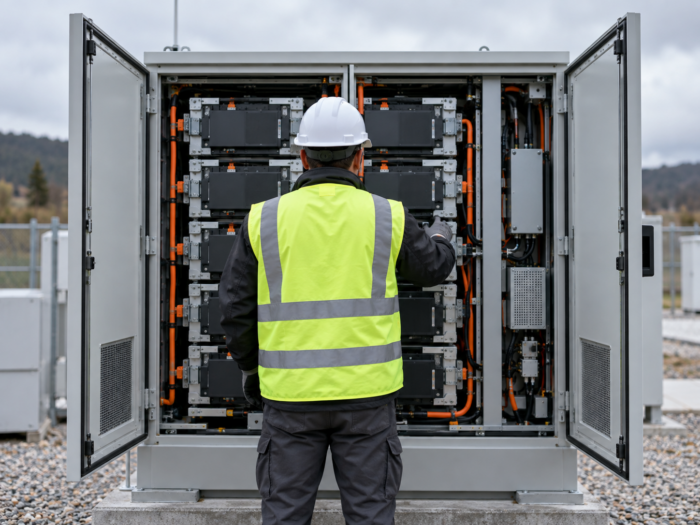
Equipment design and fast operational decisions made the difference between minor and major losses for renewable energy operators facing hail, typhoon, winter storm, wildfire and battery fire risks, according to case studies in kWh Analytics’ 2026 Resilient Power Report.
Automated hail-stow controls held solar module damage to less than 0.02% during a severe Texas hailstorm, and a battery storage owner cut its expected loss from a thermal event by about 95% by installing single-use fuses between battery modules. The report compiles case studies from kWh Analytics and contributors including the National Laboratory of the Rockies, Madison Energy Infrastructure, Clearway, Nextpower and Deriva Energy.
Battery Storage and Hardware Design Drove Outsized Losses
A solar and storage asset owner with more than $100 million invested in battery energy storage technology faced an estimated eight-figure loss in insured value after its system manufacturer could no longer provide engineering support for a known HVAC defect, according to kWh Analytics. The equipment’s long-chain enclosures were prone to rooftop HVAC fires from undersized cooling systems and water ingress that could lead to thermal runaway.
The owner adjusted charge-discharge cycling to let HVAC systems cool, sacrificing revenue, and installed single-use fuses between battery modules to isolate faults before they could spread. Since implementing the temperature-driven cycling strategy, the owner has not experienced a single HVAC thermal event, and with the fuses in place, the expected loss from a thermal event dropped by approximately 95%, the report said.
A second owner of the same battery systems took a different approach, redesigning HVAC control panels, relocating components and adding external condensate drains, along with remediating enclosure seals.
Hardware design similarly determined outcomes after Typhoon Mawar struck Guam in May 2023 with gusts up to 137 mph, according to an assessment by the National Laboratory of the Rockies. Two adjacent rooftop solar systems at a school experienced identical wind conditions of roughly 111 mph, yet one lost most of its modules while the other was undamaged. The difference traced to clamp design: rail-mounted clamps that could rotate loose under vibration released modules in pairs, triggering cascading failures, while clamps with large contact areas bolted directly into the support structure held firm.
Across 29 systems surveyed island-wide, installations using one racking manufacturer averaged 3% damage across 17 sites, while sites using the failure-prone rail-mounted clamps averaged 54% damage across three sites, the laboratory found. Upgrading to more robust clamps could add an estimated 0.03% to 0.5% to total system costs, according to the assessment.
Automated Controls Protected Assets From Hail and Snow
In June 2025, a severe hail outbreak brought hailstones as large as 5 inches to West Texas, striking Clearway’s 452-megawatt Texas Solar Nova sites, home to more than 1 million solar modules. Automated hail-stow technology, built on Nextpower’s NX Horizon trackers, tilted panels to 60 degrees ahead of the storm and held that position for roughly three hours, according to the companies.
The sites sustained fewer than 200 damaged modules, or less than 0.018% of the 1,097,778 modules installed, and generated zero insurance claims, even as nearby service vehicles suffered extensive hail damage. The automated system activated 121 times in 2025 and an additional 40 times in 2026, including during two more documented hailstorms.
Winter Storm Fern brought up to 28 inches of snow across Madison Energy Infrastructure’s East Coast portfolio in January 2026, with Maryland recording its heaviest accumulation in a decade. Madison issued remote snow-stow commands at equipped sites before snowfall began and dispatched technicians to manually position trackers at older sites, according to the company.
By combining snowmelt modeling with production data across 405 affected sites, Madison determined that only four sites would have shown a positive return on investment from manual snow clearing, and those had already shed snow via trackers. The response returned 6 megawatts of solar capacity to service 10 days sooner than natural melt would have allowed, the report said.
Proactive Shutdown Averted Wildfire Damage
When a significant wildfire event threatened one of Deriva Energy’s utility-scale renewable facilities, the company’s Remote Operations Center made the decision to proactively de-energize the site rather than wait for conditions to force an unplanned shutdown, according to Deriva. Internal stakeholder notifications were completed within minutes, following procedures aligned with North American Electric Reliability Corp. (NERC) reliability standards. The facility was restored to service without damage once the wildfire threat was contained, the company said.
Obtain the full report here. &