Newsletters
 Risk Central
 Digital Edition
AI Litigation and Its Impact on D&O Insurance
As business practices and new product offerings increasingly integrate artificial intelligence (AI) and rely on AI-driven solutions, directors & officers (D&O) and ancillary lines of insurance must navigate a complex and evolving risk landscape and will likely face substantial underwriting challenges. This article discusses civil and regulatory actions relating to AI, D&O claim trends to date, and AI-specific issues that increase the potential for systemic losses.
Shareholder Litigation
Companies directly involved in the AI field or using AI to power their core products will likely have higher growth and profitability expectations with corresponding higher stock valuations. If the entity then fails to meet expectations and there is a sharp decline in stock prices, this can lead to higher settlement values for shareholder litigation.
Due to this potential for lucrative settlements, entity disclosures regarding AI usage and its potential impact on future earnings and growth prospects have resulted in a wave of class actions. In one instance, a securities suit was filed by a plaintiff shareholder against an AI-based healthcare company and its management following a sharp decline in value, alleging that the company’s AI capabilities had been overstated.[1]
Entities also face enhanced Federal and State regulatory exposure related to implementing AI, including allegations of fraud.

Joy Schwartzman, Principal and Consulting Actuary, Milliman
Regulatory Actions — Securities and Exchange Commission
The SEC is tightening regulations on AI disclosures by publicly traded entities and regulated financial institutions, and misrepresenting AI capabilities could lead to investigations, fines, or formal proceedings. D&O insurance policies for publicly traded entities, and professional lines policies for registered investment advisers generally provide coverage for formal SEC or similar investigations.
Recent enforcement actions illustrate this potential SEC focus on AI disclosures. In one example, the SEC recently settled charges against a restaurant technology company for “making materially false and misleading statements about critical aspects” of its highly touted AI product.[2] In another case from 2024, the SEC brought enforcement actions against two registered investment advisers for misleading disclosures related to the purported use of AI and machine learning in an investment process, including claims that their platforms incorporated AI-driven forecasts.[3]
Regulatory Actions — Department of Justice
The DOJ brought criminal action against an AI-based social media startup with charges of wire fraud, securities fraud, and obstruction.[4]
Regulatory Actions — Federal Trade Commission
The FTC will use its existing Data Governance Board as an AI Governance board and rename it the “Data and AI Governance Board.”[5] The FTC’s strategic approach to AI will emphasize transparency, accountability, and a focus on public benefit.[6]
State-specific Prospective AI Regulation
Various states are implementing AI-related statutes that govern a wide variety of issues. For instance, Colorado has introduced legislation that will require any developer of a high-risk AI system to “use reasonable care to protect consumers from any known or reasonably foreseeable risks of algorithmic discrimination.”[7]
In California, Governor Gavin Newsom recently signed into law a bill requiring OpenAI and other large AI providers to disclose steps they are taking to mitigate potential catastrophic risks.[8]
Securities Class Actions with Allegations Relating to the Use of AI
There have been 53 SCA with allegations relating to the use of AI filed between March 2020 and June 30, 2025. Through June 2025, AI is the largest class of event-driven[10] SCAs, exceeding the number of SCAs related to cryptocurrency, Covid-19, cybersecurity, and special purpose acquisitions companies (SPACSs) individually.
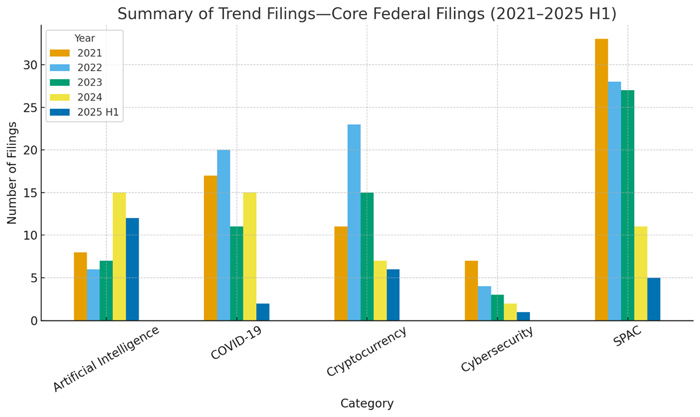 Although many of the actions are in their earliest stages and some may ultimately be dismissed, AI-related class action litigation filings more than doubled in 2024 from the previous year.[12] The vast majority of these actions will, at minimum, incur covered defense costs under D&O policies, subject to policy retentions and coverage terms.
AI Washing
Many of the SCA allegations use the term “AI washing.” This refers to the practice of companies inflating or misrepresenting their AI capabilities and the sophistication of proprietary AI technology, often driving up valuations that subsequently decline materially when expectations are not met.[13]
Common allegations in SCA and regulatory actions that are categorized as AI Washing include:
Misrepresentation regarding the capabilities of an entity’s AI product
Presto Automation Inc. – the aforementioned restaurant technology charged with “making materially false and misleading statements about critical aspects of its flagship artificial intelligence (AI) product, Presto Voice.”
Innodata – a global data engineering company charged with misleading investors into believing that the entity had developed a “proprietary, state-of-the-art” AI platform, when in reality the operations “were powered by thousands of low-wage offshore workers, not proprietary AI technology.”[15]
Tempus AI – an AI-based healthcare company facing a shareholder class action, with allegations that the company “overstated its AI capabilities…after [its] share price declined following the publication of a short seller report critical of the company and its management.”[16]
Evolv Technologies – a company that develops AI-based weapons detection for security screening, charged with making “materially false and/or misleading statements” about its business, operations, and prospects. Among the allegations, “the lack of effectiveness of Evolv’s products with regard to detecting knives and guns led to an increased risk of undetected weapons entering locations such as schools.”
Telus International – an entity that designs, builds, and delivers digital solutions for customer experience, including AI, charged with failure to disclose to investors that, among other things, their “AI Data Solutions offerings required the cannibalization of its higher-margin offerings,” thereby contributing to the entity’s declining profitability.

Robert Herm, Principal and Founder, Midway Pro Lines Risk Services
Fraud
Joonko – a technology firm that claimed to use AI to help client firms meet their diversity, equity, and inclusion (DEI) goals by matching them with a diverse pool of job applicants. SEC Enforcement Division filed a criminal case alleging that Joonko “engaged in an old school fraud using new school buzzwords like ‘artificial intelligence’ and ‘automation.’”[19]
IRL – a social media startup charged with “wire fraud, securities fraud, and obstruction in connection with a scheme to defraud investors of $170 million.”[20] An internal investigation determined that IRL’s user base was largely fictitious, with 95% of claimed users being bots.[21]
Negligence and deceptive business practices
OpenAI – a case filed against OpenAI alleged negligence and deceptive business practices related to a teen suicide. It claimed that ChatGPT, although originally used for schoolwork support, eventually counseled the teen on how to take his own life.[22]
Impact on D&O Claims Costs and Underwriting
As the use of AI continues to grow, some D&O insurers are in the early stages of adjusting their underwriting strategies to account for AI-related risks. This evolution is consistent with responses to new risk categories such as cybersecurity, cryptocurrency, and Covid-19. However, AI also poses an increased risk of “clash” or “correlated” exposure—multiple plaintiffs filing claims against a common defendant based on AI-related issues. Widespread implementation of AI across entities in a given industry could result in correlated D&O and/or errors and omissions (E&O) claims against a single defendant.[23]
For example, in 2005, a class action lawsuit was filed against several hundred auto insurers alleging “that [they] used the ‘Colossus’ software program to systematically underpay uninsured and underinsured motorist claims… The estimated collective class benefit of the settlements exceeded $1 billion.”[24]
AI could also result in exposing multiple lines of insurance via separate but related shareholder and customer litigation against the same entity. For example, entities’ use of AI to replace professional judgment in determining insurance coverage not previously disclosed to purchasers of such insurance are potentially facing a shareholder class action and a separate class action by customers, both based on alleged improper claim denials.
Although it is still too early to determine consistent D&O and ancillary lines underwriting responses to AI exposures, the following general underwriting trends are noted:[25]
- Underwriting scrutiny on AI-related disclosures and higher D&O rates and retentions for publicly traded entities with notable AI exposures are increasing.
Conclusions
As the use of AI accelerates and regulatory frameworks adapt, disclosures to investors and consumers will continue to evolve. This transformation will influence D&O underwriting and loss costs associated with AI-related exposures.
Given the rapid pace of innovation, just one year from now, the nature of the AI-related allegations discussed in this paper may have expanded and become more nuanced. The trajectory of AI company valuations bears some resemblance to the dot-com bubble of the 1990s, which was propelled by company use of the Internet. This historical analogy may be a leading indicator of things to come. If there is an ensuing bubble burst and a surge in litigation, transparent disclosures, adaptive underwriting, and proactive risk management will be crucial to mitigate the financial impact and correlated insurance claims. On 14 October 2025, The New York Times published an article in which two economists stated, “The economic impact generated by a bursting of the A.I. bubble would be greater than the loss of the trillions currently being invested to build the technology itself.” &
Source List
[1] LaCroix, K. (2025, June 18). AI-Washing Securities suit filed against Tempus AI. The D&O Diary. https://www.dandodiary.com/2025/06/articles/securities-litigation/ai-washing-securities-suit-filed-against-tempus-ai/.
[2] SEC. (2025, January 14). SEC charges restaurant-technology company Presto Automation for misleading statements about AI product. https://www.sec.gov/enforcement-litigation/administrative-proceedings/33-11352-s.
[3] SEC. (2024, March 18). SEC charges two investment advisers with making false and misleading statements about their use of artificial intelligence [Press release]. https://www.sec.gov/newsroom/press-releases/2024-36.
[4] Office of Public Affairs. (2025, August 27). Former Silicon Valley CEO charged with fraud and obstruction of justice [Press release]. DOJ. https://www.justice.gov/opa/pr/former-silicon-valley-ceo-charged-fraud-and-obstruction-justice.
[5] Young, S.D. (2024, March 28). Advancing governance, innovation, and risk management for agency use of artificial intelligence [Memorandum]. OMB. https://www.whitehouse.gov/wp-content/uploads/2024/03/M-24-10-Advancing-Governance-Innovation-and-Risk-Management-for-Agency-Use-of-Artificial-Intelligence.pdf.
[6] Ibid.
[7] Concerning consumer protections in interactions with artificial intelligence [Addendum]. SB24-205, 74th General Assembly (2023-2024). https://leg.colorado.gov/sites/default/files/documents/2024A/bills/2024a_205_enr.pdf.
[8] Godoy, J. (2025, September 29). California’s Newsom signs law requiring AI safety disclosures. Reuters. https://www.reuters.com/legal/litigation/californias-newsom-signs-law-requiring-ai-safety-disclosures-2025-09-29/.
[9] Stanford Law School. (n.d.). Securities class action filings (6879). Retrieved Month Day, Year, from https://securities.stanford.edu/filings.html.
[10] Event driven SCA’s are lawsuits filed after an entity experiences a significant negative operational event that causes its stock price to fall sharply.
[11] Summary of Cornerstone Research Securities Class Action Filings 2025 Mid-Year Assessment 8 Trend Filings—Core Federal Filings 2021–2025 H1
[12] Cornerstone Research. (2025, January 29). Securities class action filings increase for second consecutive year in 2024 [Press release]. https://www.cornerstone.com/insights/press-releases/securities-class-action-filings-increase-for-second-consecutive-year-in-2024/.
[13] Greene, J. (2025, February 6). New wave of investor lawsuits targets ‘AI washing’. Reuters. https://www.reuters.com/legal/government/column-new-wave-investor-lawsuits-targets-ai-washing-2025-02-05/.
[14] SEC. (2025, January 14). op. cit.
[15] David D’Agostino v. Innodata Inc., 2:2024cv00971 (2024). https://www.cohenmilstein.com/wp-content/uploads/2025/02/Innodata-Securities-Class-Action-Complaint.pdf.
[16] LaCroix, K. op. cit.
[17] Stanford Law School. (2025, July 8). Case summary: Evolv Technologies Holdings, Inc. securities litigation. Retrieved Month Day, Year, from https://securities.stanford.edu/filings-case.html?id=108333; Gerald Raby v. Evolv Technologies Holdings, Inc., 1:24cv10761 (Filed 2024, March 25). https://www.dandodiary.com/wp-content/uploads/sites/893/2024/03/Evolv-Technologies-complaint.pdf.
[18] Stanford Law School. (2025, July 22). Case summary: TELUS International (Cda) Inc. securities litigation. Retrieved Month Day, Year, from https://securities.stanford.edu/filings-case.html?id=108527; (Individually and on Behalf of All Others Similarly Situated) v. TELUS International (Cda) Inc., (Filed 2025, January 30). https://rosenlegal.com/wp-content/uploads/2025/02/Telus-International-Complaint.pdf.
[19] LaCroix, K. (2024, June 14). SEC files “AI-washing” enforcement action against AI-based start-up founder. The D&O Diary. https://www.dandodiary.com/2024/06/articles/securities-enforcement/sec-files-ai-washing-enforcement-action-against-ai-based-start-up-founder/.
[20] U.S. Attorney’s Office, Northern District of California. (2025, August 27). Former Silicon Valley CEO charged with fraud and obstruction of justice [Press release]. DOJ. https://www.justice.gov/usao-ndca/pr/former-silicon-valley-ceo-charged-fraud-and-obstruction-justice.
[21] Basilan, M. (2023, June 26). SoftBank-backed IRL shuts down after CEO misconduct probe; admits 95% of users are bots. International Business Times. https://www.ibtimes.com/softbank-backed-irl-shuts-down-after-ceo-misconduct-probe-admits-95-users-are-bots-3702030
[22] Duffy, C. (2025, August 27). Parents of 16-year-old sue OpenAI, claiming ChatGPT advised on his suicide. CNN Business. https://www.cnn.com/2025/08/26/tech/openai-chatgpt-teen-suicide-lawsuit; Hendrix, J. (2025, August 26). Breaking Down the Lawsuit Against OpenAI Over Teen’s Suicide. Tech Policy. https://www.techpolicy.press/breaking-down-the-lawsuit-against-openai-over-teens-suicide/.
[23] For example, the Colossus auto adjustment claims caused 24 class action settlements.
[24] Nix Patterson, LLP. (n.d.) Colossus Software Class Action. https://nixlaw.com/ourresults/npr-team-gains-over-two-dozen-national-class-action-settlements-providing-significant-recoveries-for-class-members-and-changing-the-way-first-party-auto-insurance-claims-are-handled/.
[25] Galindo, M. (2025, February 12). How AI washing is impacting D&O insurance: A growing risk for companies and their leadership. Flow. https://www.flowspecialty.com/blog-post/how-ai-washing-is-impacting-d-o-insurance-a-growing-risk-for-companies-and-their-leadership.
[26] Bernstein, J., & Cummings, R.2025, October 14). Warning: Our stock market is looking like a bubble. The New York Times. https://www.nytimes.com/2025/10/14/opinion/ai-bubble-stock-market-tech-stocks.html.