Newsletters
 Risk Central
 Digital Edition
AI Adoption Shows Early Negative Correlation With Job Growth, Raising Workers’ Comp Questions

Sectors that have embraced artificial intelligence most aggressively appear to be losing jobs, while industries with lower AI adoption are adding them, a pattern with significant implications for workers compensation premium mix, the National Council on Compensation Insurance found in its Q2 2026 Quarterly Economics Briefing.
Through the first five months of 2026, overall job growth averaged 114,000 positions per month, up sharply from just 10,000 per month in 2025, but that recovery has been uneven across sectors in ways that appear tied to AI adoption rates, the report said.
Uneven Job Growth Tracks With AI Adoption
Using data from the U.S. Census Bureau’s Business Trends and Outlook Survey, NCCI compared sector-level AI adoption rates against employment changes in early 2026. The survey measures whether firms have used AI, including machine learning, natural language processing, or virtual agents, in any business function within the prior two weeks.
Adoption rates were highest in Management, Information, and Professional, Scientific, and Technical Services, and lowest in Transportation and Warehousing and Accommodation and Food Services.
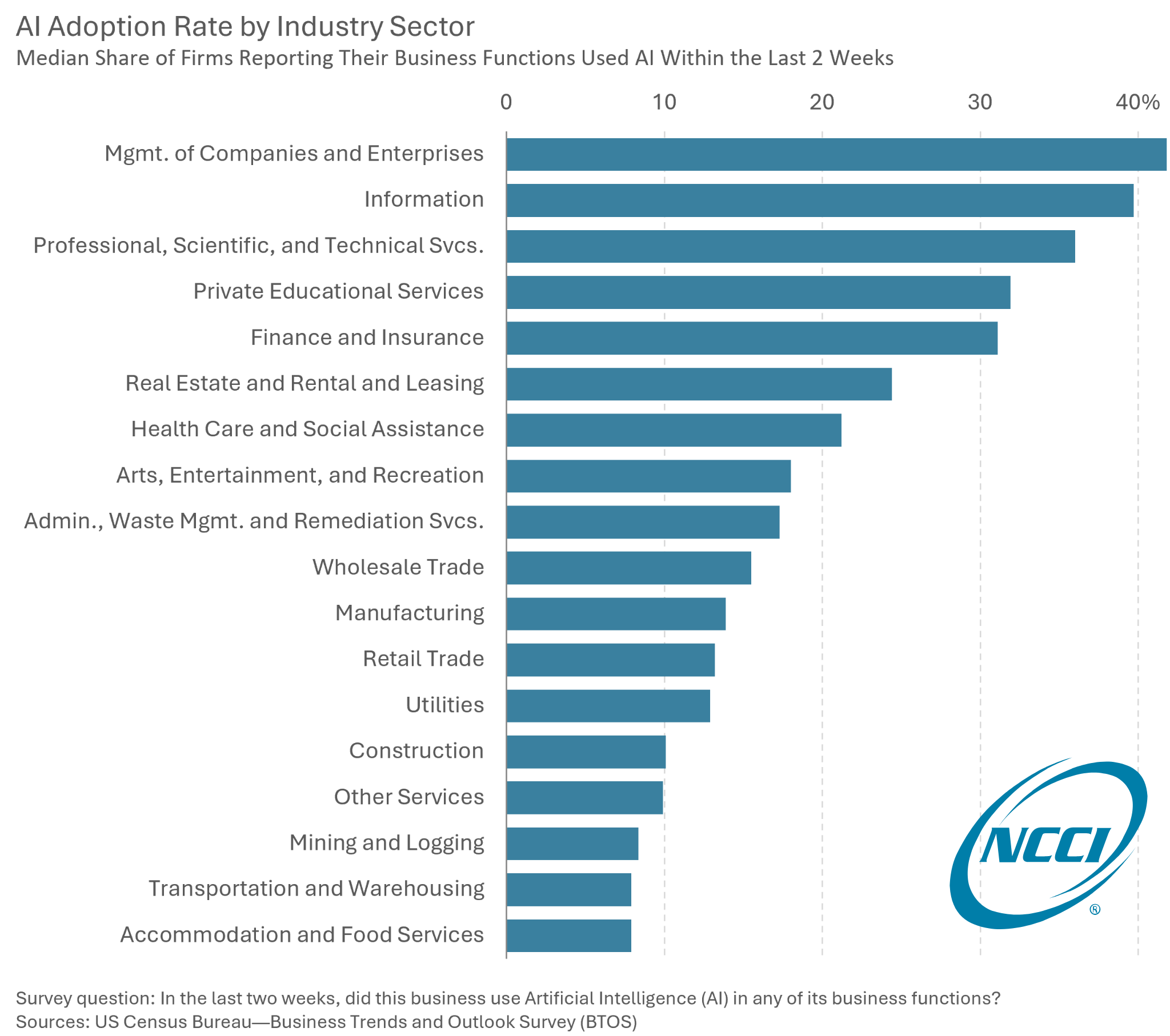
The employment picture largely inverted that ranking. Construction, Health Care and Social Assistance, Transportation and Warehousing, and Leisure and Hospitality posted solid job gains, while office-based sectors including Information and Financial Activities continued to shed positions.
NCCI noted that job growth in early 2026 “appears to be negatively correlated with AI adoption,” while acknowledging that some lingering effects from broader economic uncertainty may still be influencing results. The briefing noted two outliers: Health Care and Social Assistance and Professional, Scientific, and Technical Services both reported relatively high AI adoption yet outperformed the hiring trend. NCCI attributed this to the high-dimensionality nature of jobs in those sectors, where AI augments a wide bundle of tasks rather than replacing a narrow one, potentially spurring productivity gains that encourage additional hiring.
How Job ‘Dimensionality’ Shapes AI Risk
A central framework in the NCCI analysis is what economists call the dimensionality of a job, meaning the number and variety of discrete tasks that make up a role. Jobs with many interconnected tasks, such as those held by registered nurses or project managers, are exposed to AI but less vulnerable to outright elimination. When AI automates one task among many, it can free workers to deepen their focus on remaining tasks or take on new ones, increasing both productivity and their value to employers, the report noted.
Jobs with fewer tasks present a different picture. The briefing used long-haul truck drivers as a modern example: if autonomous vehicles eliminate the core driving task, the role may either disappear or evolve into something like logistics planning or vehicle maintenance. NCCI described the outcome as uncertain, writing that “the horse was eliminated, the travel agent evolved, and we will have to wait and see what happens to the truck driver.”
The widely cited statistic that 80% of the U.S. workforce could have at least 10% of their tasks affected by large language models does not mean 80% of jobs are at risk of elimination, NCCI cautioned. Task exposure and job elimination are distinct concepts, and conflating them overstates the displacement risk.
Productivity Gains Support Wages but Raise Safety Questions
Since mid-2023, labor productivity growth has been elevated, a trend NCCI said looks similar to the elevated trend experienced in the late 1990s and early 2000s, around the time of the proliferation of personal computing and the internet. Higher output per hour has supported wage growth even as hiring slowed, with compensation continuing to run above pre-pandemic trends.
NCCI flagged an unresolved question: whether workers are more productive because technology is enhancing their capabilities, or because leaner staffing forces them to accomplish more with fewer resources. The answer carries consequences for claim frequency, the report said. Greater capability could translate to fewer injuries, while overwork could drive fatigue, burnout, and higher injury rates.
The briefing noted that employment growth concentrated in low AI exposure sectors such as Construction, Manufacturing, and Transportation and Warehousing, which together account for nearly half of workers’ compensation premium in NCCI states, could gradually shift the premium mix away from lower-severity office-based sectors if current trends persist.
Read the full report here. &