Newsletters
 Risk Central
 Digital Edition
War Overtakes Civil Unrest as Top Political Violence Fear for Businesses

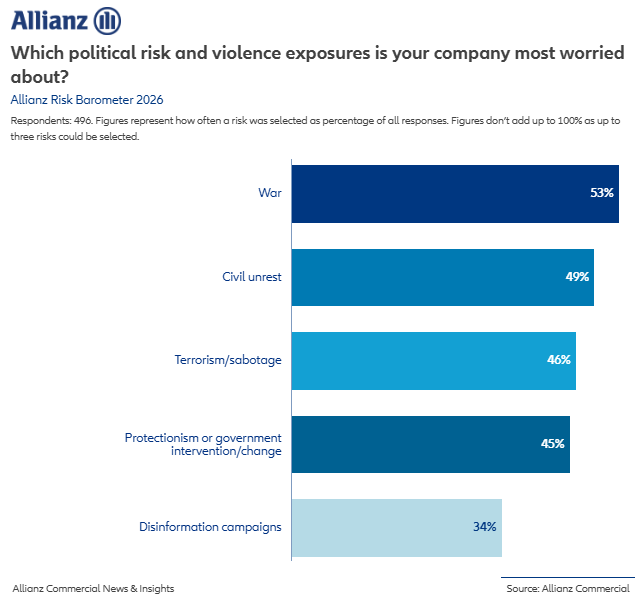
War has surpassed civil unrest as the political violence exposure companies fear most, garnering 53% of respondent votes in the 2026 Allianz Risk Barometer, up from 48% in 2025.
The shift reflects a world experiencing one of its most volatile geopolitical periods since World War II, with the U.S./Iran conflict, the ongoing war in Ukraine and broader Middle Eastern tensions disrupting trade routes, straining alliances and heightening risks to business assets, according to a new report from Allianz Commercial.
Business assets saw a 22% jump in exposure to conflict over the past five years, with 36,000 assets now located in conflict zones, up from 29,500 in the first quarter of 2021, according to figures from Verisk Maplecroft cited in the report. For sectors including extractive and mineral processing, technology and communications, and infrastructure, the number of assets in conflict-affected areas has jumped by more than 60% since 2021.
The areas of the world affected by armed fighting have grown by 89% in the last five years to cover almost 5% of the world’s six permanently inhabited continents — an area more than one and a half times the size of the European Union, the report said.
Gray Zone Threats Blur Lines Between Peace and War
Beyond conventional warfare, gray zone activities — sabotage, cyber-attacks and disinformation campaigns — are reshaping modern conflict. Europe witnessed 145 incidents of sabotage between Russia’s 2022 invasion of Ukraine and the end of 2025, according to the Associated Press, as cited in the report. Targets included power infrastructure, railways, undersea cables and airports.
Russian cyber activity against NATO states increased by 25% for the year ending June 2025, with the U.S. the most targeted region and governments the most targeted sector, according to Microsoft data referenced in the report. Hostile actors are leveraging criminal networks to carry out illegal activities, making attribution difficult, the report said.
“A severed undersea cable in the Baltic, which results in an internet outage and consequent supply chain disruption, could be the work of a fisherman, paid by a criminal gang in the pocket of a spy agency,” said Srdjan Todorovic, global head of political violence and hostile environment solutions at Allianz Commercial.
Transport was the most frequently targeted sector in Russia-linked hybrid warfare incidents in Europe in 2025, with 33 incidents, followed by defense with 15, the report found.
Civil Unrest Not Confined to Fragile States
Civil unrest ranked second globally among political violence concerns, with 49% of respondents citing it. Allianz Research tracked around 250 reported strikes, riots and civil commotion (SRCC) events between 2020 and 2025 involving more than 1,000 participants and lasting more than one day. Pakistan experienced the most events, followed by Indonesia.
Notably, the Allianz Social Resilience Index revealed that mid-resilient economies accounted for roughly 70% of global SRCC activity during that period. Countries such as France and Germany — considered high-resilience economies — recorded four to five significant protest events, while Indonesia and the U.S. registered among the highest protest frequencies overall.
“SRCC-driven disruption is no longer an emerging-market footnote, but a scenario to be stress-tested across the full operational footprint, including high-income countries,” said Luca Moneta, senior economist for emerging markets and country risk at Allianz Research.
Terrorism Surges in the West Despite Global Decline
While global deaths from terrorism fell 28% to 5,582 in 2025, fatalities surged 280% to 57 in the West, driven by antisemitism, Islamophobia and politically motivated violence, according to Vision of Humanity’s Global Terrorism Index cited in the report. Children and adolescents accounted for 42% of all terror-related investigations in Europe and North America in 2025, with radicalization accelerated by algorithmic amplification on digital platforms.
Over 90% of terror attacks in the West since 2015 have been carried out by lone wolf actors, who remain three times more likely to successfully execute an attack than groups, the report said. Counter-terrorism efforts may be hampered as countries under fiscal strain find security resources stretched across competing priorities.
When asked which particular impact of political violence concerns their company most, business interruption and the impact on contingent business interruption and supply chains each drew 72% of respondents in the Allianz Risk Barometer. Almost half of companies surveyed were looking at renegotiating and diversifying supply chains, while 35% were evaluating nearshoring and domestic manufacturing options, the report found.
Obtain the full report here. &