Newsletters
 Risk Central
 Digital Edition
New Modeling Approaches for Offshore Wind
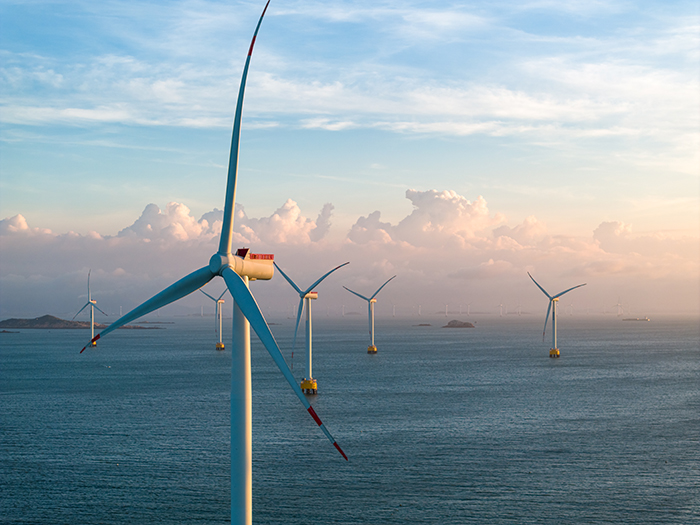
Battered more by politics than wind and waves, the development of offshore wind (OSW) power generation along the U.S. Atlantic seaboard perseveres. On August 22 the administration, which has been openly hostile to renewable energy in general and OSW in particular, issued a stop-work order on Revolution Wind, being built by Orsted and Global Infrastructure Partners to supply power to Connecticut and Rhode Island. On September 17 those two states the two states filed suit in federal court to lift the order, calling it “arbitrary and capricious,” and an “impulsive and lawless overreach.”
Separately, but also on September 17, the U.S.-flagged turbine installation vessel Charybdis arrived in Portsmouth, Virginia, the marshalling port for the largest of the five current OSW developments. Coastal Virginia Offshore Wind (CVOW) is being built off Virginia Beach by Dominion Energy. CVOW is roughly twice the size of the other developments, and notably will serve northern Virginia, the politically powerful region around Washington D.C. and home to the country’s largest concentration of data centers.
Those two projects, as well as the three others under construction, represent billions in equipment, transportation, and construction contracts, as well as billions more in power-purchase agreements. Underwriting those risks has been a challenge. There is a millennium of weather records for the Atlantic seaboard, and a century of loss data for offshore structures in the Gulf of Mexico, but the Venn diagram has no overlap.
Three firms are considered pioneers of cat modeling: RMS, now part of Moody’s; AIR Worldwide, now part of Verisk; and Eqecat, now part of Cotality, which changed its name from CoreLogic in March.
“At Eqecat we built an offshore energy model for the Gulf of Mexcio,” said Tom Larsen, assistant vice president of marketing in the insurance group at Cotality. Like OSW, offshore oil and gas installations “are highly complex facilities, fixed or floating, with exposure to the harsh marine environment as well a natural catastrophes with high-consequence incidents.”
There are two primary types of risks to offshore energy installations: physical damage, and financial damage as a consequence of reduced operations or outage.
“Physical models help to understand the damage to structures; probabilistic models tend to be more pragmatic,” said Larsen. “Based on our experience with models for the Gulf of Mexico, I don’t come in thinking one or another is preferable.
“Probabilistic models allow underwriters to extend their judgment on the reliability of the generators,” Larsen added. “Probabilistic models can also help long-term pricing and cat loss modeling if a storm should get all the turbines.”
To date physical models are obviously limited by the lack of historical data on operating turbines on the Atlantic seaboard. Nevertheless there is solid storm modeling for the area based on decades of records. “One of our oldest models is the North Atlantic Hurricane Model,” said Derek Blum, senior director of product management for emerging-risk models at Moody’s. “That model has excellent science in terms of building a probabilistic model for underwriters and risk managers to base risk transfer.”
The current focus is on creating vulnerability curves. “We are looking at the next wave of model capability to ensure that the vulnerability curve is reflective of the size and scale of events,” said Blum. “We continue to differentiate.”
Derek Stedman, product director of models and analytics at Moody’s, added that his team works with manufacturers to make sure of their operational monitoring of facilities. That data becomes part of the overall model.
“When we are looking at claims data, we want to know what happened to cause the damage. It is important that the mechanics are reflected in the vulnerability curve, because two different storms of the same category can have very different effects. They can be fast moving or slow. The kinetic energy of every storm is different.”
Some brokerages have formed partnerships with OSW cat-modeling companies, said Adam Reed, global leader of offshore renewables and upstream energy at Allianz, “and some rely on a more traditional approach. There are people trying to build models that are more bespoke to OSW with engineering and geophysics. [That said] no one really knows how accurate these approaches are. The reality [of a major storm] has not come to pass yet.”
For its part Allianz uses what Reed calls a deterministic model, rather than probabilistic. “Brokers often use expected maximum loss studies to determine wind limits. We use a system that collects every historical storm and run those against our portfolio within our internal parameters. That is important for us and for our treaty reinsurers.”
One challenge for all has been determining limits. “If you look at the total schedule [for OSW] as compared to limits for structures in the Gulf of Mexico, some of the limits that we’ve seen versus exposure have taken an optimistic view of performance,” said Reed. “We don’t want anyone to be underinsured.”
There are two variables involved in the loss estimates of OSW projects, the hazard and damageability, said Christopher O’Connor, managing director and global head of catastrophe modeling with Marsh Advisory. “There has been significant progress in the quantification of risk for OSW models in the last few years, for both the hazard and engineering aspects, However, there are areas needing improvement, particularly to better quantify the uncertainties around the estimated losses.”
Progress in modelling capability is driven by project need and anticipated pipelines, O’Connor noted. “As physical and hazard-focused models tend to be more complex, this area of research is mainly driven by research institutes and a few commercial modeling firms. Re-insurers are collaborating with academic institutes and commercial firms.”
The probabilistic approach is used in the hazard component using simulated events, O’Connor explained, “yet the damageability assessments are done through an engineering approach considering different failure modes. Of course, physical modeling of the wind turbines and incorporating claims data could significantly improve the modeling approach for OSW.”
Both are important factors of consideration, O’Connor added. “On the quantitative side, the assessment of natural hazards is where probabilistic, the event set, approaches are deployed to provide a view on how severe single losses can be due to the aggregation effects arising from a single event, particularly for property damage losses.”
The stop work order on Revolution Wind by the current administration was its second such action. In April, a stop-work order on Equinor’s Empire Wind project off Long Island, New York, was rescinded after several weeks of lobbying by industry and state officials, including the governor.
As Orsted neared completion at Revolution Wind it was also starting work on the nearby Sunrise Wind. Avangrid and Copenhagen Infrastructure Partners are building Vineyard Wind off the eponymous Massachusetts island, and have permits in hand for a second development not yet started nearby.
That last represents the second tranche of projects. There are about half a dozen others in various stages of planning and permitting ready to proceed once the current political storms abate. &