Newsletters
 Risk Central
 Digital Edition
Lloyd’s Market Posts Third Straight Year Of 20%-Plus Returns As Softening Cycle Looms
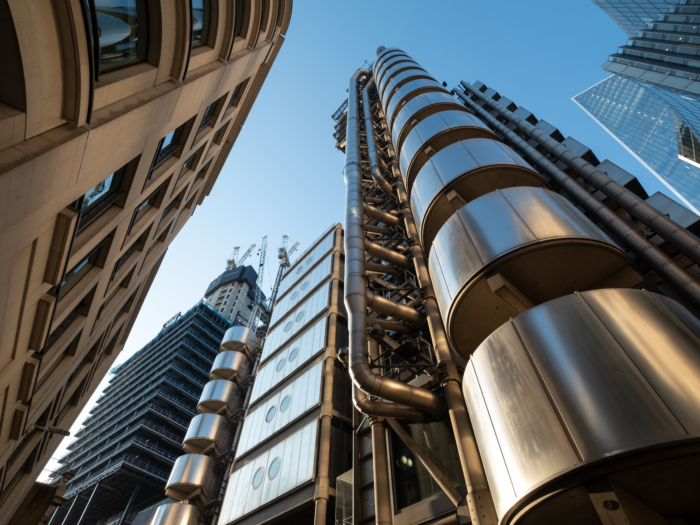
Lloyd’s of London produced a profit before tax of 10.6 billion British pounds ($14.4 billion) in 2025 and a return on capital of 22.0%, extending a run of exceptional results that has followed a prolonged stretch of weaker earnings, according to A.M. Best.
The rating agency’s review of the market and its largest syndicates found that the 2025 result was near the 10.7 billion pounds ($14.5 billion) in profits recorded in 2023, the market’s largest on record, and the 9.6 billion pounds ($13.0 billion) posted in 2024.
A.M. Best noted that each of those three years individually rivaled the aggregate 10.6 billion pounds ($14.4 billion) in profit before tax the market generated across the entire 10-year period from 2013 through 2022. Despite the recent run of strong profits, Lloyd’s 10-year average return on capital remains below 10%, reflecting the market’s exposure to periodic large losses and earnings volatility, the report said.
Underwriting Turnaround Drives Results
A.M. Best found that underwriting activities have predominantly driven the market’s earnings volatility, though depressed investment returns following the 2008 financial crisis and a spike in interest rates that triggered unrealized losses in 2022 also weighed on overall earnings.
Lloyd’s has posted an underwriting profit in each of the past five years, generating a cumulative underwriting result of 20.8 billion pounds ($28.2 billion) between 2021 and 2025, according to the report. That followed four consecutive years of underwriting losses between 2017 and 2020, during which the market accumulated underwriting losses of 7.8 billion pounds ($10.6 billion).
The market’s attritional loss ratio, a gauge of the underlying pricing cycle, fell steadily from 58.9% in 2017 to a 15-year low of 47.1% in 2024, A.M. Best found. Major claims also ran below historical norms recently, with the major claims ratio at 3.5% in 2023, 7.8% in 2024 and 5.8% in 2025, compared with more than 10% in both 2021 and 2022.
The 10-year average major claims ratio has held at approximately 10%, according to the report. A.M. Best said Lloyd’s has also benefited from prior-year reserve releases in every year between 2005 and 2025, which it described as an indication of the market’s conservative reserving philosophy.
Looking ahead, A.M. Best said softening conditions and pricing pressures across many lines are likely to push the attritional loss ratio higher in the coming years, though the pace and scale of any deterioration will depend on underwriting discipline and the incidence of major catastrophic losses.
Performance Varies Widely By Syndicate And Line
More than 100 syndicates make up the Lloyd’s market, with the 10 largest accounting for 37% of gross written premium in 2025 and those ranked 11 through 20 contributing another 19%, according to A.M. Best.
Beazley’s Syndicate 2623 was the standout performer over the past five years, accumulating 1.5 billion pounds ($2 billion) in underwriting profit, the report said.
A.M. Best cautioned that longer-term volatility in syndicate combined ratios has been significant, with several large syndicates showing 10-year average combined ratios above 100% alongside relatively high standard deviations.
Business-line results also diverged. The inwards reinsurance segment, which totaled 20.2 billion pounds ($27.3 billion) in gross written premium in 2025, saw its gross loss ratio swing between 101% in 2017 and 45% in 2023, with a 10-year weighted average of 63.7%, according to the report.
Property, the largest primary line at Lloyd’s at 14.3 billion pounds ($19.4 billion) in premium, saw gross written premium contract 2% in 2025 after a five-year compound annual growth rate of 13%, with its gross loss ratio falling to 34% in 2025 from a decade high of 103% in 2017.
Third-party liability premium reached 12.7 billion pounds ($17.2 billion), though its gross loss ratio rose to 61% in 2025 after improving to 53% in 2023.
Marine, aviation and energy premium climbed to 5.9 billion pounds ($8 billion), with a gross loss ratio of 68% in 2025 compared with a decade low of 48% in 2015, A.M. Best said.
A.M. Best said it expects competitive pricing to put further upward pressure on the attritional loss ratio in 2026, which combined with a normalization of large-loss activity could meaningfully raise the market’s combined ratio, though the 2025 combined ratio of below 90% leaves room for deterioration while staying within most participants’ target ranges.
The rating agency added that top-line growth is expected to be subdued in coming years amid pricing pressure across specialty lines, though Lloyd’s continues to draw new capital that could offset softer organic growth.
Obtain the full report here. &