Newsletters
 Risk Central
 Digital Edition
Data Center Boom Fuels Rising Fire, Water And Business Interruption Losses
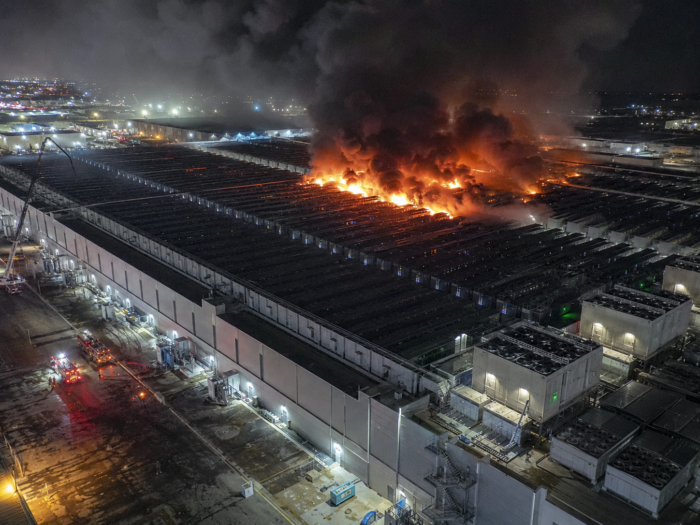
Fire is the leading driver of data center loss severity, accounting for well over 50% of nearly $800 million in insurance industry claims analyzed by Allianz Commercial, even though water damage remains the most frequent cause of claims overall.
A new report from the insurer examines how the artificial intelligence-driven infrastructure buildout is reshaping exposures across construction and operations. Based on an analysis of 221 claims totaling approximately €677 million ($782 million), natural catastrophe activity ranked second in severity, followed by so-called willful acts, including crime and cyber crime, and power failure.
By claims volume, water damage led at 21% of claims, followed by willful acts at 19% and fire at 14%. Europe accounted for 53% of claims by number and 38% by value, while North America accounted for 36% of claims by both number and value.
Construction complexity and fire risk intensify
Data centers are evolving from single-story, warehouse-like facilities into gigawatt-scale, multi-story campuses with on-site power generation and advanced cooling, a shift Allianz Commercial said is heightening both structural and fire risk. Multi-story facilities carry high structural loads and concentrate significant value in one location, while compressed construction schedules, late design changes, retrofitting and prototypical equipment increase the likelihood of loss.
Testing and commissioning, when systems first go live and are pushed near operating limits, represents one of the highest-risk phases, according to the report, because latent defects, temporary systems and multiple contractor interfaces can allow small errors to cascade into major losses.
Fire risk is being compounded by the integration of lithium-ion batteries directly into server racks rather than in separate battery rooms, which can create thermal runaway, a self-sustaining, high-temperature fire that is difficult to control, the report said.
Daniel Schroeder, senior risk engineer at Allianz Commercial, compared the practice to “letting the fox into the henhouse,” noting that damaged cells “can remain dormant for days or weeks before a defect surfaces.”
A 2025 fire at South Korea’s National Information Resources Service in Daejeon, believed to have been sparked by a battery explosion, forced 600 servers into shutdown and required firefighters to extract roughly 400 battery packs, disrupting government services nationwide, according to the report. Fire suppression systems themselves can introduce additional risk, with accidental activation, vibration or contamination potentially damaging sensitive equipment.
Real-life claims cited in the Allianz Commercial report illustrate the scale of potential losses: damage to external cooling systems, hot works-related fire and a startup delay caused by power disturbances each resulted in losses in the €50 million to €100 million ($57 million to $115 million) range at hyperscale facilities. Supply chain constraints compound the exposure, with lead times for critical equipment such as switchgear and transformers extending to as long as 80 weeks and 50 weeks, respectively, potentially lengthening reinstatement periods and increasing business interruption costs.
Climate exposure and accumulation risk challenge insurability
Around 79% of global data center capacity is located in areas with elevated exposure to acute natural hazards such as flooding, tropical cyclones and wildfires, while 54% is exposed to chronic heat and drought stress, according to a June 2026 assessment cited in the report.
Climate risks could reduce the discounted value of the global installed data center base by around $388 billion, equivalent to 38% of asset value before adaptation, per Schneider Electric’s ClimVaR model referenced in the report. Business interruption accounts for almost one-third of total modeled losses, with more than 90% stemming from upstream supply chain disruption rather than direct physical damage.
Hyperscale and colocation facilities also create significant accumulation risk, the report said, because a single campus can bring together operators, multiple tenants, construction activity and shared infrastructure in one physical or operational space. A single event, such as a power outage or cooling failure, can trigger claims across multiple insurance policies simultaneously, including property, construction, business interruption, liability and cyber coverage.
Failure to meet uptime commitments or service level agreements can also result in penalties and litigation: British Airways’ 2017 data center outage cost an estimated £80 million ($108 million) and led to legal action against facilities manager CBRE, while French cloud services provider OVHcloud was ordered to pay two customers €250,000 ($289,000) after a court found it failed to deliver promised backup services following a 2021 data center fire in Strasbourg, France.
The global data center insurance market is projected to more than double, from around $11 billion today to more than $24 billion by 2030, reflecting rapid capacity expansion, rising insured values and increasing operational complexity, according to the report.
Obtain the full report here. &