Newsletters
 Risk Central
 Digital Edition
Claim Volumes Fell Across Most Lines in 2025 as Wildfire Losses Hit Record Highs
Overall claim volumes dropped across most major property and casualty lines in 2025, with homeowners claims falling 19% year over year and personal auto claims continuing a three-year slide, according to Verisk’s 2025 ClaimSearch Trends Report.
Commercial auto claims ran counter to that trend, posting steady growth from 2021 through 2024 before a modest 5% dip last year, driven in part by a 96% surge in gig economy claims over the five-year period.
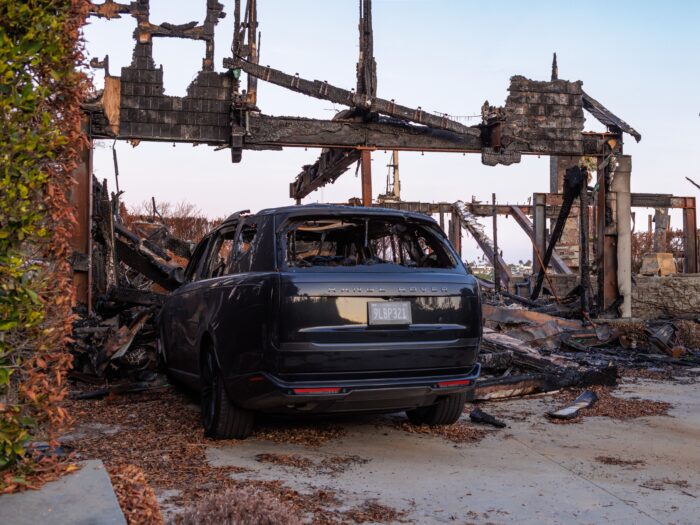
The broader decline was driven largely by a relatively quiet hurricane season, but the year’s headline loss event — the January wildfires in Los Angeles — generated an estimated $28 billion in insured losses, more than double the previous record set by the 2018 Camp Fire.
LA Wildfires Signal a New Normal for Catastrophe Risk
The Palisades and Eaton fires that swept through Southern California in January dwarfed prior wildfire loss events, the report said. The Palisades Fire alone is estimated to have caused $20 billion to $25 billion in insured losses, while the Eaton Fire added another $8 billion to $10 billion in claims. Properties in the affected areas carried significantly higher values than those destroyed in the 2018 Camp Fire — median home values near the Palisades Fire ranged from $3.2 million to $3.5 million, compared with $295,000 for homes affected by the Camp Fire, according to the analysis.
Within 30 days of the LA fires, insurers received more than 26,000 homeowners claims. A striking 30% of those were smoke-related losses, compared with just 3% of early claims from the Camp Fire. However, the report cautioned that delayed smoke claims could push the total higher still. Roughly 35% of smoke claims from the Camp Fire were not filed until 2020 or later, suggesting LA smoke claims may continue arriving for years, Verisk noted.
Three record-breaking California wildfires within eight years — the Tubbs Fire in 2017, the Camp Fire in 2018, and the LA fires in 2025 — “suggests that the current period is quite unprecedented and may indicate a fundamental shift to a new norm,” the report said.
Auto Theft Trends Shift as Catalytic Converter Risk Resurfaces
Personal auto theft claims declined sharply for the second consecutive year, falling 25% in 2025 after a 24% drop in 2024, the report found. The surge in Kia and Hyundai thefts that peaked in 2023 has reversed, with theft-to-collision ratios for those brands continuing to trend downward.
New theft patterns are emerging, however. Infiniti models dominated the highest theft-to-collision ratios in 2025, with the Q60, Q50, and G37 Coupe ranking first through third among models with at least 500 theft claims. Acura vehicles, particularly the TLX, also saw notable increases, according to the analysis.
Meanwhile, catalytic converter theft — which surged from about 5,000 partial theft claims per month in 2019 to nearly 20,000 per month in mid-2022 — had returned to near pre-pandemic levels. But the report flagged a potential resurgence, noting that platinum prices doubled in 2025 and palladium and rhodium prices also climbed. Historical data showed that partial theft claims tracked precious metal prices with roughly a one-year lag, Verisk found.
Gig Economy and Emerging Risks Reshape the Loss Landscape
Commercial auto claims bucked the broader downward trend for most of the five-year period studied, rising steadily from 2021 through 2024 before dipping 5% in 2025. Gig economy activity was a key driver, according to the report, with claims tied to ride-hailing and food delivery platforms increasing 96% from 2021 to 2025, climbing from 89,000 to 175,000 claims. Food delivery claims alone surged 300%, and gig-related losses now account for 10% of all commercial auto claims, up from 6% in 2021, the report said.
Several other emerging risk categories showed exponential growth, Verisk said. Claims involving autonomous vehicles quadrupled from roughly 100 in 2021 to more than 400 in 2025, with autonomous ride-hailing claims increasing by a factor of 20. E-bike-related claims also quadrupled during the same period, reaching just over 4,000 in 2025.
Chemical exposure claims are accelerating as well. Silica dust claims grew from just over 100 in 2021 to nearly 2,000 in 2025, predominantly in commercial lines, the report noted. Claims related to per- and polyfluoroalkyl substances (PFAS) rose from approximately 30 to about 700 over the same period, mostly reported as bodily injury and liability losses, according to the report.
Obtain the full report here. &