Newsletters
 Risk Central
 Digital Edition
Wildfire’s Employment Practices Risk
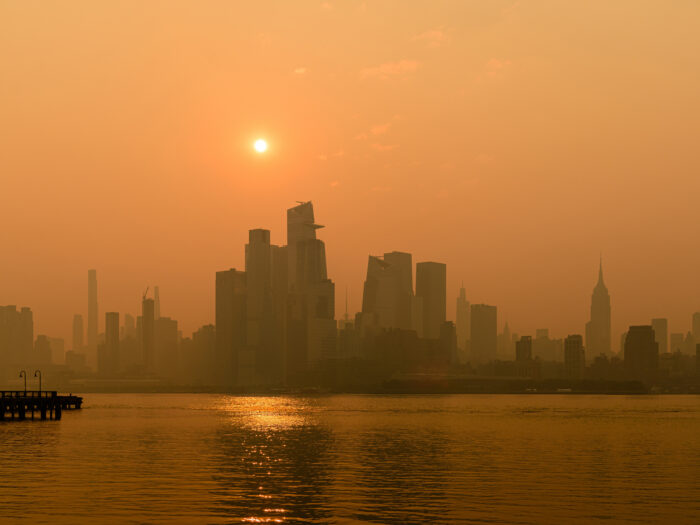
During the summer of 2026, smoke from hundreds of Canadian wildfires drifted across the Midwest and Northeast, triggering air quality alerts across more than a dozen states. The past few wildfire seasons have been especially active, and that trend is a growing concern for communities and employers.
Karl Kumli, a workplace safety and employment attorney at Fisher Phillips, said regardless of where they are, employers need a plan to address workplace safety and compliance in the face of poor air quality.
“Employers are having to start thinking about this in a way they may not have historically. It’s been an issue in the West and in Florida certain times of the year, but it’s not something employers in New York or DC tend to think about,” Kumli said.
A Peril That’s No Longer Regional
Since mid-July, smoke from hundreds of wildfires in Canada has spread across the Midwest and Northeast, raising active air quality alerts in over 16 states and putting more than 120 million people under unhealthy air quality alerts. The National Interagency Fire Center indicated a Level 5 National Preparedness Level and noted that so far in 2026, nearly 46,000 fires had burned more than 5.2 million acres across the United States, with exceptionally active fires in Washington and Oregon.
Philip Wray, Head of Property, MSIG USA, says that wildfire has moved from a peril underwriters primarily associate with California and Western states to one that they underwrite with all of their accounts.
“I would say that the industry in general now views wildfire as being a major hazard, a major peril, and something we underwrite on all of our accounts. Historically we would have looked at probably California. Now we look everywhere,” he said.
While wildfires present a direct threat to communities and businesses in the vicinity of the fires, smoke can travel hundreds or thousands of miles, as seen in this year’s fires. Wildland fire smoke has a complex mixture of gases and particles that can include carbon monoxide, hydrocarbons, particulate matter, benzene, and other substances that are hazardous to humans. A 2026 Science Advances study estimates that wildfire-smoke PM2.5 contributed to more than 24,000 deaths annually across the U.S. between 2006 and 2020.
Air Quality Impacts on Employers
Wildfire smoke and poor air quality can be a major concern for employers, especially when their employees work outside. Matt Zender, Senior Vice President and Workers’ Compensation Product Manager at AmTrust Financial Services, said that any worker can be exposed and any industry that doesn’t work in a fixed location can be exposed.

Matthew Zender, senior vice president, WC product manager, AmTrust Financial Services
The National Institute for Occupational Safety and Health (NIOSH) notes wildfire smoke as a known or suspected major hazard to outdoor workers. While workers in construction and transportation tend to have the highest exposure, even indoor workers can be at risk if the building air filtration system isn’t sufficient.
Meanwhile, insurers are also taking a closer look at policies. Dennis Willette is Head of Environmental at Westfield Specialty and provides risk-transfer solutions such as pollution liability, professional liability, and blended general-liability/pollution programs for commercial insurance clients. He notes that insurers and risk managers are considering reviewing various aspects of wildfire risk in areas and in ways they didn’t in the past.
“You’re seeing fires and fire risk changing and popping up in areas where they weren’t necessarily before. As we evaluate wildfire exposure through the lens of our policies, we’re seeing the risk shift,” says Willette.
It’s worth noting that smoke-related losses and claims can have a long tail. According to data from Verisk, smoke damage made up approximately 30% of claims filed within the first 20 days of the 2025 Los Angeles wildfires, with another 35% of smoke-related claims from comparable past events being filed as late as two years after.
Where liability falls depends on the assessments of the injury, says Kumli. For example, if there’s a chronic issue that someone is experiencing or has been exposed to long-term air quality issues, that may fall under a casualty claim. “However, if someone has asthma and they suffer an asthma attack that is related to being out in poor quality air, that’s going to be a more straightforward workers’ compensation claim,” says Kumli.
How Employers Can Mitigate the Risk
Kumli notes that while there isn’t yet a nationwide federal OSHA standard on air quality, some states have issued standards for how to address wildfire smoke. For example, California’s Cal/OSHA has a standing Protection from Wildfire Smoke rule that requires employers to monitor air quality, reassess work practices, and offer N-95 respirators for use when the smoke reaches unhealth levels. Oregon also has a similarly PM2.5-triggered rule with specific AQI thresholds that note when employers must act.
These states use the fine particle pollution PM2.5 index, similar to the EPA’s air quality index, says Kumli. The index goes from 0 to 500, with 0-50 being good and 51-100 being moderate. Anything over 150 triggers state policies that require employers to offer N95 masks to their employees.
In mid-July, the air quality index in Chicago reached a record 877, triggering the EP to recommend everyone stay indoors and reduce activity levels.
“The standards being used in these states are a good metric for employers to look at in terms of setting internal policies and having some sort of external benchmark to use,” Kumli said. “Employers really need to think about having some sort of program in place.”
Zender notes that in situations like this, all employers should be continually monitoring air quality. As some parts of the day can be safer than others, employers can orient shifts around those times. When possible, tasks should be done indoors, and when working outside, indoor breaks should be provided. However, it’s still essential to monitor air quality indoors. “Particles can get into the build through cracks or draft rooms, fan systems, open windows, and doors,” he said.
Willette notes that indoor air quality comes down to proper filtration and HVAC maintenance, while outdoor mitigation depends on conditions and only if it is paired with monitoring. “I think monitoring and controlling are probably two of the more important aspects, because you can’t know how effective any mitigation measure is if you don’t know the actual conditions,” he said.
Finally, one easy option, for those jobs which it supports, is to enable employees to work from home or rotate people to reduce outside risk exposure. Employers can also use projected air quality forecasts to try to reschedule projects and work to avoid the worst conditions. They should also be proactive in providing masks and offering employees personal protective equipment resources.
“Those are really the things that employers should be focused on as the low-hanging fruit and easy things they can do for workers,” said Kumli.
Wildfires have outgrown their traditional geography, and insurers now underwrite it everywhere, not just in the West. However, coverage has moved faster than protection. Until federal guidance catches up, they should treat wildfire smoke as they would any other workplace hazard. They should monitor air quality, issue masks when conditions deteriorate, and consider adjusting schedules or workflows to reduce exposure. &