Newsletters
 Risk Central
 Digital Edition
U.S. Storms and European Flooding Drive Below-Average Q1 Catastrophe Losses
Global economic losses from natural disasters in the first quarter of 2026 were approximately $37 billion, about 43% below the long-term mean of $64 billion since 2000 and the lowest first-quarter total since 2015, according to Aon’s Q1 2026 Global Catastrophe Report.
The insurance sector absorbed roughly $20 billion of those losses, broadly in line with the 21st-century average for Q1 insured catastrophe losses, the report said. The global insurance protection gap remained low at approximately 46%, as the majority of disaster activity during the first quarter occurred in well-covered regions of the U.S. and Europe.
Flooding and Severe Weather Lead Global Losses
The largest portion of Q1 economic losses was attributed to flooding, with notable events in Western and Southern Europe, South America and elsewhere, Aon said. A sequence of flooding and windstorm events in Europe resulted in total physical damage approaching $10 billion, the report said. Windstorms Kristin, Nils and Goretti were among the most notable European events, contributing to roughly $4 billion in insured losses across the region.
More than half of global losses stemmed from winter weather and severe convective storm outbreaks in the U.S., the report said. The SCS outbreak of March 10-12 and a late-January winter storm became the costliest events of the quarter globally. There were at least 12 events that resulted in total economic losses of at least $1 billion each.
At least 1,640 people were killed due to natural disasters during the quarter, below the 21st-century Q1 average of 12,190. The deadliest individual event was seasonal flooding in southeastern Africa, which killed at least 241 people, according to the report.
Winter Storm Fern and a Divided U.S. Winter
In late January, one of the most impactful winter weather events in recent memory struck the U.S. Winter Storm Fern swept across the central and eastern U.S., bringing freezing rain, heavy snowfall, severe thunderstorms and record-setting cold temperatures, the report said.
More than 130 people were killed, while economic and insured losses reached $4.6 billion and $3.5 billion, respectively. Freeze damage — particularly frozen and burst pipes — was the primary driver of losses across the south-central and southeast United States, according to the report.
Meanwhile, the western and central U.S. experienced well above-average temperatures during the winter, resulting in lower-than-average snowfall and near-record-low snowpack levels. Aon noted that this has increased water supply concerns and raised the risk of wildfire in the coming spring and summer months.
U.S. Dominates Insured Losses as SCS Season Opens
Natural catastrophes in the U.S. accounted for more than 75% of global insured losses in Q1, reaching approximately $16 billion, the report said.
Source: Aon
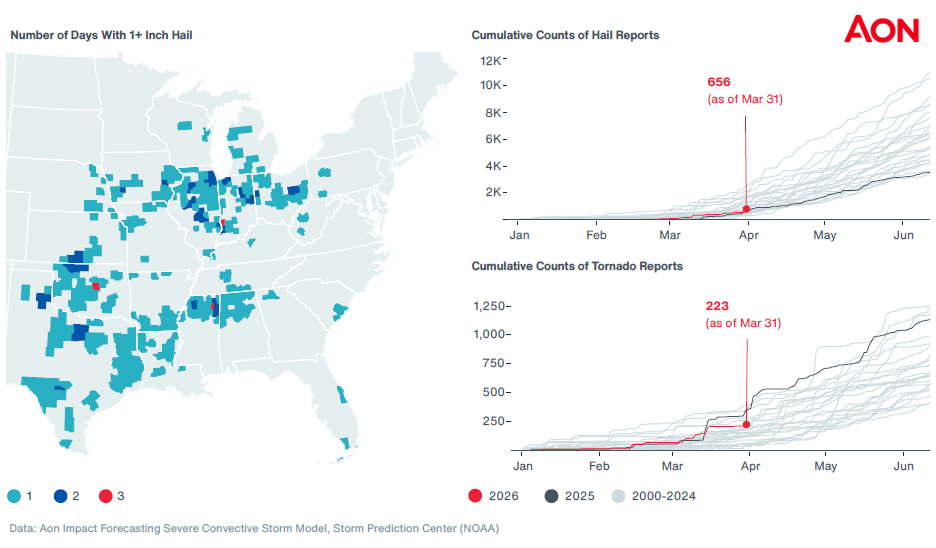
The March 10-12 SCS outbreak generated $10.5 billion of economic losses and $8.5 billion of insured losses. The SCS outbreaks produced the largest hailstone on record east of the Mississippi River (6.6″ diameter), multiple EF3+ tornadoes and significant wind and hail damage across major population centers including parts of Texas, Oklahoma, Kansas City, Chicago and Ohio.
However, a ground survey conducted by Aon’s Catastrophe Insight team in the Chicago area on March 11 found that actual damage was notably less severe than initial hail reports suggested, highlighting that alarming storm reports do not always translate proportionally into insured losses. The active start to the 2026 SCS season was broadly consistent with the ongoing La Niña pattern, which is historically associated with elevated hail and tornado activity, the report said.
Obtain the full report here. &