Newsletters
 Risk Central
 Digital Edition
The Quiet Speed Bump of Perceived Injustice

Harvey Warren has enjoyed many careers, from screenwriter to film producer to financial services professional. With a bachelor’s degree in communications from Ithaca College and a master’s degree from Syracuse University, writing has always been his passion. As the Optimized Patient he fulfills his dream to write about healing. Mr. Warren lives in Los Angeles with his wife, Wileen.
This is the second in a series of articles exposing what is driving the excessive recovery times and the high cost of workplace injuries.
AI is top of mind for just about everyone under the age of 90. I was curious to see if Claude had any research-based, data driven understanding of why it takes a similar injury in the workplace twice as long to heal as a non-workplace injury.
Claude’s answer is the subject of this article, which will likely be surprising to you. I have often written that “the patient is the wildcard in the recovery process.” Claude told me why that is in ways I never dreamed of.
Think about this verbatim part of Claude’s executive summary: “…the industry has been treating symptoms while missing the underlying disease. A substantial and growing body of peer-reviewed research identifies a psychological construct — perceived injustice — as a powerful, measurable, and often overlooked predictor of prolonged disability, failed rehabilitation, and increased litigation in the workers’ compensation context”.
I believed that what the injured worker didn’t know about the recovery process per se was what made the patient the wildcard. If you don’t have any reliable information on the real effects of mindset, nutrition, activity and rest on your recovery, you may be part of the recovery problem. True – and – then Claude took that up a quantum notch with a focus on the mindset issue of “perceived injustice.”
That term comes from the research derived from the IEQ (Injustice Experience Questionnaire). Yes, that’s a thing, a very important and overlooked thing. According to Claude, the injustice experience in workers’ compensation is the hidden driver and root cause of excessive recovery times.
Perceived injustice is the subjective belief or feeling that one has been unfairly treated, wronged, or subjected to a lack of fairness. It refers to a personal or social evaluation of a situation where there is a perceived gap between what is and what should be.
For the sake of transparency, I don’t create infographics. What follows is an unedited image directly from ChatGPT. I gave ChatGPT the same prompt I gave to Claude.
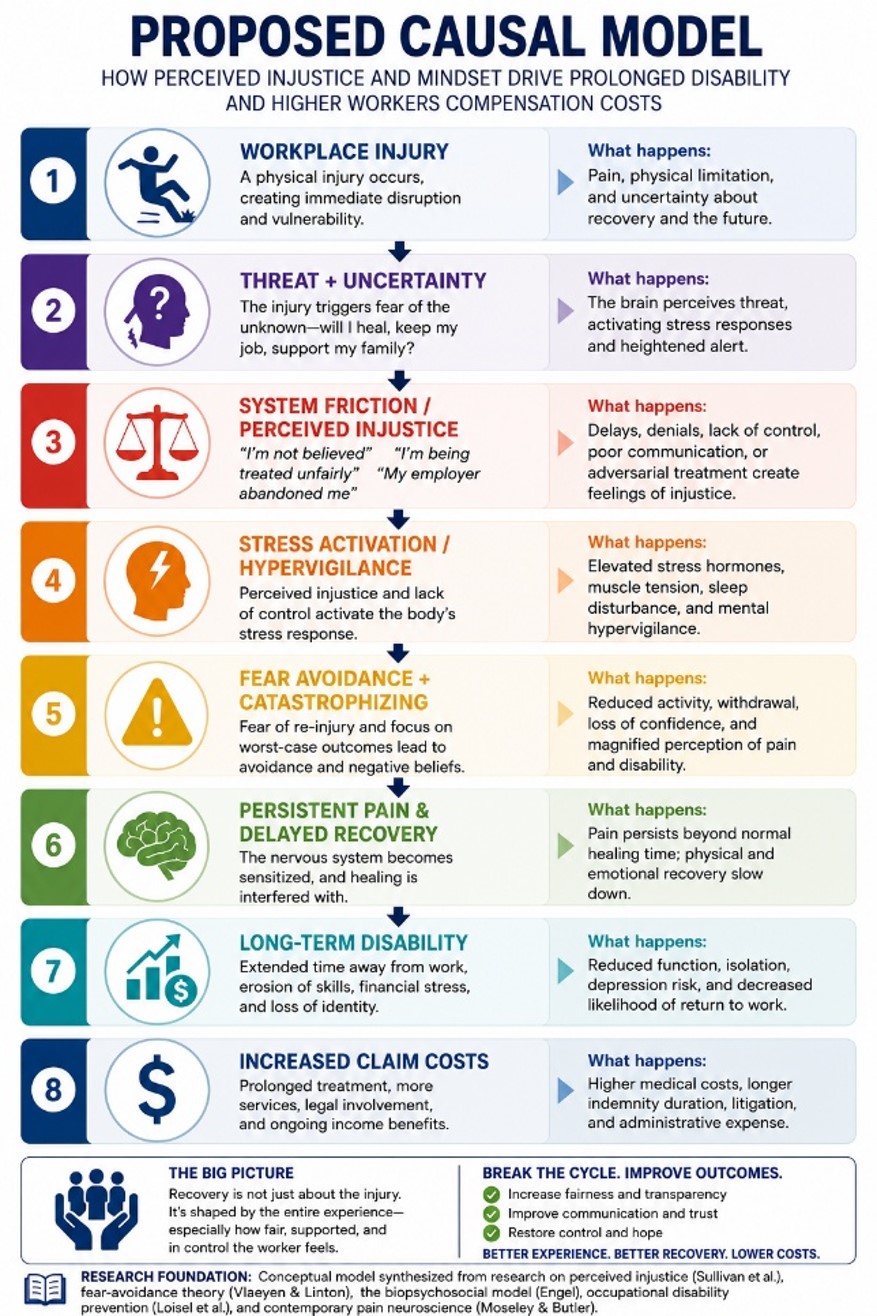 It validates the infographic it generated with this language: “Conceptual model synthesized from research on perceived injustice (Sullivan et al.), fear-avoidance theory (Vlaeyen & Linton), the biopsychosocial model (Engel), occupational disability prevention (Loisel et al.), and contemporary pain neuroscience (Moseley & Butler).”
These “mindset variables” are not soft or secondary concerns. The idea being suggested here is that an injured worker who feels they are not being treated justly may result in delayed return to work and other negative outcomes like; chronic pain development, opioid utilization, litigation duration, disability persistence, and total claim cost.
Workers’ compensation cost-containment strategies have historically focused on medical utilization, fraud reduction, claims administration, and litigation management.
However, decades of research in pain science, occupational medicine, psychology, and behavioral economics suggest that a major hidden driver of prolonged disability is the injured worker’s psychological and social experience of the injury process itself — particularly perceived injustice, loss of control, distrust, fear, and adversarial system interactions.
Injured workers who believe they were wronged, their suffering is not acknowledged, someone else is to blame, or the system is unfair, show substantially worse recovery outcomes independent of injury severity. Workers’ compensation systems frequently treat recovery as a purely mechanical tissue-healing problem while neglecting the neuropsychological realities of pain and recovery.
Expectation science is enormously important here. Recovery expectations strongly predict actual recovery. Workers who believe, “I’ll never recover,” or “my employer doesn’t care,” or “the system is against me,” have measurably poorer outcomes.
Many cost-reduction efforts fail because they target: utilization, provider behavior, litigation, fee schedules, fraud, and administrative efficiency, while ignoring the psychosocial variables that actually drive prolonged disability. Simply, the industry optimized transactional efficiency while underestimating human recovery psychology.
In reality, mindset interacts with biology. Research says perceived injustice amplifies disability risk and psychosocial factors are evidence-based predictors indicating that recovery is multidimensional.
The future of workers’ compensation cost reduction may depend less on controlling medical transactions and more on improving the injured worker’s psychological experience of recovery. Systems that reduce perceived injustice, increase trust, improve communication, and restore worker engagement may achieve better clinical outcomes at lower long-term cost.
Human recovery psychology is an under-managed operational variable. The debate between “real injury” and “psychological factors” is itself outdated. Modern neuroscience demonstrates that biological injury, emotional processing, social threat perception, and environmental context are deeply intertwined in the experience of pain and recovery.
What we now realize is that the effort to “educate and engage” the injured worker in addition to traditional workers’ compensation benefits is substantially improving return to work times because mindset, nutrition, activity and rest strategies address the hidden driver of excessive cost, perceived injustice.
So, what is the solution? Education and engagement! And, if education and engagement (think support other than medical) can help, the questions are: When to deploy and what to deploy to keep injured workers motivated and moving forward in their recovery? Watch for my next article in this series where I discuss the concept of the 90-day rule. &