Newsletters
 Risk Central
 Digital Edition
Secondary Perils Drive Record Aggregate Insured Losses Across North America in 2025
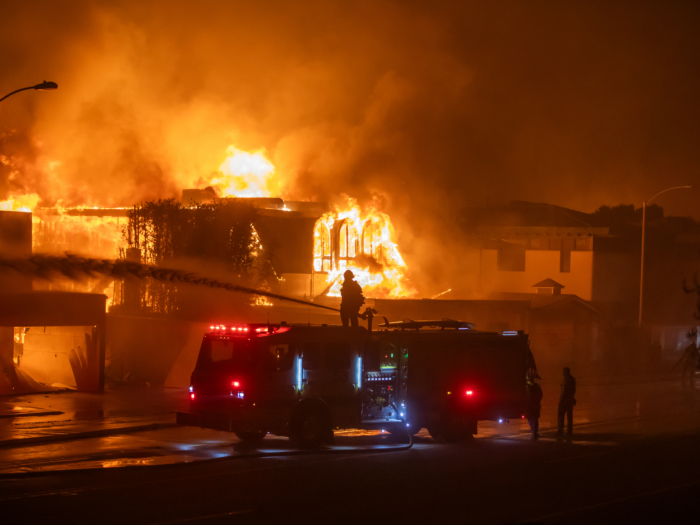
North America’s natural catastrophe insured losses reached $90 billion in 2025, with wildfires and severe convective storms combining to produce the highest annual aggregate insured losses ever recorded from secondary perils in the region, according to Swiss Re’s sigma research.
While the total fell below the previous five-year average of $97 billion and the $117 billion recorded in 2024, the data underscores a rising baseline of loss driven by structural shifts in exposure and hazard patterns rather than a reduction in underlying risk.
The January 2025 wildfires in southern California alone generated $40 billion in insured losses — by far the largest insured wildfire event on record. Severe convective storms (SCS) added $46 billion, making 2025 the third-costliest year on record for that peril.
Losses from all other perils were muted, pushing secondary perils’ share of total losses to an all-time high of 99.9%, the report said. The overall insured share of economic losses was unusually high at 71%, reflecting the strong insurance penetration that wildfire and SCS events typically carry in the U.S.
“What stands out is not just the $90 billion in insured losses across North America, but the fact that secondary perils like wildfire and severe convective storms are now driving the overwhelming majority of that impact,” said Monica Ningen, CEO of Property & Casualty Reinsurance US at Swiss Re. “These are no longer ‘secondary’ in any practical sense.”
Wildfire Exposure Outpaces Economic Growth
The $40 billion wildfire loss was concentrated in some of the highest-value and most densely built wildland-urban interface (WUI) areas in the country. Strong Santa Ana winds spread embers into tightly packed Los Angeles neighborhoods, destroying more than 16,000 structures — nearly three times the average annual total since 2016 — even though the burned area was only about one-third of the post-2016 average, according to the report.
Over the past 55 years, insured wildfire losses in North America have grown about twice as fast as exposure, Swiss Re found. Exposure-related factors such as construction costs, population at risk and economic growth per capita explain a little more than one-third of wildfire loss growth. The remaining roughly 60% points to changes in the underlying risk landscape, including the concentration of high-value assets in fire-prone areas, shifts in weather conditions and expanding sources of fuel.
Population growth since 1975 in high wildfire-risk areas has been three times higher than across the country overall, and since 1990, exposure growth in WUI zones has outpaced non-WUI zones by a factor of 1.8 nationally and 1.9 in California. The report noted a self-reinforcing feedback loop: humans cause about 85% of U.S. wildfire ignitions, meaning that as WUI populations increase, both the exposure and the ignition hazard rise simultaneously.
Severe Convective Storms Extend Costly Streak
SCS-insured losses of $46 billion extended a run of years with losses above $45 billion, following $59 billion in 2023 and $52 billion in 2024 at 2025 prices. The number of SCS events causing average annual losses of $1 billion or more in the five years to 2025 was 59% higher than in the five years leading up to 2020, according to Swiss Re.
Exposure growth explains approximately 80% of SCS-associated loss growth, the report said. Urbanization and sprawl are increasingly concentrating high-value, damage-prone assets in hail belts.
Additional factors include aging housing stock — older homes are more vulnerable to hail and wind damage — and the growing prevalence of rooftop solar and other exterior equipment. U.S. property reconstruction costs, while flat since March 2025, remain 37% above December 2019 levels, further affecting claims costs.
Adaptation Delivers Measurable Results
The report highlighted evidence that targeted adaptation and mitigation measures can materially offset loss growth.
In Alabama, a coordinated strategy combining the Insurance Institute for Business & Home Safety’s FORTIFIED building code standard with premium discounts, public retrofit grants and independent verification has led to measurably lower insurance losses, Swiss Re said. Homes built or retrofitted to the FORTIFIED standard have seen claims frequency decline 55% to 70% and severity drop 14% to 40%, with loss ratios up to 72% lower than conventional construction, according to University of Alabama research cited in the report.
Obtain the report here. &