Newsletters
 Risk Central
 Digital Edition
Rising Losses From Floods, Hail and Wildfires Signal New Era of Climate Risk

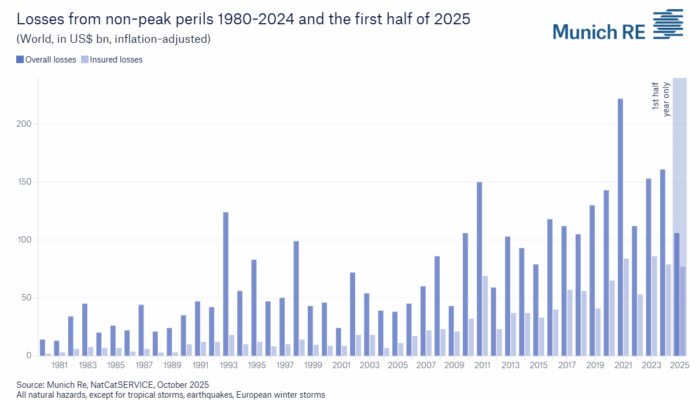
Global losses from severe thunderstorms, flooding and wildfires have tripled since the early 2000s, with insured losses from so-called secondary perils jumping nearly sixfold to $73 billion annually, signaling a fundamental shift in natural catastrophe risk that demands new prevention strategies and insurance approaches, according to a Munich Re analysis.
The insurance industry’s traditional distinction between “peak perils” like hurricanes and earthquakes and “non-peak perils” like thunderstorms and floods is becoming obsolete as climate change amplifies weather-related disasters.
Annual inflation-adjusted losses from these events have surged from $47 billion in the early 2000s to $160 billion in recent years, with the first half of 2025 alone recording $106 billion in damages, according to the report.
The physics behind this escalation are straightforward: each degree Celsius of warming enables the atmosphere to hold approximately 7% more water vapor, creating conditions for more intense storms and rainfall. This enhanced moisture capacity, combined with higher energy or warmer temperatures, is producing weather events of unprecedented severity across multiple regions, Munich Re said.
In the U.S., which accounts for 40% of global losses and 67% of insured losses from these perils, severe thunderstorms now generate hurricane-level damages year after year. The number of extreme weather days featuring more than 30 tornadoes or hailstones exceeding 5 centimeters in diameter continues to climb, with storm activity shifting eastward toward more densely populated areas, the report said.
Europe has experienced a fivefold increase in total annual non-peak peril losses, while Asia-Pacific nations face mounting flood damages, particularly in China where major financial centers sit vulnerable along riverbanks.
Protection Gaps and Model Uncertainties Challenge Insurers
The rapid escalation of non-peak peril losses presents insurers with dual challenges: adapting risk models to capture evolving weather patterns and addressing massive protection gaps that leave billions in damages uninsured, according to Munich Re.
While severe thunderstorms and wildfires in developed nations show relatively high insurance penetration rates, flood-related losses remain largely uninsured globally, the report said.
The protection gap widens dramatically in developing nations, where those affected by natural disasters often bear nearly all costs themselves due to limited insurance availability or affordability. Even in wealthy countries, flood insurance penetration remains low, leaving governments and individuals exposed to mounting financial burdens as extreme rainfall events become more frequent and severe.
Unlike flood, the percentage of insured losses is comparatively high for hailstorms, thunderstorms and wildfires in industrialized countries, Munich Re said. The January 2025 Los Angeles wildfires alone destroyed $40 billion in insured property, demonstrating the concentrated risk in high-value areas.
Traditional catastrophe models, designed primarily for peak perils with historical precedent, struggle to accurately price the cumulative impact of multiple moderate events occurring with increasing frequency.
Unlike a single major hurricane or earthquake, non-peak perils generate steady annual losses that compound over time, requiring insurers to fundamentally reconsider their approach to risk assessment and capital allocation.
View the full report here. &