Newsletters
 Risk Central
 Digital Edition
Research Finds AR Tools, Exoskeletons and AI Systems Show Promise for Reducing Musculoskeletal Injuries
Musculoskeletal disorders continually represent the largest category of workplace injury and have cost employers billions of dollars annually in workers’ compensation, lost productivity and turnover for the past 25 years.
To accelerate practical solutions, the National Safety Council’s MSD Solutions Lab awarded nearly $200,000 across four university research teams in its 2024-2025 Research to Solutions grant program, with each project targeting a different technology-driven approach to reducing MSD risk in real-world work environments.
“MSDs impact millions of workers and cost employers billions of dollars each year,” said Katherine Mendoza, senior director of workplace safety programs at NSC. “The findings from the 2024-2025 grant recipients demonstrate that emerging technologies can help organizations better understand workplace risks, engage workers and implement targeted solutions that improve safety outcomes. By empowering researchers and employers to explore and test new safety strategies, we’re advancing practical approaches that can be adopted and scaled across industries.”
Augmented Reality Brings Ergonomic Guidance to the Shop Floor
North Carolina State University received $49,999 to develop and field-test an augmented reality tool that overlays three-dimensional reach zone visualizations onto a worker’s physical environment in real time. Using a Meta Quest 3 headset, the app displayed color-coded zones, green, yellow and red, indicating primary, secondary and undesirable reach areas based on established ergonomic guidelines.
Twenty workers across three facilities, including an agricultural machinery manufacturer and a pharmaceutical production site, evaluated the tool in their actual work environments. Participants completed assigned tasks quickly, with average task completion times ranging from roughly 9 to 41 seconds, and rated the tool favorably on a validated usability questionnaire.
In follow-up interviews, workers described the color-coded system as intuitive and said the tool was best suited for targeted applications such as onboarding new employees and periodic workstation reassessments rather than continuous shop-floor use. Participants expressed willingness to recommend the tool to others.
Exoskeletons Show Usability Gains but Limited Impact in Construction
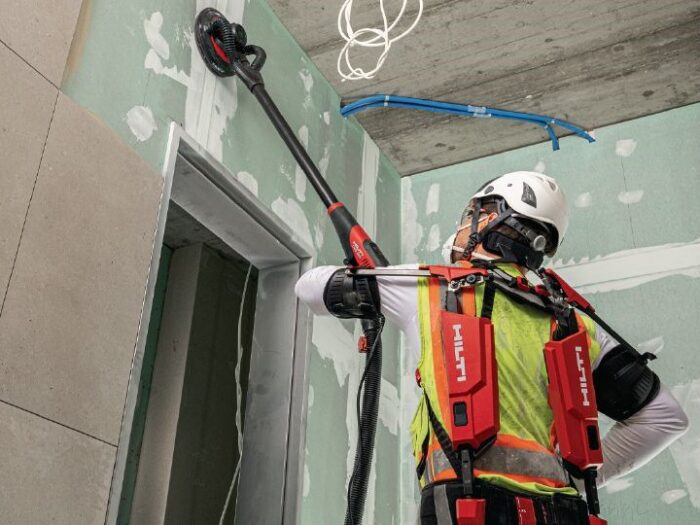
Wichita State University received $48,467 to assess passive arm-support exoskeletons across four construction trades: drywall, plumbing-pipefitting, sheet metal and electrical. Eight workers wore the Hilti EXO-S exoskeleton for up to three weeks while performing trade-specific tasks, providing the kind of field evidence that has been largely absent from prior exoskeleton research conducted in laboratory settings.
Workers consistently rated exoskeletons as more helpful for overhead and ceiling-level tasks, such as sanding ceilings, installing ceiling drywall and operating heavy tools overhead, than for tasks performed at lower heights. Participants generally agreed the device was comfortable, easy to don and doff, and helpful with certain tasks, and their intention to use it in the future held steady or increased over the intervention period.
However, objective measurements found no statistically significant changes in body part discomfort, shoulder strength or joint mobility from baseline to the end of the study period, a finding the researchers noted as an important limitation given the otherwise positive worker perceptions.
Smartphones and AI Offer Low-Cost Alternative for Spinal Load Assessment
Oregon State University received $49,999 to evaluate whether a smartphone-based, open-source motion capture platform called OpenCap could estimate lumbar spine compression forces during manual lifting, a measurement typically requiring expensive laboratory equipment. Using data from 21 participants across 919 lifting sequences, the team adapted OpenCap’s deep learning model for lifting-specific analysis and tested two approaches to predicting spinal load.
A machine learning model trained on anthropometric data, lifted weight, object position and trunk kinematics outperformed a conventional musculoskeletal model, achieving a normalized root mean square error of 9% versus 12%. The two-smartphone configuration performed comparably to a three-smartphone setup, suggesting that acceptable accuracy is achievable with minimal equipment. The researchers noted that future validation across more dynamic tasks and diverse populations is needed.
AI Bias in Ergonomic Assessment Tools Demands Deliberate Mitigation
Virginia Tech received $50,000 to examine whether machine learning algorithms used in wearable sensor-based ergonomic assessments produce equitable results across male and female workers. Using inertial measurement unit data from 22 participants performing load-carriage tasks, the team compared conventional machine learning models against a novel Debiasing Variational Autoencoder designed to separate sex-related movement features from load-relevant patterns.
Conventional models, including k-Nearest Neighbors, Support Vector Machine and Random Forest, showed clear sex-based disparities in prediction accuracy that shifted depending on which sex was more represented in the training data. The debiasing model achieved the lowest mean absolute error at 3.42 kg, compared to 4.89 kg for Random Forest, and produced the most consistent results across all training compositions and fairness metrics.
The report noted that relying on a single fairness metric is insufficient and that multiple complementary measures are necessary to fully capture potential gender biases in these systems.
Obtain the full report here. &