Newsletters
 Risk Central
 Digital Edition
Renewable Energy Risks Grow Alongside Data Center Demands
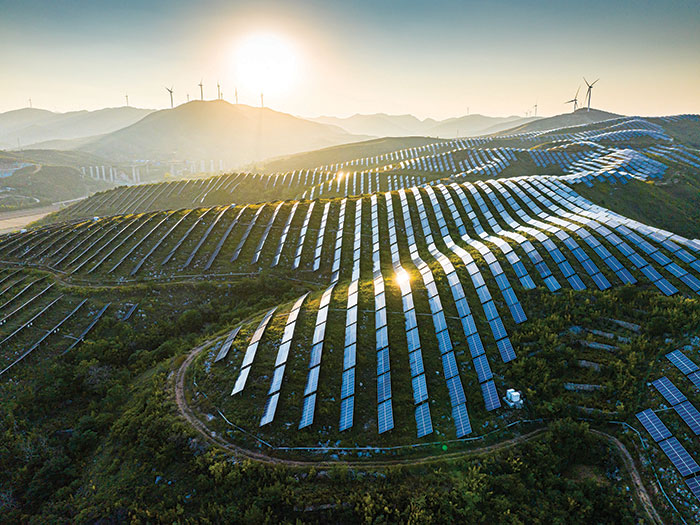
After a long stretch of hard insurance markets for all types of energy, new capacity has been coming into the sector.
Underwriters said that the market remains balanced to firm, while brokers said it is softening. The emerging trend for renewable energy is how it is being incorporated into developments in other economic sectors.
Large utilities are concerned with total demand, and often find renewables are the fastest way to get electrons on the grid. That means complex risk engineering for such varied fleets of facilities. At the same time, massive data centers are being designed with renewable power as part of the basic development, often along with battery storage.
That is changing the ways brokers place such big programs. It is also raising complex questions around business interruption and contingent liability. The basis of all energy industries, renewable and not, is “reliability, security, and affordability,”said Chris Fasser, strategy and operations lead in energy transition at AXA XL.
Kimberly Rafuse, an energy risk engineer with AXA XL, submitted that the risk profiles for renewable energy are different from conventional energy.
For example, both offshore oil and gas platforms as well as offshore wind turbines have Nat CAT exposure, but onshore wind turbines and solar photovoltaic (PV) arrays can be damaged by non-CAT storms with lightning and hail.
Another difference is that the asset base and infrastructure of conventional energy is for the most part long established. The last greenfield refinery in the U.S. was built in 1977, while construction and interconnection for wind and solar generation is booming.
“That means that there are a lot of actors involved,” said Rafuse, “including financial and construction companies as well as equipment manufacturers.”
All the more reason for risk managers to be involved early in the planning and design process.
“We are trying to move to the left of the schedule as much as possible,” Fasser said. A part of that is not wanting underwriters to seem to be gatekeepers later in the process, especially for emerging technologies.
Quite to the contrary: “We have partnerships with green tech incubators,” incubators,” Fasser said. “We want to keep current with emerging technology.”
One major challenge is the lack of loss history for emerging technologies across renewable energy. “We know we have to be a bit bold,” said Fasser. “These are learning opportunities for us as well, managing our own risks and being sensitive to our business while being supportive of this growing sector.”
The Appetite Is There
What is not in question is the imperative for renewable energy. “There have been some concerns, for example data centers and electric vehicles,”Rafuse said. “It may be that the growth curve for new types of technology may not be as steep as first thought. The timing for net zero [carbon emissions] may move out, but we need these things. They will look different in different jurisdictions, but they will happen.”
The utility-scale PV solar industry is maturing, said Amanda Lania, senior vice president at CAC Specialty and a 2021 Risk & Insurance Power Broker®. Her book of business is primarily in solar and associated battery storage.
“Operators are steadily improving their design standards, technology choices, and equipment selection — for example thicker glass on PV panels to be more resilient to hail. And they are asking how those kinds of improvements might be reflected in lower premiums. I get that question every week,” she said.
In addition to those capex investments, insureds are making use of more sophisticated weather monitoring and developing more robust operational plans.
“They are creating new operational protocols, especially in hail risk mitigation, and sharing those protocols with brokers and insurers,” Lania said.
“Insureds are driving this, as are brokers, pushing the idea that they are investing in best-in-class equipment and developing new procedures, so they should be rewarded for that.”
Lower premiums are not the only way those advances can be recognized, Lania noted.
“It could be lower deductibles for hail, or higher sub limits. It’s not always just about pricing. That is part of the maturation of the industry.”It also takes some time for loss histories to work their way through actuarial and into underwriting. “We are getting there in terms of claims data.” she said.
Softening or Balanced Markets?
Initiatives from insureds notwithstanding, the property market for solar and storage has softened after several years of hardening.
It’s axiomatic that the cure for high prices is high prices, and indeed, firmer markets have attracted increased capacity, both from new underwriters and MGAs entering the sector as well as existing markets adding capacity.
“I’ve been in this space since 2012,” said Lania, “and pricing has increased drastically since I started. I can’t speak for any insurers, but my sense is that pricing has gotten to where they think it should be to participate.”
Terms and conditions, as well as policy language, are softening as well. “Again, it’s not always about cost, though paramount obviously,” Lania said. “It’s also about deductibles, and sub limits, as well as consistency across policies in the program. There are only a handful of lead markets, but lots of carriers willing and able to provide follow capacity.”
The market for renewables is “balanced, leaning firm,” said Todd Wilson, who leads domestic energy casualty at The Hartford.
He noted that “there has been a significant amount of capacity for umbrella coverage. That has been tightening in a slow following to what has been happening in traditional energy.”
For example, casualty limits had been up to $25 million, but recently that has dropped to half as much or even less, with terms and conditions tight. That is being driven by cat exposure “and the cats are not getting any better,” said Wilson.
Depth and breadth are important in renewable energy, noted Marc Gantar, head of industry-specific vertical segments at The Hartford. “For general liability, auto, property and casualty, it all goes back to the risk engineers. Especially when data may not be there, having eyes on the assets is critical.”
Integrating Renewable Energy
An emerging factor for renewables is how quickly they are being integrated with broader developments.
Many utilities have fleets of wind, solar. nuclear, and thermal generation with integrated battery storage. Hyperscale data centers are being designed with integrated renewable power, not just as a supplement to the grid but as part of the baseload supply, often also with battery storage.
That shows how far renewables have come — the term ‘alternative’ energy is now reserved for emerging technologies such as hydrogen. It also presents a challenge for brokers and underwriters in that renewables are becoming part of much bigger programs with the focus on construction and builder’s risk, business interruption and contingent B.I., as well as delay in startup and project cargo.
Those big programs also mean multiple carriers.When projects were a few hundred million, a single large carrier could still be comfortable underwriting the whole thing.
“Capacity for those large data centers is very tight,” said Gantar. “It is common to see multiple carriers on the builders risk.”
That said, he emphasized that “specialization does matter. This is a very dynamic sector, and having our engineers understand the risks helps owners understand them too. That will extend into understanding and adjudicating claims.”
Expanding Capacity
There has been a longer-than normal hard market for renewable energy, driven by losses in the U.S. and worldwide said Molly Lovelette, vice president of Alliant Power and a 2025 Risk & Insurance Power Broker.
But now new entrants and expanded capacity from existing markets are starting to shift the balance. “There is also the maturation of operators to mitigate losses,” she added. That is especially true for hail damage to solar facilities, a large portion of her book of business.
“There is not much you can do for softball-sized hail as we have seen in Texas, but for most storms there are effective methods. We have seen clients’ facilities hit with 2-inch hail without damage if their panels were stowed properly.”
First-generation solar panels were fixed in place; later generation of panels track the sun and then rotate to a steeper angle for stowage to minimize damage.
“Our large utility clients tend to have mixed facilities, some traditional thermal and some renewable,” Lovelette said. “It makes for interesting insurance strategies because some markets write both and some don’t. Some thermal generators have been putting solar or battery storage on their old coal facilities.”
While some large carriers can underwrite a wide range of generating facilities, “thermal markets tend to have different policy forms than renewables markets,” Lovelette said. “There are risks unique to each, but there are a lot of sophisticated underwriters who cut their teeth in thermal and have moved into renewables.”
Going back to 2022 there was a strong move to renewables after the Inflation Reduction Act became law. There has been some pullback recently, Lovelette noted, but that is only a reduction, certainly not any cessation.
The Effects of AI
“There is a lot of focus on data centers for AI,” Lovelette explained, “and there is often a partnership to co-develop with renewables. That has been an interesting challenge for insurance markets because data centers are such large facilities. There have been some struggles about who is responsible for what in business interruption, delay in startup, and contingent exposures. We have had to get creative with manuscripting policies. Ultimately it goes back to the original contractual obligations under the power-supply agreement.”
Some of that AI is going back into sophisticated new models to help with risk assessment and underwriting.
In late September, for example, Planette AI released a high-resolution weather forecasting platform specifically for insurance providers and financial institutions. Called Joro, it fills the gapр after traditional forecasts that are acute to about three days out, but far less so out to a week or two.
“Insurance companies are raising rates, declining renewals, and pulling out of entire markets because they can’t predict risk with existing tools,” said Hansi Singh, co-founder and CEO of Planette.
“Energy grids are failing because they aren’t prepared for how temperature extremes are driving electricity demand. “We’re giving professionals a sharper, more complete picture of what’s coming in the next weeks and months, so they can plan precisely and act early, even in highrisk zones.”
Singh explained that weather comes from the interaction of the atmosphere with oceans, land, and ice.
“Most models hold those others fixed and just let the atmosphere move. But the atmosphere forgets after a week; two at the most. Oceans, land, and ice have longer memories. That is what gives us seasonal and sub-seasonal patterns.”
She said that the goal was not just to push forecasting forward with AI, but “to deploy it in a way that makes it useful for insurers, brokers, utilities, and anyone with an exposure to weather. There is a property-riskuse case very much applicable for cat modeling.”
There is also a mid-term aspect, Singh said. For example, the platform can anticipate that a wet period will be followed by a long dry period in a certain region, meaning brush could grow ro heavily then die. That would create a condition for wildfire, so the appropriate measure would be to clear the brush that otherwise not be a concern.
More broadly renewable energy companies, as well as their brokers and underwriters, are at the front lines of climate change, which is putting pressure on the entire economy.
“The system is not designed for these [climate change-driven] risks,” said Singh. “Longer-term forecasting can provide guidance for reconfiguring the system, and also provide comfort for re-insurers.” &