Newsletters
 Risk Central
 Digital Edition
Natural Catastrophe Insured Losses Hit $107 Billion in 2025 as Wildfire and Storm Risks Accelerate
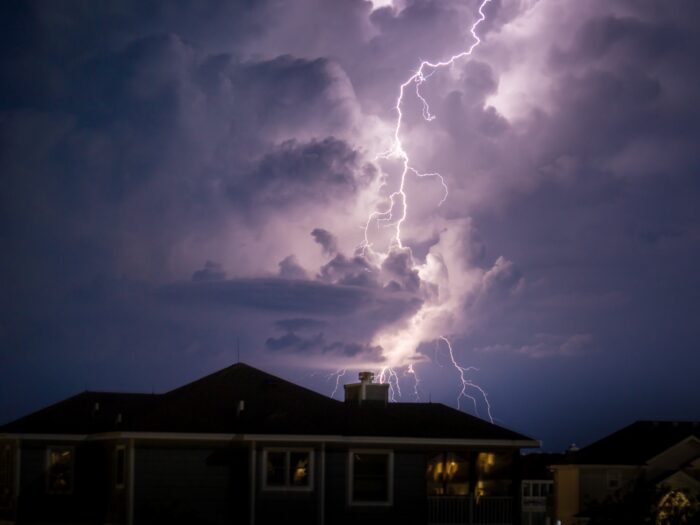
Global insured losses from natural catastrophes reached $107 billion in 2025, a figure that was high by historical standards yet well below the $140 billion implied by long-term growth trends, according to a new Swiss Re Institute report.
The deviation from long-term loss trends was driven almost entirely by the absence of a major U.S. hurricane landfall — a favorable outcome Swiss Re characterized as luck rather than a reduction in underlying risk. Secondary perils — wildfires, severe convective storms and floods — filled the gap, accounting for an all-time high of 92% of insured losses globally in 2025, the report said.
The January 2025 wildfires in Los Angeles County’s Palisades and Eaton neighborhoods produced combined insured losses of $40 billion, making them the costliest wildfire event on record and placing them among the top 10 most expensive insured natural catastrophe events ever documented, according to the report. Without those fires, 2025 would have been the least costly year for insurers since 2016, the report noted.
“The U.S. continues to shoulder a disproportionate share of global insured catastrophe losses, and that trend is being driven as much by rising exposure and economic growth as by the hazards themselves,” said Monica Ningen, CEO Property & Casualty Reinsurance US for Swiss Re. “Severe convective storms, wildfire and winter freeze are causing real, widespread damage to homes, businesses and infrastructure across the country. Addressing that growth in risk requires greater investment in mitigation, smarter building, and stronger public-private partnerships.”
Trend Growth Points to Significantly Higher Losses Ahead
Despite the below-trend result in 2025, the structural forces behind rising catastrophe costs remain firmly in place, Swiss Re said. Since 1996, insured losses have grown at an average annual rate of 5% to 7% in real terms. If that trajectory holds, Swiss Re projected insured catastrophe losses of roughly $148 billion in 2026, rising to $186 billion by 2030.
In a peak-loss scenario — driven by major hurricane landfalls or earthquakes striking areas of high insurance penetration — 2026 losses could reach $320 billion, the reinsurer said. By 2030, a peak-loss year could generate approximately $400 billion in insured losses, more than double the last actual peak year in 2017, according to the report.
The report cautioned that past lulls in hurricane activity, such as the 2006-2016 stretch without a major U.S. landfall, ended abruptly with high-impact events. The 2025 Atlantic season underscored the point: it produced three Category 5 hurricanes — the second-highest count on record — and 60% of all hurricanes reached Category 5 intensity, the highest share ever recorded. The storms simply did not hit heavily insured coastlines, Swiss Re said.
Exposure Expansion Into High-Risk Zones Fuels the Crisis
Exposure growth explains more than 80% of the upward trend in global weather-related insured losses since 1970, Swiss Re found. But the picture grows more concerning at a regional and peril-specific level. Insured losses from North American wildfires and European severe convective storms are growing roughly twice as fast as exposure alone would predict, Swiss Re said, pointing to the compounding effects of hazard intensification, rising vulnerability and the concentration of high-value assets in dangerous locations.
Wildfire stands out as the fastest-growing peril, with insured losses climbing an estimated 12% per year. Since 1990, exposure growth in high-risk wildland-urban interface zones has outpaced non-WUI areas by a factor of 1.8 nationally and 1.9 in California, the report said. About one in three Californians now lives in the WUI.
Severe convective storm losses reached $51 billion in 2025 — the third-costliest year on record for the peril — extending a streak of annual losses above $50 billion. The number of SCS events causing losses of $1 billion or more was 44% higher in the five years ending in 2025 than in the prior five-year period, according to the report. Urbanization, rooftop solar installations and U.S. reconstruction costs that remain 37% above December 2019 levels are all contributing factors.
Protection Gaps Persist Despite Record Insurance Share
Roughly 49% of 2025 economic losses were insured — the highest share on Swiss Re records — but that figure was skewed by the concentration of events in well-insured U.S. markets. In emerging economies, 80% to 90% of losses remain uninsured, and even advanced economies face significant protection gaps for low-frequency, high-impact perils such as earthquakes, Swiss Re Institute said.
The Myanmar earthquake in March 2025 illustrated the disparity: it caused an estimated $11 billion in economic losses and claimed approximately 3,900 lives, yet insured losses were just above $200 million. Adaptation measures — including updated building codes, improved land-use planning and physical hardening of properties — can help stabilize loss trajectories and maintain insurability, the report said, but investment in such measures has not kept pace with exposure growth in many regions.
Obtain the full report here. &