Newsletters
 Risk Central
 Digital Edition
Holiday Cargo Theft Keeps Climbing as Criminals Refine Their Timing and Tactics
Trends: A Pattern Emerges Around, Not During, the Holiday
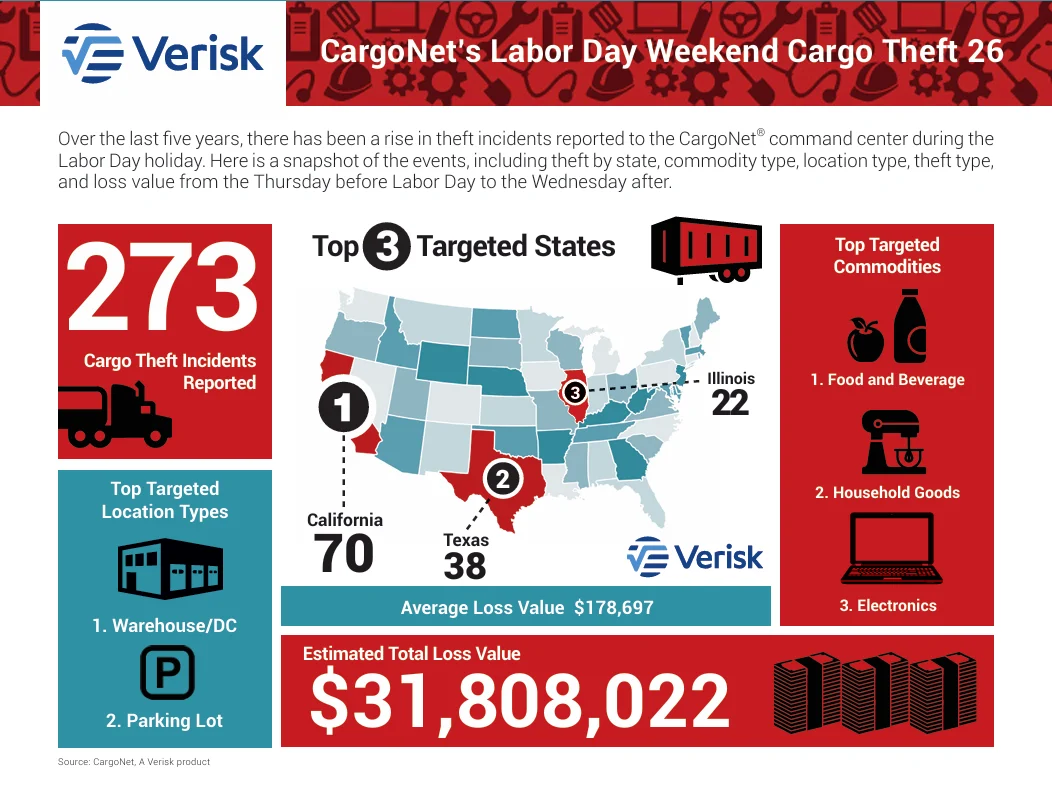
The data reveal a counterintuitive rhythm to holiday cargo theft. Rather than striking during the long weekend itself, criminals concentrate their activity on the days bracketing it. The Friday before the holiday was the busiest day across the five-year period with 55 incidents. That was followed by the Tuesday after the holiday, with 49; Thursday, before holiday, with 46; and Wednesday after the holiday, with 44. Combined, those four days accounted for 194 of the 273 total incidents analyzed — 71% of all activity — while Saturday, Sunday and Labor Day Monday together saw just 79 incidents.
That timing lines up with the rise of deceptive pickup and non-delivery schemes, which rely on live staff, functioning phone lines and freight moving through normal business channels — conditions that vanish over the holiday weekend and return once operations resume, the report noted.
Geographically, theft remains concentrated in major freight corridors: California, Texas and Illinois accounted for 130 of the 273 incidents, or 48% of the total, reflecting dense freight networks, large consumer markets and infrastructure that allows stolen goods to move quickly. Food and beverage shipments led commodity categories with 49 incidents, followed by household goods, electronics, vehicles and accessories, and metals — categories chosen for their resale potential and ability to be broken down and redistributed.
Challenges and Opportunities: A Dual Threat for Risk Managers
Verisk CargoNet frames the Labor Day threat as two overlapping risks rather than one. The first is straightforward physical exposure: loaded freight sitting idle during closures or schedule disruptions creates an easy target. The second is more insidious risk is verification exposure, in which reduced staffing and time pressure make it easier for criminals to impersonate trusted carriers or alter shipment instructions.
This second category is evolving quickly, Verisk CargoNet said. Organized groups are increasingly compromising carrier accounts, software-based phone systems, email accounts and compliance-platform credentials, allowing them to operate from within channels a broker or shipper would normally trust. Because these actors may have authentic account access and knowledge of active shipments, traditional safeguards focused solely on carrier vetting are no longer sufficient. Theft can occur at tender, at pickup, or after a legitimate carrier has already taken possession of freight, if a criminal alters delivery details post-pickup.
Implications: Rising Losses Demand Sharper Vigilance
The financial stakes underscore the urgency. Verisk CargoNet estimated the commodity value across the five years of Labor Day incidents analyzed at approximately $31.8 million.
The company added that in the first half of 2026 alone, cargo theft losses exceeded $359 million, with average stolen shipment value climbing to roughly $341,518. For insurers and freight operators, the message is clear: incident counts alone no longer capture the full scope of risk, as organized groups grow more selective, targeting high-value metals, technology components and other freight capable of yielding outsized returns from a single theft.
Read the report here. &