Newsletters
 Risk Central
 Digital Edition
Exosuit Study Demonstrates 62% Reduction in Warehouse Back Injuries
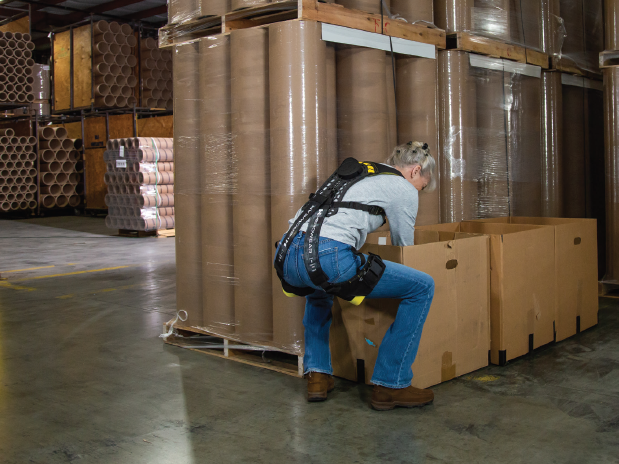
A comprehensive longitudinal study analyzing over 311,000 hours of warehouse work has provided the first large-scale evidence that exosuits significantly reduce back strain and sprain injuries among distribution center workers without transferring injury risk to other parts of the body, according to a new study by HeroWear.
The latest research adds crucial data to a growing body of evidence that back-assist exosuits reduce injury risk during the repetitive lifting and bending that defines warehouse work, according to HeroWear, an exoskeleton company that was spun off from Vanderbilt University in 2019.
Five distribution centers across the food and beverage, retail, manufacturing, and general warehousing sectors participated in the study, collectively monitoring case-picking workers over periods ranging from eight to 23 months. Case-picking roles involve repetitive lifting of 20 to 50 pounds hundreds or thousands of times daily, the report said.
The findings revealed a striking outcome: total strain and sprain injuries decreased by 62%, dropping from a historical rate of 10.2% to 3.8% after exosuit deployment. In practical terms, this translates to injuries declining from one occurrence every 20,000 work hours to less than one every 50,000 work hours.
Among case picking workers in distribution centers, the number of back injuries fell to zero without a corresponding increase in strains or sprains to other parts of the body, the report said.
Persistent Pain Points Driving Hardware Investment
Distribution centers have long grappled with formidable operational challenges that extend far beyond worker comfort. The sector faces an annual cost burden exceeding $13.7 billion from back and overexertion injuries alone. Worker turnover remains a chronic problem, with facilities experiencing turnover rates between 50 and 150% annually—requiring thousands of dollars per worker for recruitment and training.
These conditions create a cascading effect: high turnover leads to inexperienced workers, which fuels increased injury rates, lost productivity, and mounting overtime costs. Even facilities with robust safety cultures and established ergonomic programs found themselves unable to eliminate worker pain and fatigue entirely.
Case-picking roles proved particularly problematic. Workers routinely ended shifts sore and exhausted, and many continued to suffer from musculoskeletal disorders despite traditional ergonomic interventions.
This combination of high injury costs and persistent worker dissatisfaction finally compelled the five participating distribution centers to explore emerging solutions beyond standard ergonomic redesigns, mechanical lifts, and automation, according to the report.
“A night shift employee will pick up an average of 60,000 pounds a night,” said Travis Erickson, director of operations for Plymouth Inc., which participated in the study. “Our main goal at Plymouth is to make sure we are supporting every worker to have a happy healthy life outside of work. Some of our workers who have had back issues started wearing the Apex 2 exosuit and don’t have back issues any longer.”
Implications for Workplace Safety Strategy and Adoption
According to the Occupational Safety and Health Administration, each strain or sprain injury carries an average cost of $67,248, combining roughly $32,000 in direct medical and workers’ compensation expenses with $35,000 in indirect costs from lost productivity and replacement worker training.
The research builds upon over a dozen existing longitudinal studies and more than 50 academic investigations into exosuit effectiveness, creating a converging body of evidence.
“Emerging technologies demand continuous learning, and the only way we advance is through converging, real-world evidence,” said HeroWear Co-Founder and Chief Scientific Officer Dr. Karl Zelik. “I’m deeply grateful to the companies willing to share longitudinal data. They’re accelerating progress for all of us and helping make every workplace safer.”
Obtain the full report here. &