Newsletters
 Risk Central
 Digital Edition
Engineers Develop Soft Robotic Exoskeleton That Cuts Muscle Strain by 22%
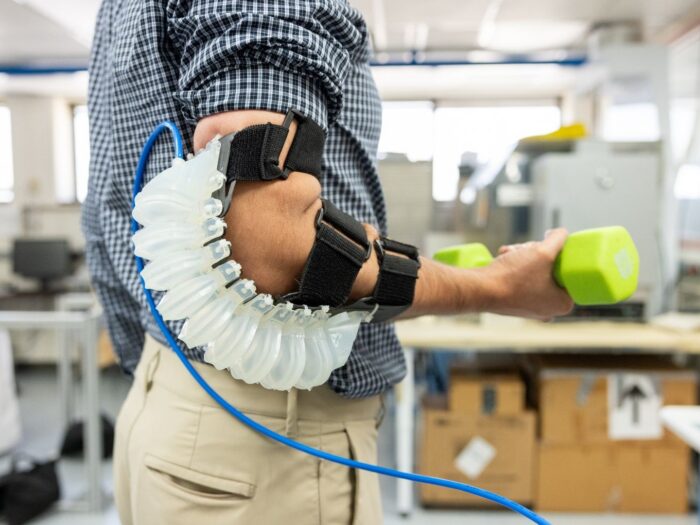
A wearable robotic device meaningfully reduces physical strain during industrial work, with testing showing a 22% decrease in muscle activity during lifting tasks and an 8-10 point reduction in perceived workload, according to engineers at The University of Texas at Arlington.
The Pneumatically Actuated Soft Elbow Exoskeleton, or PASE, represents a shift in how companies can protect workers from repetitive-motion injuries. The device assists movement during common industrial activities like lifting, assembling and drilling by using a lightweight silicone pneumatic actuator—essentially an air-filled mechanism that supports the arm and elbow, UTA said.
The design prioritizes practicality. Constructed from silicone and mounted on a carbon-fiber base with a neoprene outer layer, PASE functions as a single-piece system that minimizes complexity while maximizing comfort. Importantly, the device leverages pneumatic systems already available in most manufacturing facilities, enabling straightforward workplace integration, according to UTA.
“Our goal was to create a preventive, assistive device that reduces muscle strain before injuries occur,” said Eshwara Prasad Sridhar, graduate research assistant in the UTA Department of Industrial, Manufacturing, and Systems Engineering.
Addressing Industry’s Hidden Costs
Work-related musculoskeletal disorders account for approximately 30% of all U.S. workplace injuries and carry an estimated $45–54 billion annual price tag in workers’ compensation and recovery costs, according to UTA.
An interdisciplinary team at UTA conducted a study involving 19 participants aged 18–45 who tested PASE across three tasks—manual lifting, basic assembly and power drilling—demonstrating consistent reductions in both muscle activity and worker fatigue.
The findings, published in the Journal of Rehabilitation and Assistive Technologies Engineering, underscore an opportunity for organizations to shift from reactive injury management to preventive intervention. By reducing strain before injuries develop, companies can protect their workforce while potentially decreasing long-term insurance and health care expenses.
Expanding the Vision
The interdisciplinary research team has submitted a National Science Foundation proposal to expand PASE into a full upper-limb exoskeleton capable of assisting the elbow, wrist and fingers simultaneously.
Dr. Veysel Erel, research scientist III at the UTA Research Institute and leader of soft robotics efforts, noted the broader significance of the work: “Projects like this show how engineering can directly improve people’s quality of life by reducing fatigue, preventing strain and creating safer work environments.”
Read the full article here. &