Newsletters
 Risk Central
 Digital Edition
Doing Well by Doing Good

Harvey Warren has enjoyed many careers, from screenwriter to film producer to financial services professional. With a bachelor’s degree in communications from Ithaca College and a master’s degree from Syracuse University, writing has always been his passion. As the Optimized Patient he fulfills his dream to write about healing. Mr. Warren lives in Los Angeles with his wife, Wileen.
This is the fifth and final in a series of articles exposing what is driving the excessive recovery times and the high cost of workplace injuries.
At 75, I don’t really consider myself naive. But I have to say, when it comes to navigating the business dynamics of the workers’ compensation industry, I was completely naive.
I came to the challenge of improving the recovery experience for injured workers believing recovery education and/or peer-to-peer support would be enthusiastically embraced.
What I discovered was that before any other consideration about the benefit for the injured worker came the questions about how much it costs and what is the return on investment.
I answered the call from Brian Allen to use my book, The Optimized Patient, as the foundation of a novel approach to the recovery process. Both of us were flat footed and completely unprepared to address the cost and ROI of a program borne of compassion not cost cutting.
I’m happy to say that we’re quite prepared to answer that question now. The news is good. Workers’ comp non-medical recovery support is one of those remarkable and wonderful situations where compassionately doing good is the most direct route to doing well.
The key to reducing workers’ comp costs is improving the recovery treatment, not the medical treatment components of the workers’ comp system.
The research I have reviewed suggests that this distinction is one of the more useful reframes to emerge in occupational medicine and workers’ comp claims management over the last decade or so, and it points to a real structural problem in how the system pays for and manages care.
Injury treatment focuses on the underlying pathology, such as a torn ligament, herniated disc, or damaged rotator cuff. Its goal is to heal or stabilize the injury as much as possible.
Recovery treatment, in our view, focuses on the strategies and activities that support injury treatment and hasten return to work (or return to baseline activity).
Incredibly, the activities and support provided – or lack thereof – that address the psychosocial dynamics of recovery may predict disability duration far better than injury severity does.
Research around return-to-work by Gordon Waddell and others has repeatedly shown that biomedical injury severity is a weak predictor of disability duration.
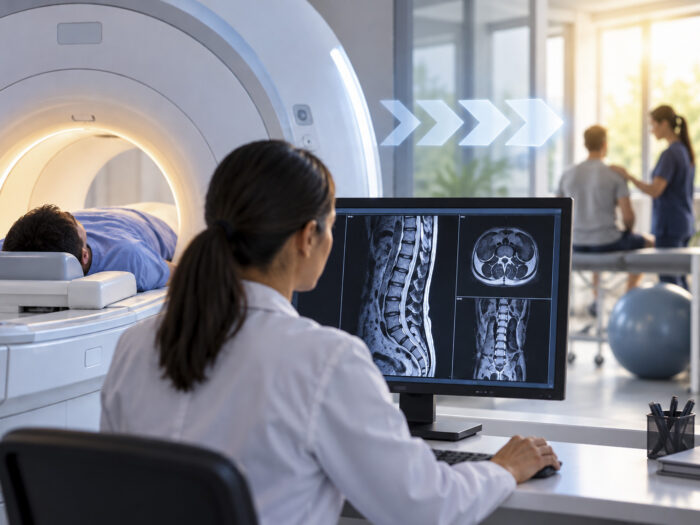
Two people with identical MRI findings can have wildly different return-to-work timelines, and the difference is usually explained by psychosocial and systemic factors — not the injury itself.
Most workers’ comp systems are architected around injury treatment. Fee schedules reimburse procedures, imaging, and visits — not functional outcomes.
A physician can be entirely successful by injury-treatment standards (surgery went well, tissue healed) while the claim drags on for months because nobody addressed the worker’s fear of re-injury, their disengagement from the workplace, or a home environment that reinforces disability behavior.
Personally, when recovering from spine surgery, I felt woefully uneducated and uninformed about what my role was to support my own recovery. It seemed to me that a responsible book should exist detailing how to get better faster and stay better longer.
Education and injury suggest OSHA. OSHA’s core educational principle is primarily prevention: eliminate or control hazards before injury occurs. Workers’ comp clinical care is secondary prevention: once an injury has occurred, contain damage and restore function.
Support materials such as recovery coaching and recovery education, sit at what’s sometimes called tertiary prevention: preventing a completed injury from becoming a permanent disability or a repeat injury.
The continuum insight is that these aren’t separate problems requiring separate philosophies — they’re the same hazard-control logic applied at different points in time. A hazard you failed to eliminate becomes an injury; an injury you fail to manage well becomes a disability.
A worker’s expectation about whether they will recover is one of the strongest predictors of whether they actually do recover. There is a well-documented relationship between self-efficacy, behavioral activation, and physical rehabilitation outcomes.
A worker who believes their condition is irreversible is less likely to engage fully in rehabilitation, less likely to attempt graded return-to-work activities, and more likely to experience pain as catastrophically threatening.
Recovery mindset should establish and reinforce that the injured worker matters and that the worker will recover. But it requires explicit intervention.
Standard physical medicine does not address this. Standard case management, as typically practiced, does not address this. The industry’s investment in physical rehabilitation without psychosocial co-treatment is akin to repairing a car engine while ignoring a flat tire.
Neuroscience, a topic that will be addressed by Joseph McClendon III, an internationally recognized neuropsychologist and motivational speaker and the keynote at this year’s 2026 National Comp Conference — provides powerful insight on return-to-work outcomes.
A Cochrane systematic review of 60 studies involving over 30,000 people with low back pain found good evidence that positive expectations of recovery are related to a higher likelihood of returning to work.
In truth, the workers’ compensation industry has a lot in common with the injured workers they serve. Workers’ compensation is an industry that wants to get better, they just don’t know how.
It turns out I wasn’t so naive after all. The compassionate provision of recovery education and engagement through coaching turns out to be just exactly what the doctor ordered. &