Newsletters
 Risk Central
 Digital Edition
Sponsored Content by Scan.com
Compress the Timeline, Compound the Savings: Rethinking Imaging in Workers’ Comp
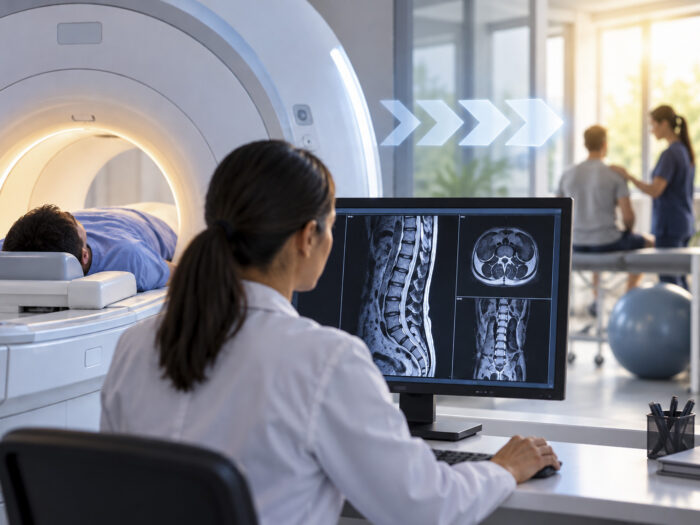
MRI has long been a cornerstone of diagnostic medicine, and its use continues to accelerate. After a sharp pandemic-era dip, MRI volumes in the United States are once again surging past pre-COVID levels, putting the modality on pace for approximately 40 million scans annually according to a National Institute of Standards and Technology (NIST) report.1
For workers’ compensation payers, that trajectory raises important questions about cost, utilization and, perhaps most critically, how quickly imaging can be leveraged to compress care timelines and improve outcomes for injured workers.
“MRIs are an inflection point in care,” said Darren Barr, VP of Strategy and New Ventures at Scan.com.
“If an MRI is being ordered, it means your care team needs to identify, confirm or rule out a suspected diagnosis. The longer you wait to complete that study, especially in work comp, the more claim costs can begin to compound.”
The Numbers Behind MRI Utilization and Cost Trends
The growth in MRI volumes over the past two decades has been substantial. In 2003, roughly 24.2 million MRIs were completed in the U.S.3 By 2018, that number had climbed to 39 million annually.4
The pandemic caused a significant disruption; volumes fell to about 27.4 million scans in 2020. But the recovery was swift, with 34.7 million scans conducted in 2022.5 NIST reports estimate roughly 40 million scans to be completed annually.1
Even as utilization climbs, reimbursement for MRIs, particularly in the workers’ compensation space, has moved in the opposite direction. Barr pointed to fee schedule compression as a primary driver, much of it tied to changes in Medicare relative value units that began around 2013 and 2014.
“Payers utilizing imaging outside of hospital settings have probably experienced a 60% unit-cost reduction in diagnostic reimbursements over the last 10 to 15 years,” Barr said.6
State variability remains significant. In California, the maximum allowable reimbursement for a lumbar spine MRI has dropped from roughly $700 in 2014 to $333 today while in New York, the same procedure sits around $1000. Five states still operate without formal fee schedules, relying instead on usual, customary and reasonable reimbursements.
But focusing exclusively on the price tag of a scan misses the bigger picture and perhaps a real opportunity, Barr argued.
“While ordering an MRI seems simple, the real savings come from executing it well — getting the right information back within the right timelines,” he said.
“The cost of an MRI is negligible if it takes you two weeks instead of two days to coordinate one and decide downstream care.”
With injured workers often earning around $200 a day, even a short delay in scheduling imaging adds direct wage-replacement cost — and once employer productivity losses (temporary staffing, overtime, workflow disruption) are factored in, that cost compounds heavily across the life of a claim.7
Rethinking Guidance on When to Order an MRI

Darren Barr, VP of Strategy and New Ventures, Scan.com
Utilization patterns in workers’ compensation are also shifting. Historically, the industry has been cautious about early imaging, in part because of guidelines like ODG’s recommendation against MRI within the first six weeks for conditions such as low back injuries. Concerns about the “if you find it, you buy it” phenomenon have long influenced adjuster behavior.
“As we age, MRI’s can expose life’s natural wear and tear on the body,” Barr observed. “Having an unexpected finding on an MRI can be common, but it’s important to distinguish between pre-existing baseline and what is actually driving the claim.”
The newer trend Barr described flips the traditional model. Rather than delaying imaging to avoid uncovering incidental findings, more organizations are pushing to have MRIs ordered earlier. They do this by removing barriers for physicians and networks including friction with authorizations and UR rules. Pairing early imaging with clinical decision tools, such as age of injury analyses, ensures actionable data while mitigating the risk of paying for unrelated, pre-existing conditions. This analysis delivers deeper insights that manage claim exposure while streamlining treatment plans to support better, faster patient recovery.
“You may still accept the claim, but you’re not responsible for making a 40-year-old patient’s shoulder like a 20-year-old’s,” Barr said.
After shifting away from traditional models, those organizations that have pushed for this earlier imaging approach while layering in clinical decision support tools have reported stronger long-term results, Barr said.
“Behind every dollar lost to delay is a person waiting to get their life back. Every day out of work isn’t just an expense on a claim, it’s another day a patient is waiting to regain their health, their income, and their peace of mind.”
Compressing Timelines Through Clinical Support and Technology
The bridge between early imaging and better outcomes is care compression. That means reducing the friction, administrative delay and coordination lags that traditionally stretch out claim timelines.
For years, ancillary care networks have positioned themselves as administrative buffers. Barr encouraged buyers to emphasize focus on those who are removing friction from the process.
“If you’re not actively empowering the people on the front lines, such as physicians, nurse case managers, and adjusters, you’re making an already complex journey harder for everyone involved,” he said.
“Having tools that support the patient’s care team in getting faster, more comprehensive, results while offering network cost controls is where you start to see the biggest impact.”
That’s the philosophy behind Scan.com’s approach. Through direct integrations and partnerships with imaging centers, the company has real-time access to images and reports. That structure enables faster delivery of clinical decision support tools like age of injury and causation reviews.
“Cost savings are important, but the real value comes from fast results and compression in care.”
Dr. Lawrence Goren, a physician with four decades of experience in workers’ compensation, had this to say about the topic, “It is well established that compression of care creates much better outcomes, which result in workers’ compensation cost savings, decrease in litigation, and hard and soft operational savings for the employer,” Dr. Goren said.
“A delay in imaging can cause ripples throughout the effective and efficient care of patients.”
“Best-in-class care has to involve care compression and early participation of well-trained radiologists.”
The Role of AI in Care Compression
Advanced technology and AI are essential drivers of speed and efficiency across clinical and network workflows. By instantly extracting critical details, such as prescription data and patient demographics, from dense referral files, smart automation reduces process errors and administrative delays to keep patient care moving forward.
On the clinical side, AI helps radiologists prioritize studies with likely positive findings, summarize reports, and pinpoint key areas for review. By helping clear administrative bottlenecks, these tools are becoming indispensable, especially as the American College of Radiology projects a U.S. shortage of up to 42,000 radiologists by 2033.8
“You always want a human in the loop with AI, especially when diagnosing potentially life-altering findings,” Barr said. “But AI enables networks to schedule care faster, while helping radiologists reduce errors and work through files more efficiently.”
In healthcare, the goal should never be to replace humans with AI, but leverage AI to enable a better care experience.
The Bottom Line
Payers and employers that pair early imaging with intelligent clinical tools unlock a powerful impact to their bottom line: lower litigation, reduced indemnity costs, and significantly improved patient satisfaction.
“Every day saved in the diagnostic phase is a day given back to an injured worker,” Barr said. “How quickly we can compress care timelines and help patients recover isn’t just a business objective, it’s what it really boils down to in our industry.”
To learn more, please visit www.scan.com.
Footnotes
1. https://www.nist.gov/how-do-you-measure-it/how-does-mri-machine-work
2. https://www.auntminnie.com/clinical-news/mri/article/15633159/imv-mr-volumes-down-but-radiology-departments-remain-positive
3. https://www.auntminnie.com/clinical-news/mri/article/15587149/mri-procedure-growth-rate-slows-study-shows
4. https://www.auntminnie.com/clinical-news/mri/article/15625026/imv-mr-providers-work-harder-as-procedure-volume-grows
5. https://www.auntminnie.com/clinical-news/mri/article/15633159/imv-mr-volumes-down-but-radiology-departments-remain-positive
6. Schartz E, Manganaro M, Schartz D. Declining Medicare Reimbursement for Diagnostic Radiology: A 10-Year Analysis Across 50 Imaging Studies. Curr Probl Diagn Radiol. 2022 Sep-Oct;51(5):693-698. doi: 10.1067/j.cpradiol.2022.01.007. Epub 2022 Jan 14. PMID: 35153101.
7. https://www.dol.gov/agencies/owcp/dlhwc/NAWWinfo
8. American College of Radiology, “The Radiologist Shortage: A Workforce Update from HPI” (Harvey L. Neiman Health Policy Institute), ACR Bulletin, Feb. 5, 2026


This article was produced by the R&I Brand Studio, a unit of the advertising department of Risk & Insurance, in collaboration with Scan.com. The editorial staff of Risk & Insurance had no role in its preparation.