Newsletters
 Risk Central
 Digital Edition
A.I. Meets Physical Therapy: Enlyte’s Kim Radcliffe on Turning Unstructured Notes into Predictive Risk Scores
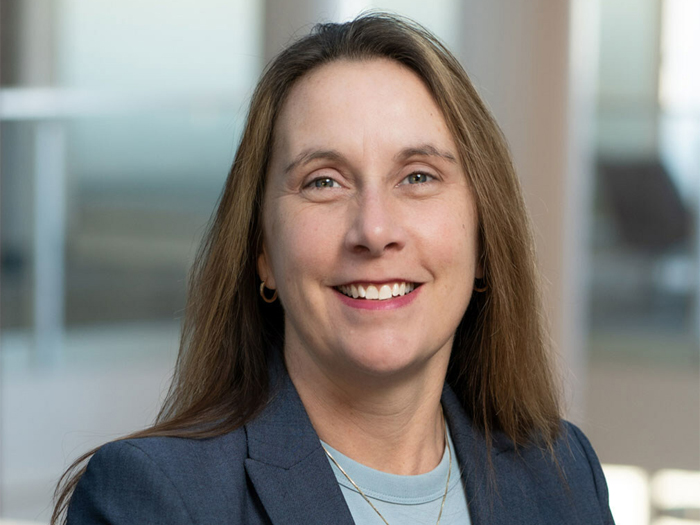
Physical therapy has long been an underappreciated data goldmine in workers’ compensation—rich with clinical detail, patient-reported outcomes, and psychosocial cues that can signal whether a claim is headed toward a smooth recovery or a complicated one. The challenge has always been access: notes are inconsistent in format, buried in clinical shorthand, and too labor-intensive to review case by case. Kim Radcliffe, senior vice president of product management at Enlyte, has spent nearly two decades on this problem, and she believes A.I. is finally closing the gap.
Radcliffe explains how Enlyte is teaching A.I. to normalize disparate outcome measures into a single risk score, why physical therapists are often better positioned than physicians to catch early warning signs, and how A.I. is easing the documentation burden squeezing PT productivity. She also makes a cautious case for a future where A.I.-driven screening could route certain injured workers straight to physical therapy. Throughout, one theme surfaces repeatedly: human judgment stays firmly in the loop.
Risk & Insurance: Unstructured notes have always been a challenge across this industry, but physical therapy seems like an especially rich case given the sheer volume of documentation involved. How is A.I. helping you extract value from what’s in those notes?
Kim Radcliffe: It’s perfect timing for A.I. in physical therapy. Traditional PT was pretty basic—range of motion, strength, pain level. Not very work-comp specific. But providers have evolved to be more specialized, and most now include psychosocial assessments in their notes—the yellow flags relevant to workers’ comp. Those injured workers tend to carry more fear and doubt, factors that can impact healing.
There’s also been growth in patient-reported outcome measures—PROMIS, SPADI, Quick DASH. But every provider uses different ones, depending on body part, company, EHR. So the challenge becomes: how do we normalize that and use it for predictive risk?
The A.I. tool we’re building works in domains—range of motion, strength, patient-reported outcomes, psychosocial language—teaching it what normal looks like and what normal progression looks like. Then it synthesizes that into a risk score or flag. If a patient’s perceived function doesn’t match their objective measures, that’s a flag, even at evaluation. It doesn’t matter what scale the provider uses—we can normalize it into a progress score or flag that improvement isn’t happening.
R&I: So in effect, you’re taking data that’s historically lived in silos and unifying it into a single, actionable picture.
KR: Timing is critical with physical therapy. Physicians’ notes can and should provide this, but they’re often still using the traditional medical model. Physical therapists spend more time—an evaluation is an hour, treatments are 45 minutes to an hour—with a lot of one-on-one communication and trust-building. They’re often the first course of treatment after the physician, seeing patients within a week.
If we see early signs—psychosocial flags, or a disconnect between perceived disability and objective findings—we might flag that case for a case manager, even though it wouldn’t traditionally get flagged. It’s amazing how trust impacts recovery when there’s a psychosocial component—fear, catastrophizing, even the relationship with an employer.
A lot of this—flags, assessments—has been part of the industry for a long time. It’s what everyone was doing anyway, just lubricated by A.I. now, faster and more powerful. About 10 years ago, we were using Optical Character Recognition (OCR)—if this word’s in the note, flag it—with lots of false positives and negatives. Now it’s about getting upstream, identifying cases earlier. Previously it was so labor-intensive that you’d wait to flag a case until it was already off track, by which point patients could have more complications.
R&I: Beyond clinical outcomes, what role is A.I. playing on the utilization review and cost-management side?
KR: UR is proven to reduce cost, but overly aggressive UR has its own cost, especially when reviews keep coming back “green”—you’re spending money just to confirm a case doesn’t need intervention. A.I. can reduce the burden of unnecessary UR. The green is just as important as the red: if A.I. can say with confidence a case is clear, you need less human intervention, though a human stays in the loop. It’s a win on both sides.
R&I: Shifting to the provider side—how is this technology changing the way physical therapists themselves are able to do their jobs?
KR: PT has been one of the last specialties to adopt A.I. for scribing, partly because PT documentation is grid-based—reps, sets, range of motion—rather than narrative like a physician’s notes. But more groups are adopting it now. That matters because progress notes need to be robust while the therapist is also doing the hands-on assessment. Relieving some of that documentation burden lets therapists spend more time with patients without eating into patient care—and given the salary pressures doctorate-level PTs face, that relief matters.
R&I: Let’s talk about productivity more broadly. Where are you seeing the most meaningful gains?
KR: Across the board. For providers, it’s reducing documentation burden without cutting into patient time. For nurse case managers, adjusters, and us on the claims side, the AI tool summarizes notes into something clean, so you’re not sorting through pages to understand a case. That lets you manage more claims and prioritize where you need to spend time.
R&I: With all this capability, how does Enlyte think about the responsible, and safe, use of clinical A.I.?
KR: This is something we focus on heavily. We have a technology review board keyed into A.I.. The biggest risk anyone talks about is hallucination or error, so relying solely on AI without a human in the loop is the danger. We’ve used clinical experts to build out the domains, and machine learning improves through constant feedback—flagging when the tool missed something or got it wrong.
The important part is that final human. Our tool shows what it flagged and why, and points to exactly where in the notes, so clinicians can go right to the source instead of reading pages themselves. I don’t think we’re close to needing less human expertise—the biggest impact of our program is still clinician-to-clinician conversation. We have governance around this: there’s never a final output without a human validating accuracy.
R&I: Before we wrap up, is there anything on the horizon for this space that you think readers should be watching?
KR: One thing I keep noodling on: as A.I. helps us see the value of starting therapy as soon as possible, I think we’re getting close to a PT-first model in some cases—bypassing traditional steps and going straight to a physical therapist. A.I. could build the screening for that. As soon as a notice of injury comes in, you could fast-track cases that fit the right qualifiers—an acute, low-trauma injury like an ankle sprain, not someone falling off scaffolding—straight to PT.
Right now the occupational medicine model still requires seeing a physician first, maybe getting imaging. I think the hesitation is risk aversion—insurers worry that skipping diagnostics adds litigation exposure. But therapy providers doing this work are trained to know what to look for, under their own licensure. Montana already allows PTs to serve as primary care in a small sample, with certification and training, and most states now allow direct access, so the infrastructure exists nationally.
I don’t know how fast that needle moves. It’ll take the right insurer willing to step up and try it. But as screening tools evolve, that should build the confidence needed to get there. When it works, it works well—the patient resolves in two or three weeks and gets back to work. If it doesn’t resolve, no harm done—they’re still being treated, just progressing to the next appropriate step. I’ll keep pushing on it. &