Newsletters
 Risk Central
 Digital Edition
US Commercial Construction Growth Slows as A.I. Data Centers Drive Market
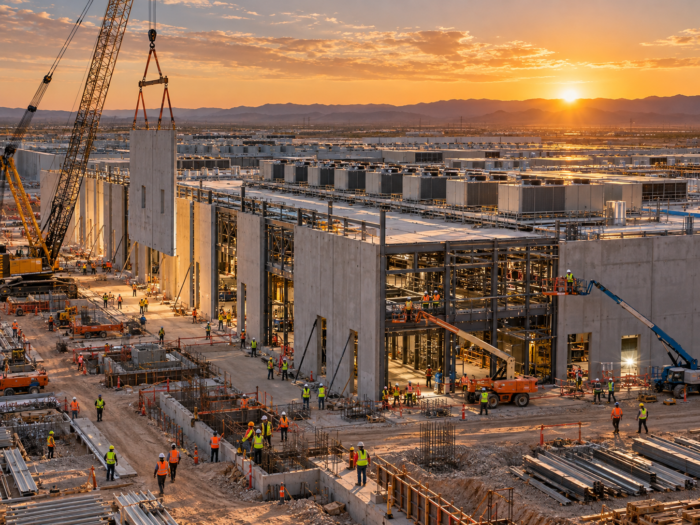
Non-residential construction spending grew nearly 1% in 2025, effectively stalling after years of expansion, and is on track to decline in 2026 for the first time since 2010 excluding a pandemic-related dip in 2021, according to QBE North America and Control Risks, citing U.S. Census Bureau data.
The firms’ 2026 U.S. commercial construction outlook found that office spending, a Census subcategory now driven primarily by data centers, grew 12% in 2025 and rose 5.9% in the first six months of 2026 compared with the same period in 2025. Data centers now account for more than half of spending in that category.
Excluding data centers, total non-residential construction spending was essentially flat in 2025 and fell 4.6% in the first six months of 2026 vs. the same period in 2025, the report said.
Forward-looking indicators point to continued softening. The American Institute of Architects/Deltek Architecture Billings Index registered 46.7 for commercial/industrial architecture firms in June 2026, below the 50 threshold that separates growth from decline, and the American Institute of Architects reported that commercial/industrial firms have remained under 50 since July 2022.
The broader economy is also cooling: real GDP growth slowed to 2.1% in 2025 from 2.8% in 2024, according to the Bureau of Economic Analysis, with the Federal Reserve projecting growth in the low 2% range annually through 2028.
Labor and Cost Pressures Mount
Associated Builders and Contractors estimated in January 2026 that the industry needs 349,000 net new workers in 2026 and 456,000 in 2027 to meet demand, figures revised down from 2025 projections due to weaker spending forecasts, the report said. The Associated General Contractors of America (AGC) found that 82% of surveyed contractors are struggling to fill hourly craft positions and 80% are struggling to fill salaried openings. Data center construction, where many trades command higher wages, is concentrating demand among already scarce specialized workers, according to the report.
Immigration enforcement is compounding the strain. The Pew Research Center estimated unauthorized immigrants made up roughly 15% of the U.S. construction workforce in 2023, the highest share of any major industry, rising to 19% in construction and extraction occupations specifically. An AGC survey from January 2026 found 33% of construction firms had been affected by immigration enforcement actions in the preceding six months, including 11% reporting workers left or failed to appear due to actual or rumored enforcement.
Cost volatility remains elevated. Construction wages rose 3.5% from June 2025 to June 2026, compared with 3.1% across all sectors, the report said. Diesel prices were 50% higher as of Aug. 20, 2026, than a year earlier, driven by the U.S./Israel-Iran war, while gasoline rose 31%. Tariffs have pushed producer prices for steel mill products up 22.5%, aluminum mill shapes up 40.5% and copper and brass mill shapes up 18.4% between July 2025 and July 2026.
A.I. Infrastructure Offers Growth and Risk
The report identified A.I.-related infrastructure investment as both the sector’s largest growth driver and a significant concentration risk. Much of the data center pipeline is backed by long-term commitments from large technology companies, meaning a slowdown in A.I. investment would likely curb new project starts rather than trigger a collapse of existing activity, the report said.
Power constraints and grid interconnection limits are already slowing development in major data center markets, while community opposition over power consumption, water use and land use has become a factor in 2026 midterm races, according to the report.
Capital remains available but increasingly concentrated. Construction mergers and acquisitions rose for a third straight year in 2025 to 562 transactions, with private equity deals climbing 31% to 305 and accounting for 54% of all sector deals, overtaking strategic buyers for the first time, Capstone Partners found.
A June 2026 PwC analysis found average deal value in the first two quarters of 2026 was 63% higher than in the second half of 2025 despite fewer transactions. Foreign investment commitments, including Japan’s $550 billion framework with up to $110 billion announced in specific projects, could add further construction demand, though conversion of South Korea’s $350 billion package and the EU’s expected $600 billion into actual projects has been slower, the report said.
Obtain the full report here. &