Newsletters
 Risk Central
 Digital Edition
The Hidden Driver of the High Cost Workers’ Comp Claims

Harvey Warren has enjoyed many careers, from screenwriter to film producer to financial services professional. With a bachelor’s degree in communications from Ithaca College and a master’s degree from Syracuse University, writing has always been his passion. As the Optimized Patient he fulfills his dream to write about healing. Mr. Warren lives in Los Angeles with his wife, Wileen.
This is the first in a series of articles exposing what is driving the excessive recovery times and the high cost of workplace injuries.
Workplace injuries take twice as long to heal as non-workplace injuries. That is a researched established fact. Moreover, it is the single most important fact and key to understanding how to dramatically reduce the high cost of workers’ comp.
But don’t take my word for it. Run ChatGPT with the following simple, neutral prompt, “Is there reliable data on why injured workers receiving workers’ comp take longer to recover than the universe of all injured people?”
If you do that you will see that the evidence confirming that fact is expansive. The infographic below is based on reliable research gleaned from an AI search with verified citations.
If you are unfamiliar with the many articles I have written about injury recovery, I come at the topic from the patient’s perspective.
It has been my message to workers’ comp professionals for the last five years that “people want to get better; they just don’t know how.” Educate and engage them and you can help them get “better faster and stay better longer.”
However, if workers’ compensation recoveries virtually take twice as long as non-workplace injuries, something else must be affecting workplace outcomes. Clearly, an injured worker possesses no more and no less injury recovery “know how” than those who are not injured on the job.
So, what is going on here?
Something about getting injured on the job changes the way your body heals? Clearly, that can’t be correct. Maybe it’s all of that fraud, and secondary gain, and malingering that’s driving the delta in the data.
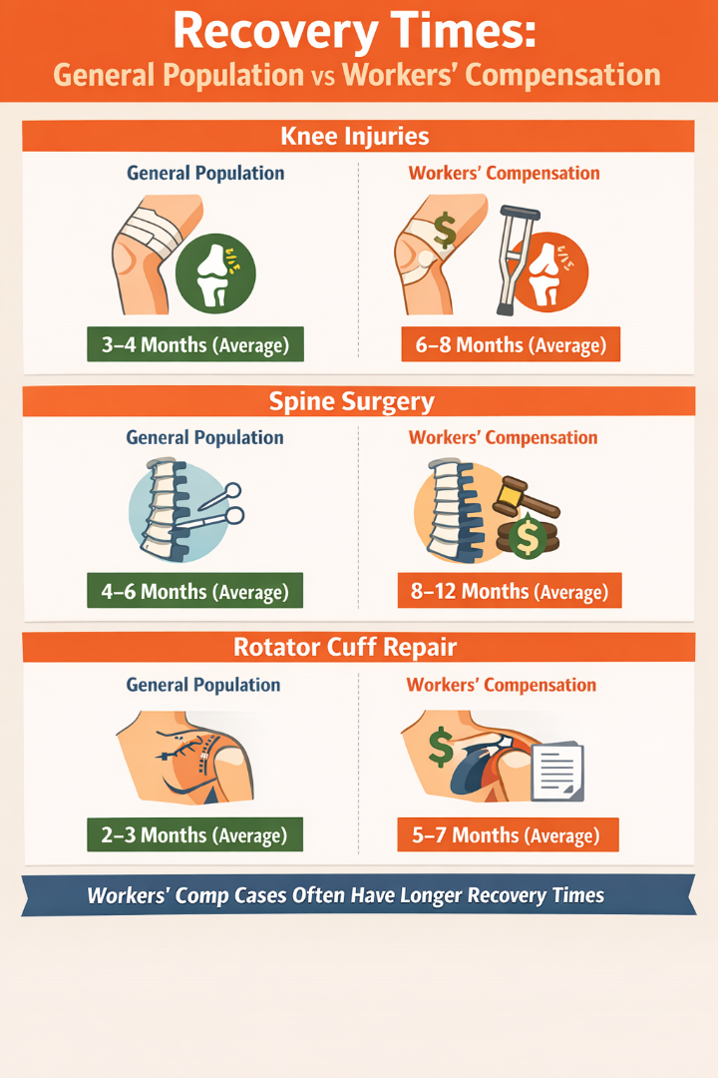 In your experience, does this infographic line up with those variables? It didn’t for me and frankly, it didn’t for all the researchers who have studied the disparity between workplace and non-workplace recovery times.
Fraud, secondary gain, and malingering have little or nothing to do with a physical injury.
There is a specific frame of mind or “mindset” at play that may actually shed some light on the truth that an injury on the job and an injury at home are actually identical except for one key factor; how the injured person “feels” or “thinks”’ about how the injury occurred.
There is no one to blame in a non-workplace injury.
An injury on the job comes loaded with a lot of perceptions and emotional mindset traps that are unique to the employee/employer relationship.
I was surprised to learn that those perceptions that are unique to an injury on the job have been so thoroughly researched that it has entered the lexicon as a named mindset, “perceived injustice”.
The delta in recovery times between workplace and non-workplace injuries is driven by how the injured worker “feels about” what is happening to them.
It is essential to understand that “what is happening to them” is not just about the injury and pain and challenge associated with healing their body.
Research suggests that the psychosocial reality of a “perceived injustice” mindset is the real culprit driving excessively long return to work time frames.
In the next article I will share the IEQ “Injustice Experience Questionnaire” developed in 2002 by Michael Sullivan to arithmetically quantify a worker’s likelihood to become a chronic case or a catastrophic loss.
It’s real. It’s data driven. It affects your bottom line. &