Newsletters
 Risk Central
 Digital Edition
The 90-Day Peril

Harvey Warren has enjoyed many careers, from screenwriter to film producer to financial services professional. With a bachelor’s degree in communications from Ithaca College and a master’s degree from Syracuse University, writing has always been his passion. As the Optimized Patient he fulfills his dream to write about healing. Mr. Warren lives in Los Angeles with his wife, Wileen.
This is the third in a series of articles exposing what is driving the excessive recovery times and the high cost of workplace injuries.
If you knew with certainty that any injured worker who does not return to work within 90 days will likely never return to work – would it change the way you administer your workers’ compensation program in those first critical 90 days?
Ironically, simple research about workers’ compensation claims handling suggests system and administrative factors themselves do not address that concern. In fact, the way claims are commonly handled can delay treatment and add to the 90-day problem.
Research also suggests that the reason for that is workers’ compensation systems often slow the treatment process by introducing a multitude of steps like treatment authorization, utilization review, independent medical exams, claim disputes, and litigation. Think about all of that and wonder if injured worker processing is unwittingly slowing the treatment and driving recovery in the direction of that 90-day peril.
 Research further suggests that faster access to care delivery correlates with quicker returns to work. Reducing return to work durations would seem to correlate with better injured worker handling.
At convention, it would seem that employers and claims handlers are doing everything conceivably possible to speed up returns to work by improving injury treatment processing. I would like to suggest – improving recovery treatment is separate and apart from injury treatment and could be key in those first critical 90 days.
I am not qualified to address injury treatment system issues but writing the Optimized Patient I felt deeply the challenge of navigating recovery. Every person I have interviewed or assisted confirms that there are a lot of “feelings” around the recovery process. Many of those feelings are detrimental to a smooth recovery.
In the previous article I offered a deep dive in the understanding of how “perceived injustice” is a driver of excessive cost in workers’ comp. If you couple that understanding with the 90-day rule, the question becomes, “what can you provide the injured worker to combat the difficulty many injured workers feel as they navigate the workers’ compensation experience, especially in the first 90 days?”
I am known as a strong advocate of patient education and engagement to optimize outcomes. It never occurred to me that an education and engagement strategy has a positive mindset effect on the injured worker receiving support.
I would suggest that the simple provision of education and engagement as soon as possible in the claim process will provide an essential additional “touch” to move the injured worker toward a more rapid recovery. There are many researched and common-sense reasons for that.
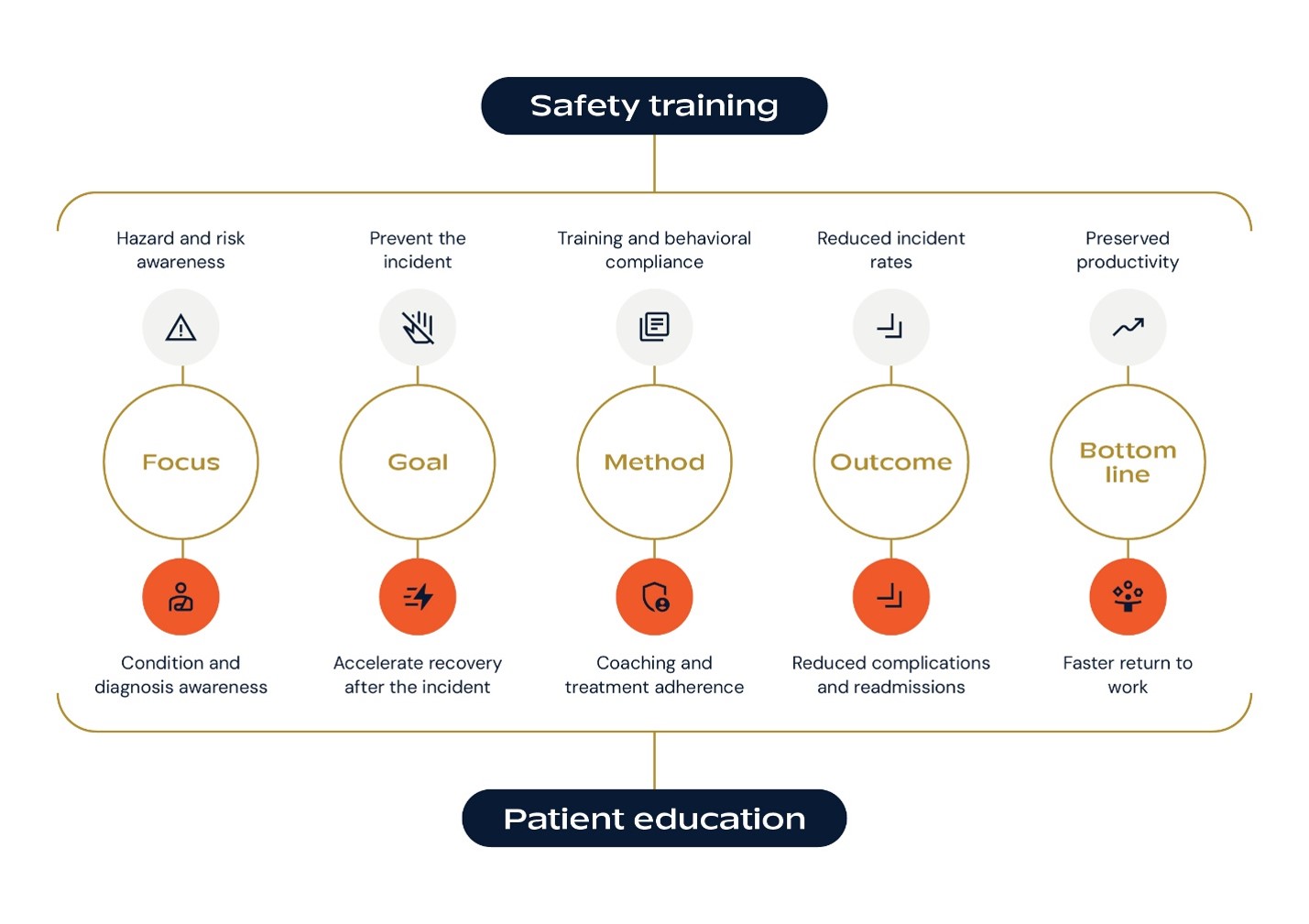
Take a look at the continuum of OSHA education to recovery education. It is a striking assessment by Claude about the place that patient education may have in workers’ compensation injury cases.
I share this to suggest that workers who take OSHA safety training will naturally understand why they are being provided with recovery education support. When prevention education fails, recovery education kicks in as part of workplace training.
Like OSHA training, recovery “training” is a curriculum that can be immediately deployed when an injury is serious enough that it may approach the 90-day benchmark in recovery.
Understanding that the injured worker may already be prone to issues arising from perceived injustice, helping to mitigate perceived injustice in the system with recovery support should tend to bring the injured worker back to work before crossing the 90-day meridian.
The most striking part of the research was the differentiation between injury treatment and recovery treatment. Recovery treatment, in my experience, is about providing the injured worker with non-medical tools like mindset, nutrition, activity and rest coaching.
We often speak in panels about how, unless you have been seriously injured, it is hard to imagine the dark feelings that arise when you are spending weeks at home in considerable discomfort.
Recovery treatment is about providing more than medical care. It is about keeping the injured worker focused and engaged in the job of getting well and benefiting from their medical treatment in those first 90 days.
During the dive into the 90-day rule, litigation showed up as a contributing factor to 90-day failures. But there is good news here as well. It appears that recovery treatment is also a very effective factor in avoiding litigation. More about that in the next article. &