Newsletters
 Risk Central
 Digital Edition
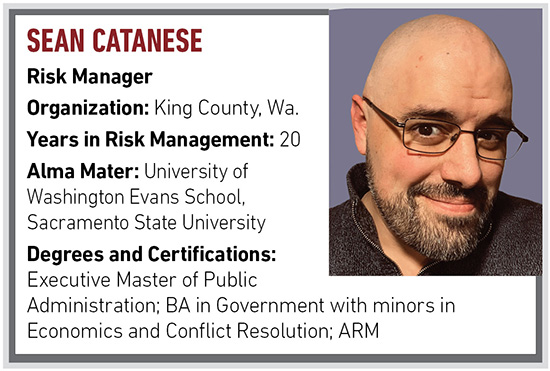
Risk Manager Sean Catanese’s Journey from Landscaping to Leadership
Our “Profession” page features highlights and insights from risk managers about their careers. Here we talk to Sean Catanese, the risk manager for King County, Wa.
Risk & Insurance: What was your first job?
Sean Catanese: I started working with my father in his landscaping business when I was about nine years old and continued with him off and on until he handed it off to his employees some years later.
I had other jobs along the way, but I love working in my own backyard and a community garden every week, weather permitting. The work also gave me a special appreciation for the importance of worker safety early on.
R&I: How did you come to work in risk management?
SC: I had just completed a political internship in Sacramento as I finished up my undergraduate degree. I was looking for something outside of politics, as sort of a palate cleanser.
My interest in safety and my comfort with Excel and technology led me to a job with a risk pool administrator. I wasn’t at all familiar with the industry, but tagging along on my first site inspections and identifying worksite hazards really cemented a sense of purpose for me.
I grew from safety training and inspections to more advanced analysis and assessment tools, and enterprise risk management (ERM) consulting from there. But I also found that consulting wasn’t a good fit for me. I’m proud of what I’ve helped build since joining King County in 2014, and I’m deeply interested in where we go from here.
R&I: What is the risk management community doing right?
SC: By now, the idea that an organization’s approach to risk must transcend insurance and financial concerns alone isn’t new. We can make a credible argument that organizations are finding their way through uncertain times more effectively when they have mature ERM programs backed by leadership and meaningful resources. But the work isn’t ever done, especially in the public sector. We have to keep proving the value of the approach.
R&I: What could the risk management community be doing a better job of?
SC: So much of what we do is wrapped up in helping the organizations we serve consider the future effectively, but we’d also be well-served by considering our own community’s future more deeply.
Few risk managers come into the profession through formal, structured learning. While it feels optimistic to advocate building academic disciplines and degree programs around risk management, the next generations of leaders in business and government really ought to have some familiarity in the area. We could do a better job of both setting that expectation and supporting institutions in helping their students meet it.
R&I: What emerging commercial risk most concerns you and why?
SC: The large-scale effects of more severe weather, wildfires and other disasters associated with climate change. That’s not “emerging” precisely — we’ve been dealing with those events for years — but the risk is intensifying and broadening in ways that will challenge the resiliency of traditional insurance systems.
The risks fall especially hard on the public sector, as we’re both responsible for essential infrastructure and the place our residents turn to for resources and help when a crisis impacts them.
R&I: If you could point to two mentors who influenced you, who would they be and why?
SC: Grace Crickette was a client when I was a consultant, and she saw potential in what I could do. She pushed me to think more creatively, beyond the technical processes of building risk assessment tools. She helped me understand how those tools were going to help leaders make decisions about their most important challenges.
Jennifer Hills was King County’s risk manager when I joined and has just retired in March. She showed me how to lead and make a difference within an organization despite not having direct authority much of the time. She also helped me connect the day-to-day work to the values and purpose of the organization.
Grace and Jennifer both set high expectations for me, but they also gave me the time, tools, and resources I needed to do my best work. I couldn’t have asked for better examples for leadership in these spaces.
R&I: What do you find most fulfilling about your work?
SC: The sense of purpose in this work is everything for me. On our best days, when we get it right, the result is a person who has experienced harm is made whole, or a disaster is successfully mitigated or — even better — those harms are prevented and avoided. The upsides have less adrenaline, of course — a safe, on-time bus trip, a housing project opening, or an infrastructure project completed on time and on budget. But they mean everything to the communities we serve.
R&I: What accomplishment are you proudest of?
SC: I joined the enterprise risk management teaching faculty for the Public Risk Management Association in 2022. Through that work, I’ve been privileged to connect with peers around this country and across several more who share interests in both ERM and public service. While they don’t all build mature, successful ERM programs, the opportunity to share successful practices and lessons learned has been extremely valuable.
R&I: What do your friends and family think you do?
SC: We have three jobs among the adults in our household. One is in game design, one is in tech, and I’m in public sector risk management. When we describe the dynamic to friends, it’s: “The game designer makes the joy, the one in tech makes the money, and Sean saves the world.” That’s a lighthearted way to describe risk management, but since so much of the day-to-day can be quite serious, it’s suitable for an audience less familiar with the work. &