Newsletters
 Risk Central
 Digital Edition
Predict & Prevent® Podcast 26: How AI and Cameras Prevent Cold Chain Disasters
What if legacy security cameras already installed at distribution centers and warehouses could do more than just record footage? What if they could also prevent spoiled food from reaching grocery stores or catch cargo errors or even theft before it happens?
That’s the vision driving Technova Industries, a company transforming how the logistics industry handles cold chain verification. On this episode of the Predict & Prevent® podcast, host Pete Miller, CEO of The Institutes, sits down with Aymen Azim, co-founder and CEO, and Jenna Faville-Azim, co-founder and chief marketing officer, to explore how their AI-powered technology is breathing new life into legacy security systems.
The problem Technova set out to solve is deceptively simple: the security industry is riddled with outdated equipment that’s expensive and disruptive to replace. Highway cameras installed in the late 1990s, aging warehouse systems, and manual verification processes create costly blind spots throughout the supply chain.
“We thought about a technology that could connect to these legacy systems, old cameras, for example, and connect these old systems to the new technologies that we’ve been seeing today, like AI or even generative AI,” Aymen explains. “Not to have cameras just record, but have them manage operations and help with everyday activities.”
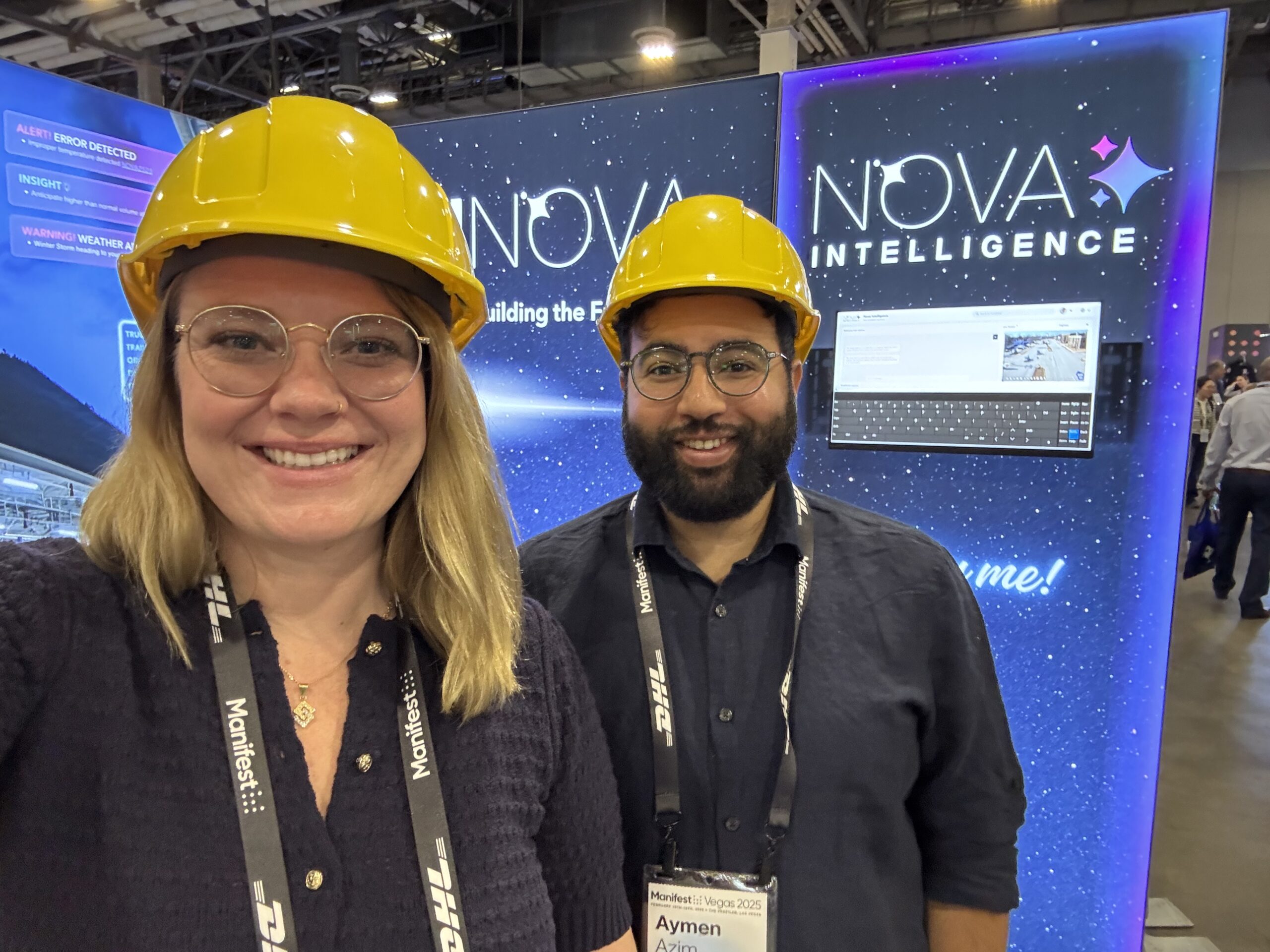
Jenna and Aymen Azim, Technova Industries
The breakthrough came when Technova discovered the logistics industry’s massive verification challenges. At one of the largest grocery warehouses in the country, they witnessed a thousand trucks moving in and out daily—with temperature checks and trailer verification still being done manually. The consequences of human error? Drivers pulling wrong trailers, spoiled goods traveling 500 miles to the wrong destination, and millions in preventable waste.
Technova’s solution reimagines cold chain verification entirely. Rather than installing expensive sensors in every trailer, they use existing security cameras to read temperature displays visually. One camera can now monitor 200 to 300 trailers daily, capturing not just temperature but trailer numbers, fuel levels, and USDOT information.
“We’re giving the systems, the logistics system, we’re giving them eyes through cameras,” Aymen says. “When you’re dealing with vaccines or medical devices going from a warehouse to a pharmacy, the first thing you want to look at is how do I get this good at the right place at the right time and not spoil? Because if you’re going to put a vaccine for a kid, you can kill that kid.”
Jenna emphasizes that Technova views cold chain verification as fundamentally a security issue. “We’re using the security cameras not just to solve an operational problem, but really to touch on a security problem of ensuring the security of the food, the vaccines, and the products that we ship.”
The implications for insurance companies are significant. With precise checkpoint data establishing clear liability, insurers face fewer ambiguous claims while shippers benefit from reduced premiums tied to lower risk profiles.
Looking ahead, Technova envisions filling the visibility gap during transit by partnering with truck stops to create verification checkpoints along routes. If a trailer’s temperature drops mid-journey, the system could redirect drivers to nearby stores before entire loads spoil.
“We believe we can get to a fully automated system, but we have to go step by step,” Aymen notes. “Five years ago, I would tell you we can’t do this. But today I can tell you for sure that we can do it because it’s already happening.”
Listen to the full episode, “How AI and Cameras Prevent Cold Chain Disasters,” to learn how generative AI is achieving near-perfect accuracy in visual verification and why the status quo in logistics is changing. &