Newsletters
 Risk Central
 Digital Edition
Portable Benefits Legislation Surges As States Rethink Worker Classification Rules

State legislatures introduced a notable surge of portable benefits legislation in 2026, driving a broader shift in worker classification bills nationwide, according to the National Council on Compensation Insurance.
NCCI was monitoring 1,102 state and federal bills as of July 31, 2026, along with 210 proposed workers’ compensation-related regulations, and reported that 167 bills had been enacted and 90 regulations adopted across all jurisdictions by that date. The organization said the volume of legislation it tracks has generally increased since 2022, though totals fluctuate year to year depending on legislative session types.
NCCI identified a noticeable increase in worker classification-related bills this year, primarily driven by portable benefits legislation for independent contractors, prompting the organization to highlight the trend as a distinct topic in this year’s report.
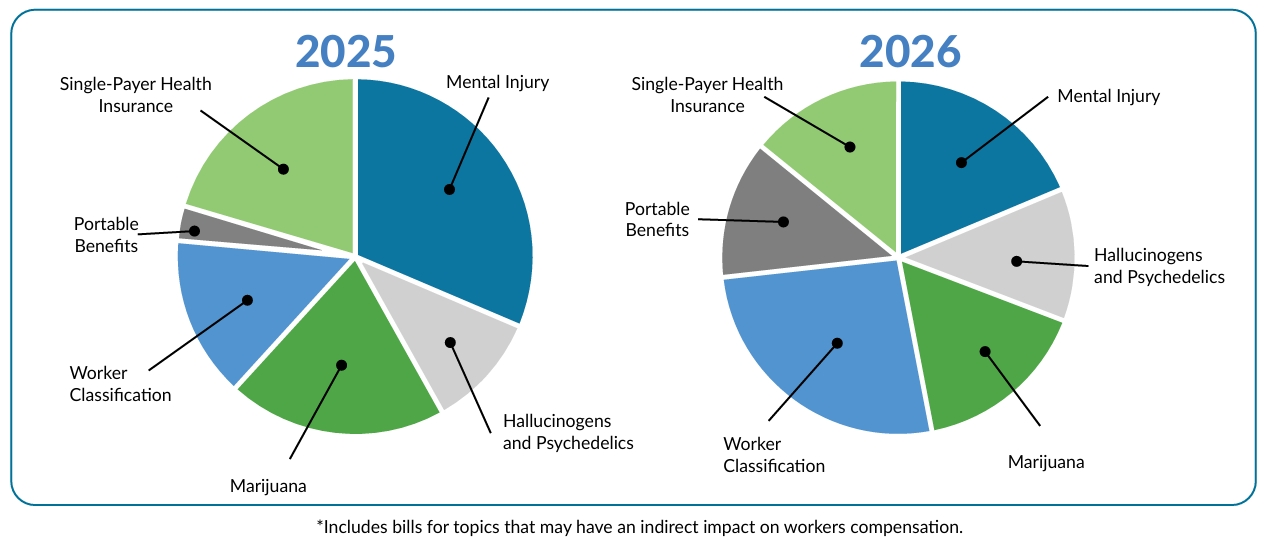
Source: National Council on Compensation Insurance
Portable Benefits Take Center Stage
Portable benefits, which attach coverage such as workers’ compensation, health insurance, retirement plans and paid leave to the worker rather than a specific employer, generated significant legislative activity this year, NCCI found.
States including Idaho, Kentucky, Louisiana, Mississippi, New Jersey, North Carolina, Rhode Island and West Virginia considered legislation to create portable benefit plans that specifically reference workers’ compensation, according to the report. Idaho, Louisiana and West Virginia’s H.B. 4009 have been enacted, while North Carolina’s H.B. 1083 and S.B. 445 remain pending in opposite chambers. Hawaii and Illinois considered portable benefit pilot programs, and Georgia, Kansas, New Hampshire and Wyoming enacted portable benefits bills without a workers compensation-specific component.
At the federal level, the “Modern Worker Security Act” (H.R. 1320) would ensure that providing portable benefits to a worker does not factor into determining employee status; that bill remains pending, NCCI said.
Mental Injury And Classification Debates Continue
Legislation addressing workplace-related mental injuries remained a persistent theme, with much of the 2026 activity focused on who qualifies for coverage, which conditions are covered and which practitioners can diagnose them, according to NCCI.
Virginia enacted H.B. 1313, making PTSD, anxiety disorder or depressive disorder claims compensable for law enforcement officers and firefighters without an accompanying physical injury, and separately enacted H.B. 29, extending certain incapacity benefits to a maximum of 104 weeks for those conditions. Minnesota enacted SF 3720, adding psychiatric mental health nurse practitioners to the list of professionals authorized to diagnose workers’ compensation-related PTSD.
Meanwhile, worker classification battles continued beyond portable benefits: Louisiana enacted H.B. 185, expanding the definition of independent contractor to include employees of independent contractors, and Oklahoma enacted S.B. 1944, broadening exemption criteria for independent contractors in agriculture, ranching or horticulture. NCCI also tracked continued activity around gig workers and health care worker platforms, noting that Rhode Island enacted bills (H. 7030/S. 2107) establishing a regulatory framework for health care worker platforms with classification criteria similar to independent-contractor models.
Marijuana, Psychedelics And Single-Payer Proposals Persist
Ten states, including California, Florida, Georgia, Hawaii, Massachusetts, Missouri, New Jersey, Rhode Island, Utah and Washington, considered legislation in 2026 to establish single-payer health insurance systems, with six of those states’ bills including a workers’ compensation component, according to NCCI. No state has fully implemented such a system, though Maryland enacted H.B. 1367, creating a commission to study a comprehensive health care system, including workers’ compensation’s role in it.
On marijuana, Georgia enacted S.B. 220, renaming low-THC oil as medical cannabis, while Oklahoma enacted H.B. 3127, maintaining that reimbursement for medical marijuana is not required under workers’ compensation while imposing a zero-tolerance policy for safety-sensitive positions.
Federally, the Justice Department and Drug Enforcement Administration announced an order in April 2026 placing FDA-approved and state-licensed marijuana products in Schedule III of the Controlled Substances Act, NCCI said.
On psychedelics, Colorado enacted H.B. 26-1325 establishing an ibogaine research pilot program, Tennessee enacted SB 2149 authorizing ibogaine clinical trials for opioid use disorder, and Utah enacted H.B. 390 authorizing a clinical study of psychedelic-assisted therapy for veterans with treatment-resistant PTSD.
Read more about the report here. &