Newsletters
 Risk Central
 Digital Edition
NY Construction Fatalities Remain Elevated as Enforcement Weakens and Disparities Persist
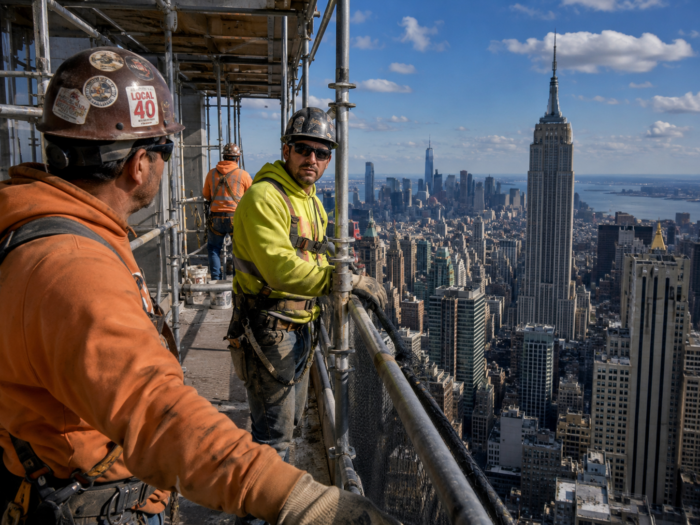
Fifty-five construction workers died on the job in New York State in 2024, which is a decline from the 74 fatalities recorded in 2023 but still elevated compared to earlier years in the decade, according to a report by the New York Committee for Occupational Safety and Health.
Between 2015 and 2024, at least 587 construction workers have died on the job statewide. The report draws on data from the Bureau of Labor Statistics, OSHA, the New York City Department of Buildings, and other sources to document fatality trends and the enforcement environment surrounding them.
Fatality Rates and the Non-Union Gap
Construction fatality rates declined modestly in 2024 but remain high, NYCOSH said. New York State’s rate fell from 10.4 per 100,000 workers in 2023 to 8.9 per 100,000 in 2024; New York City’s rate dropped from 11.6 to 9.4 per 100,000 over the same period.
By comparison, the overall worker fatality rate in New York City was 1.5 per 100,000 in 2024, meaning construction workers in the city were more than six times as likely to suffer a fatal workplace incident as the average worker citywide, the report found.
In New York City specifically, 19 construction workers died in 2024, down from 30 in 2023. Over the full 10-year period from 2015 to 2024, New York City averaged approximately 22 construction fatalities per year.
The report also highlights a persistent disparity between union and non-union worksites. NYCOSH analyzed 31 OSHA-investigated construction fatality cases in New York State in 2024 and found that 81% of the workers who died were non-union. The report attributes this pattern in part to unionized workers’ greater access to safety training, collective bargaining protections, and hazard-reporting mechanisms.
Latinx Workers and Immigrant Vulnerability
Latinx workers continue to die on the job at disproportionate rates, according to the report. While Latinx individuals represent an estimated 18.6% of New York State’s workforce, they accounted for 25.8% of all worker fatalities in 2024, the report found. NYCOSH noted that this disparity reflects broader patterns of dangerous job assignments, limited access to safety training, and weaker enforcement in sectors where Latinx workers are concentrated.
Fear of immigration enforcement has compounded these risks, the report said. Workers concerned about their immigration status may be less likely to report unsafe conditions, refuse hazardous tasks, or seek medical care following an injury, all of which can increase exposure to preventable harm, the report said.
Enforcement Trends Signal Growing Gaps
Several indicators in the report point to a weakening enforcement environment. OSHA conducted 3,162 inspections in New York State in 2025, a 7.3% decrease from 3,411 in 2024 and a 29.1% drop from pre-pandemic levels in 2019. Average OSHA fines in construction fatality cases fell to $25,295 in 2024, down from $32,123 in 2023 and the lowest figure since 2017.
OSHA press releases for the New York region — which the report describes as a tool for public accountability — dropped to just three in 2025, compared to 21 in 2019.
The report also found that in 77% of OSHA-investigated construction fatality cases in New York State in 2024, the worksite where a worker died had concurrent OSHA violations, yet no legal barriers currently prevent those employers from receiving public subsidies or government contracts.
The report recommended a range of actions, including statewide construction safety training mandates, expanded anti-retaliation protections for immigrant workers, stronger penalties under Carlos’ Law, licensing consequences for repeat offenders, and passage of the TEMP Act to address heat-related risks.
Obtain the full report here. &