Newsletters
 Risk Central
 Digital Edition
Judicial System Breakdown Fuels Epidemic of Litigation Abuse, Report Warns
The American Tort Reform Association (ATRA) has identified eight jurisdictions where litigation abuse has reached crisis levels, with fraudulent schemes and questionable verdicts inflating lawsuit costs to an estimated $367.8 billion annually across the U.S. economy, according to its 2025-2026 report.
The report identifies Los Angeles, New York City, South Carolina’s asbestos court, Louisiana’s coastal litigation venues, Philadelphia’s Court of Common Pleas, St. Louis, Illinois counties (Cook, Madison and St. Clair), and Washington state courts as the eight most problematic jurisdictions for litigation abuse.
“These jurisdictions are trial lawyers’ laboratories where they test novel liability theories and concoct new ways to sue,” said Tiger Joyce, president of ATRA. “Personal injury lawyers push abusive lawsuits in Judicial Hellholes that drain resources, unfairly punish small businesses, and reduce access to justice for everyone.”
Los Angeles earned the top spot following a $1 billion verdict in a single talc-mesothelioma case involving an 88-year-old plaintiff, which ATRA said signals an alarming pattern of nuclear verdicts that have become normalized in certain courts. The surge in nuclear verdicts extends beyond talc to asbestos claims, with the five courts most frequently handling asbestos filings all classified as judicial problem areas.
Illinois’s three counties alone accounted for nearly half of all asbestos filings nationwide last year, while South Carolina’s asbestos court has created “an international crisis” by exporting problematic litigation through corporate takeovers of domestic and foreign companies by court appointed receivers, according to ATRA.
ATRA attributes this concentration of asbestos filings to the reputation these courts have earned for favoring plaintiff claims and awarding substantial damages.
Beyond mass tort cases, fraud has infiltrated the litigation system itself, according to the report.
Courts in Los Angeles, New York City, and Philadelphia have become centers for schemes involving plaintiffs’ attorneys and medical professionals who collude to artificially inflate damages. Some cases have reached what the report terms “fraudemic” levels, with judges failing to discipline bad actors or enforce traditional procedural safeguards.
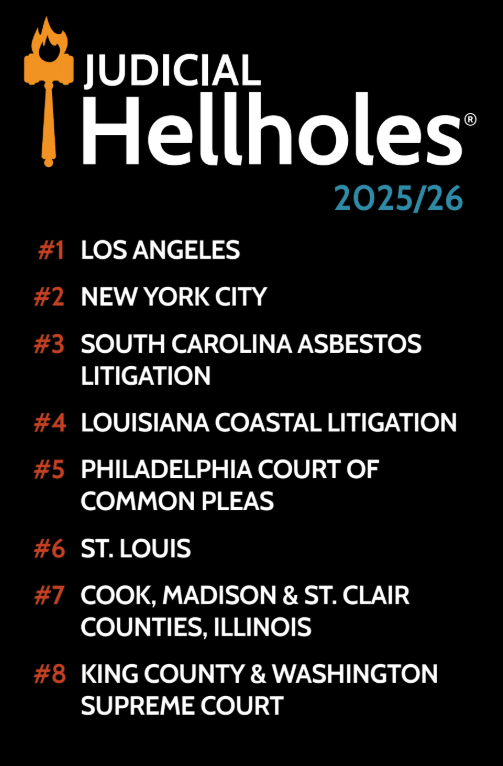
Source: American Tort Reform Association
System Failures Create Cascading Business Risks
The breakdown in judicial oversight has driven companies to turn to federal racketeering laws for protection—a drastic measure indicating fundamental systemic failure.
“Filing RICO suits to fight fraud is an absolute last-resort measure,” Joyce said. “When businesses have no other choice to protect themselves and expose fraud, it means there’s a fundamental breakdown—a failure of basic procedural rules and judges who fail to hold lawyers accountable.”
Small businesses face particular vulnerability, increasingly targeted by frivolous claims or technical violations under the Americans with Disabilities Act, particularly in the identified judicial problem jurisdictions. Meanwhile, agenda-driven science has infected litigation proceedings, with cases based on discredited research advancing despite scientific consensus to the contrary, according to ATRA.
Baby formula lawsuits in St. Louis and southern Illinois counties exemplify this trend, with claims proceeding despite concerns from the American Academy of Pediatrics about profound evidentiary problems, the report said. Similarly, litigation over maternal prenatal Tylenol use and autism has resurged after initial dismissal for cherry-picking dubious studies, revived by recent political commentary that contradicted established medical guidance.
Economic Consequences and Political Pressures Mount
Excess tort litigation costs translate to a hidden “tort tax” of $1,666 per American annually and contribute to the loss of approximately 4.8 million jobs across the country each year, according to ATRA.
Political involvement has further complicated litigation trends, with Texas Attorney General Ken Paxton’s pharmaceutical lawsuits potentially destabilizing what was once considered a model judicial system, earning Texas a spot on ATRA’s “watch list.”
Paxton’s October suit against Tylenol maker Kenvue, which invoked political slogans, has prompted concerns from reform advocates about turning Texas into a full-fledged judicial problem jurisdiction. The report also notes that Paxton has awarded lucrative state contracts to trial lawyers handling his litigation efforts.
For more detail on the eight jurisdictions, view the full report here. &