Newsletters
 Risk Central
 Digital Edition
Global Leaders Brace for Turbulent Decade as Competition Eclipses Cooperation
The consensus among global leaders and experts is increasingly grim: a new competitive order is displacing decades of international cooperation, creating cascading risks that threaten economic stability, technological governance and democratic institutions, according to the World Economic Forum’s Global Risks Report 2026.
Geoeconomic Confrontation Replaces Multilateral Frameworks
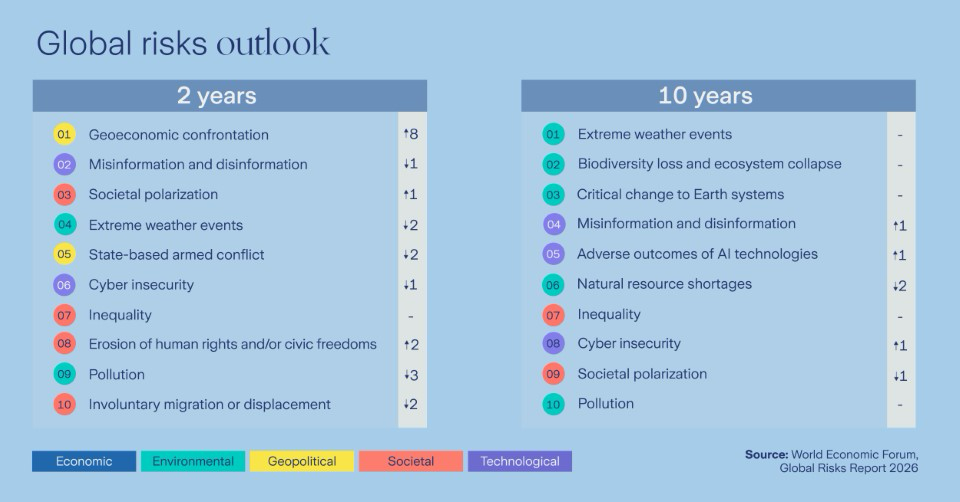
For the first time, geoeconomic confrontation has emerged as the single greatest risk facing the world over the next two years, and also was selected by 18% of respondents as the most likely trigger for a material global crisis in 2026. This represents a dramatic shift in global dynamics, with governments increasingly turning inward and abandoning multilateral frameworks that have underpinned international stability since World War II, the report noted.
The retreat from multilateralism reflects a broader pattern of declining trust, protectionism and strategic competition, particularly around critical supply chains and economic weaponization.
“Deepening divisions are at the center of the societal risks we all now face, from social fragmentation and inequality, to declining health and wellbeing. Despite the growing severity of these global risks, major governments are moving away from many established frameworks designed to tackle our shared challenges. As a result, divided societies are being driven closer to the brink of social instability and increased conflict,” said Andrew George, president, Specialty for Marsh Risk. Marsh and Zurich partner with the WEF on the global risks report.
State-based armed conflict follows as the second-highest concern for 2026 at 14%, signaling leaders’ fears that rising geopolitical tensions could destabilize entire regions. The interconnected nature of modern economies means such conflicts carry far-reaching consequences beyond their borders, threatening supply chain stability and amplifying economic fragmentation.
Meanwhile, 68% of respondents now describe the emerging global political environment as a multipolar, fragmented order in which competing powers contest rules and norms, compared to only 6% who expect a return to the previous rules-based international order, the survey found.
Economic Risks Surge as Uncertainty Dominates
Economic concerns have registered the sharpest increases in severity rankings over the two-year outlook, with economic downturn (No. 11) and inflation (No. 21) rising eight positions each. Asset bubble risks climbed seven positions to No. 18 as mounting debt burdens, volatile markets and potential economic bubbles threaten stability.
According to Saadia Zahidi, Managing Director at the World Economic Forum, “mounting debt sustainability concerns coupled with potential economic bubbles – in a context of rising geoeconomic confrontation – could herald a new phase of volatility, potentially further destabilizing societies and businesses.”
The concentration of wealth fueling permanently bifurcated economies creates additional pressures, according to the WEF report. With cost-of-living pressures remaining elevated while inequality deepens, the social contract between citizens and governments is fracturing. Respondents identified inequality as the most interconnected global risk overall, meaning it triggers and amplifies multiple other risks across economic, social and political domains.
Technology Accelerates Risks While Environmental Concerns Fade
Technological advancement presents a paradox: while innovation offers transformative benefits, it simultaneously generates acute risks, the report said. Misinformation and disinformation ranks second in severity among two-year threats, while artificial intelligence adverse outcomes shows the sharpest increase in concern when comparing short-term versus long-term risks—jumping to position 5 over the decade-long outlook from position 30 a year ago.
Notably, environmental risks have been deprioritized in the near term outlook despite remaining critical long-term concerns, according to the report. Extreme weather events dropped to fourth position from second in the two-year outlook, while pollution fell to ninth from sixth.
However, environmental risks retain their status as the most severe long-term concerns, with extreme weather events topping the 10-year risk list and comprising half of the top 10 long-term risks. These include: biodiversity loss and ecosystem collapse, critical change to earth systems, natural resource shortages and pollution.
“Despite extreme weather, cyberattacks and geopolitical conflicts posing escalating threats, disruptions to critical infrastructure ranked just 23rd among global risks for the next decade,” said Peter Giger, group chief risk officer for Zurich. “This is a dangerous oversight. From power grids strained by record heat to coastal cities at risk from rising seas, we rely on systems that are underprepared and underfunded. When infrastructure fails, everything else is at risk. We must recognize how interconnected these threats are and invest now to strengthen resilience before the next crisis hits.”
Obtain the full report here. &