Newsletters
 Risk Central
 Digital Edition
2026 Theo Award Winner: MacDonald-Miller Facility Solutions
 Lee Pyfrom will be the first to tell you he was skeptical.
It was about eight years ago at a regional safety conference, and a chiropractor was presenting on how muscle rolling could reduce back strains. Pyfrom, Director of Safety at MacDonald-Miller Facility Solutions in Seattle, heard the topic and nearly headed for door.
“I almost walked out of the presentation,” he says. “I wasn’t going to buy it.”
He stayed. And what happened next changed how he thinks about injury prevention.
The presenter handed everyone in the room a muscle roller and walked them through a simple sequence: roll out your calves, your hamstrings, your IT bands. Ten seconds on the outside, ten seconds in the middle, ten seconds on the inside, then switch legs. Then he asked everyone to touch their toes — or try to — and remember how far they’d reached. After the rolling, he asked them to try again.
“He said, raise your hand if your flexibility increased after rolling out your legs,” Pyfrom recalls. “Sure enough, all the hands went up. I increased my flexibility by about two and a half inches. I was instantly 100% bought in. This wasn’t a snake oil salesman. This was practical, and it worked on me.”
He went back to his leadership and asked to buy rollers for the shop.
“I said, if we save one back strain a year, this pays for itself,” he says. “One back strain, and we’re done.”
Proving It on the Shop Floor
At MacDonald-Miller — a mechanical systems contractor whose field teams perform physically demanding HVAC, plumbing, and building automation work — back injuries are the most stubborn source of recordable claims. Muscle strain and overexertion are the top culprits, and back injuries carry costs that ripple well beyond the workers’ compensation claim itself.
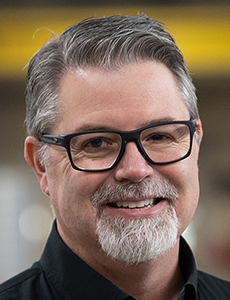
Lee Pyfrom, Director of Safety, MacDonald-Miller Facility Solutions
Pyfrom started where he always starts with safety innovations: the shop, a controlled environment where he could observe and adjust. He pulled in small groups of five — leading them through the same demonstration the chiropractor had run — and watched the reactions play out exactly as his had.
“People were like, ‘Oh my God, Lee, what are you having us do now?'” he says. “And I’m kind of laughing. I’m like, ‘I know, I know. I was in your shoes. Just hear me out.'”
By the end of most sessions, the skeptics had become converts. Some were asking how to buy rollers for their families.
MacDonald-Miller incorporated the Tiger Tail 18″ Original muscle massager — a handheld rolling tool designed for myofascial release — into its existing pre-shift Stretch and Flex program. Within a couple of years, the shop went from averaging two or three back strains annually to zero.
Then COVID hit. And a back strain appeared.
Pyfrom investigated. It turned out the team had quietly dropped the muscle rolling routine during the pandemic — hygiene concerns had made people reluctant to share the rollers. His fix was immediate and simple: he issued individual rollers to every shop employee.
“We took the excuse away,” he says. “They only had to use theirs.” The shop returned to zero.
Scaling Without Losing the Thread
The program has since expanded to MacDonald-Miller’s service technicians, who work in the field on commercial building systems and were, as Pyfrom notes, a more naturally receptive group. Results have been similarly strong — back strains down dramatically across that population as well.
Getting buy-in, Pyfrom has learned, depends less on authority and more on finding the right people.
“In any new policy or procedure, you gather the stakeholders — the gatekeepers,” he says. “They’re not necessarily the managers. They’re the people that others follow. If they say this won’t work, the crew won’t follow. If they say yes, the crew will follow. Find those gatekeepers. Get them on board. Teach them why this matters.”
He tells a story about a training session on a construction site where one veteran worker sat with his arms crossed, visibly unimpressed. A younger woman next to him turned and said, unprompted: “And you wonder why you feel terrible every day — it’s because you’re not willing to try stuff like this.” Pyfrom didn’t have to say a word.
The rollout has been supported by a partnership with Tiger Tail, a local women-owned business in the Seattle area. The company produced instructional videos — now hosted on MacDonald-Miller’s internal YouTube channel — and created posters with QR codes linking directly to the footage, placed at service tech supply stations throughout the company. Employees can pull up the video on their phones in seconds.
“Now we don’t have to go to every single crew and teach them how to do it,” Pyfrom says. .
Simple Solutions, Real Results
The numbers over the past several years reflect what Pyfrom observed informally long before he had the data to confirm it. Recordable injuries fell dramatically — from multiple claims per year to just one in a four-year span. The company has generated substantial savings, with each injury prevented representing thousands of dollars in avoided costs.
And the tool that drove it costs about $40.
“How many of these can you buy for the cost of one back strain?” Pyfrom says. “It’s cheap. It’s a one-time purchase. And it’ll take five minutes at most, pre-shift, to implement.”
He’s tried to convince other companies in the industry to give it a try. Most haven’t taken him up on it yet.
“I am not a salesperson. I get no benefit from Tiger Tail,” he says. “This is just a safety person who found something that works. And I don’t know any industry that wouldn’t benefit from this.”
He’s been in safety for 23 years. He’s implemented programs of every variety, from complex behavioral systems to multi-site process overhauls. When asked what stands out, his answer is immediate.
“This implementation has been probably the most successful of my career,” he says. “And it’s probably one of the simplest.” &

 The Theo Award celebrates its sophomore year, honoring 28 workers’ compensation programs for their excellence and service to workers across the nation. To learn more about the award and amazing qualities each winner possesses, visit here.