Newsletters
 Risk Central
 Digital Edition
Three Green Technologies Creating New Property Risks — and How to Manage Them
The push toward sustainability has transformed how buildings are designed, powered, and constructed. Solar panels now adorn rooftops across the country. Electric vehicles and e-bikes have become commonplace in parking structures and apartment buildings. Mass timber construction has grown into a roughly $4 billion industry expected to more than double in size over the next seven to ten years.
While these green technologies offer clear environmental benefits, they also introduce property risks that many building owners and risk managers have yet to fully address.
“Munich Re defines green tech as technologies that allow us to move away from fossil fuels for power—really, anything that’s ecologically sound from an energy-producing or resource-using standpoint,” said Ed Leibrock, Head of Corporate Property at Munich Re F&C, North America. “All three of those are great green technologies and really wonderful for the environment, but they bring along extra property hazards with them.”
Understanding these emerging risks — and implementing effective mitigation strategies — has become essential for property owners, risk managers, and insurers navigating the transition to sustainable building practices.
The Hidden Hazards of Going Green
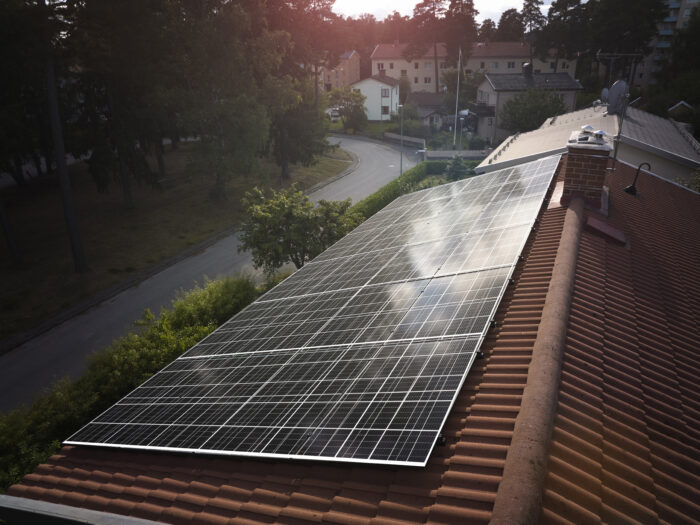
Solar panels present multiple challenges that extend beyond their environmental benefits. Firefighters face significant obstacles when responding to fires in buildings with rooftop solar installations.
“One of the biggest challenges is that many times firefighters themselves don’t want to fight the fire because solar panels are constantly energized and therefore can be hazardous,” Leibrock said. “There’s really no way to de-energize a solar panel.”
When fires reach rooftops with solar panels installed, the situation can deteriorate rapidly. The gap between the roof surface and the panels creates what Leibrock described as a chimney effect, allowing flames to spread laterally at an accelerated rate. Additionally, solar panels prevent firefighters from ventilating the roof — a standard tactic for removing smoke so crews can safely fight fires from inside a structure.
Rather than refusing to respond, firefighters typically adapt their approach when solar panels are present. “If they really see that there’s an issue with solar panels, they work on containing it and avoid going anywhere near fighting the fire in contact with those solar panels,” Leibrock said. “Sometimes it’s like a sort of controlled burn in the area where there’s solar panels, and they’re trying to put out the fire everywhere else.”
Installation quality introduces additional concerns. Solar panels add considerable weight to roofs, requiring proper engineering to ensure structural integrity. Installers must also secure panels against high winds while avoiding water intrusion from mounting hardware that penetrates the roof membrane.
Electric vehicles, e-bikes, and scooters present a different but equally pressing set of property risks. Lithium-ion batteries powering these vehicles are known for their potential to experience thermal runaway events — essentially, explosive fires that are extremely difficult to extinguish.
“The issue with electric vehicles, and that goes for everything from cars to e-bikes and scooters, is simply that the batteries are a pretty volatile item,” Leibrock said.
The proximity of these vehicles to buildings compounds the risk. EV charging stations are often positioned in prime parking spots adjacent to structures. Electric vehicles frequently park in garages beneath buildings. Meanwhile, residents routinely bring e-bikes and scooters into apartments and homes for charging.
Mass timber construction introduces a third category of emerging property risk. This engineered wood product — created by laminating and gluing multiple pieces of timber together — has gained popularity among architects for its ability to span large distances and create striking open spaces where the wood grain itself serves as a decorative element.
The aesthetic nature of mass timber creates unique challenges when damage occurs. Unlike a charred steel beam that can simply be scraped and repainted, damaged mass timber loses its decorative value.
“The wood and the wood grain is the decorative element to it,” Leibrock said. “So you don’t really scrape that down and paint it. I mean, that’s the only way you could cover it up, but that eliminates the aesthetic value to it. So there’s definitely a coverage question there as to whether the — what I’ll call cosmetic damage — is covered in a property policy.”
Additionally, because mass timber buildings are assembled similarly to post-and-beam construction, replacing a single damaged member in a multi-story structure presents significant logistical challenges when the rest of the building remains structurally sound.
While industry efforts have resulted in resins and glues that do not significantly increase flammability, mass timber remains more combustible than steel or concrete alternatives. Repair costs also differ from new construction economics.
“It’s a little bit cheaper to build, but from what we can tell, it’s not cheaper to repair,” Leibrock said. “It is cheaper to replace if it burns to the ground, but it is not cheaper to repair. And most losses are not full losses. They’re partial losses.”
Protecting Properties from Solar and EV Risks

Ed Leibrock, Head of Corporate Property at Munich Re F&C, North America
For solar panel installations, Leibrock emphasized the importance of engaging qualified professionals. “Investing in a qualified contractor and an engineer is definitely something that every risk manager or property owner should be taking into account — not just taking the lowest bid to get them installed,” he said.
Material selection also matters. Some solar panels incorporate plastics that increase fire risk, while others utilize steel or aluminum construction. Property owners should evaluate these differences when specifying equipment.
Perhaps most significantly, Leibrock recommended reconsidering rooftop installation entirely when alternatives exist. “Putting them on the roof, while it seems like a great idea, causes a number of potential problems with the actual building itself,” he said. “A much better idea, if you have the space in the parking lot, is to put them over the cars. It’s probably a better deal at the end of the day for you as far as risk goes.”
For electric vehicles and their smaller counterparts, spatial separation serves as the primary defense. “We recommend 100 feet of clear space between a building and an EV charging station,” Leibrock said. “That’s a very good fire break.”
When charging infrastructure must be located within or beneath buildings, fire-rated enclosures become essential. “We like to see a three-hour rated wall separating them from the remainder of the building,” Leibrock said. “That’s pretty common to see with the scooters and bikes because it’s pretty easy to create a dedicated room and just put three-hour rated drywall up and a nice steel self-closing door.”
Even concrete podium structures beneath buildings, while acceptable, are not ideal. Intense heat from EV fires can weaken concrete and compromise structural integrity.
The adoption of fire-safe rooms has accelerated in major urban markets. “I work in New York City, and almost every building that’s been redone in the city has created a fire safe room for EVs, bikes, and scooters because people are taking them to work,” Leibrock said. “They’re either building a room, or they have a policy that strictly disallows them from coming into the building.”
Managing Mass Timber Exposures
Mass timber’s appeal lies in its exposed beauty, but Leibrock noted that encapsulation offers meaningful risk reduction. “If you actually encapsulate it in drywall, that very much helps the fire rating of the building and diminishes the spread of fire,” he said. “So while it’s a beautiful element, if you don’t have to show it, covering it up isn’t such a bad idea.”
A balanced approach can preserve aesthetics where they matter most while protecting other areas. “I’ve seen a few buildings where they might leave part of it exposed because it’s a key element to, let’s say, their main boardroom or something like that,” Leibrock said. “And then the other parts of the building where it’s just the offices, they will encapsulate it.”
For areas where mass timber remains exposed, minimizing nearby combustible finishes and fire exposures near main structural members becomes critical. Sprinkler systems provide additional protection by delivering water quickly to prevent fire spread across the wide-open spaces that mass timber construction enables.
The industry continues working to better understand mass timber fire behavior. A group including industry participants and government agencies from both Canada and the United States is preparing to conduct a full-scale fire test of mass timber buildings within the next year or so.
As green technologies continue reshaping the built environment, understanding their associated property risks allows owners and risk managers to capture environmental benefits while protecting their investments. “These are great technologies,” Leibrock said. “But if you’re going to bring them into the building, you need to find a really good way to design the system to contain them.” &