 Newsletters
 Risk Central
 Digital Edition
The ‘60 Tips’ Toolbox: Wisdom From Across the Industry
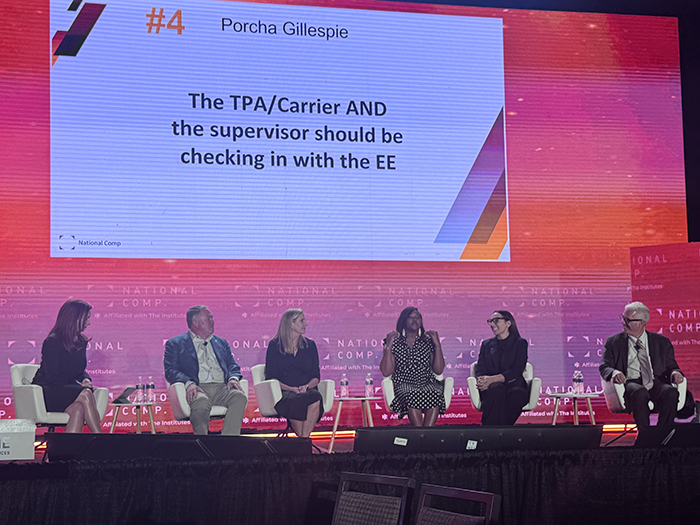
At National Comp 2026, the perennial favorite “60 Tips in 60 Minutes” featured a top-notch panel from across the industry. This year’s theme, “Turbocharged Claims Closure: 60 Tips for Moving Workers Through the System Faster” was a rapid-fire masterclass in removing obstacles to shorter claim duration, from the first phone call to the final settlement. Every seat at the table was represented: TPA, carrier, employers, physician and the bench.
Here’s just a sliver of what the panel brought to the table this year from their first-hand experiences — one standout tip from each panelist. This is just 10% of what attendees brought home this year, with the bonus of a whole lot of laughter.
1. Complexity Doesn’t Always Announce Itself
Jennifer Cogbill, Senior Vice President, GBCARE Advisor Team, Gallagher Bassett
When most people picture a complex claim, they picture a catastrophic injury, a life flight, a call to 911. Cogbill says that’s rarely how complexity shows up. More often, a back or soft tissue injury that could have been managed conservatively gets mismanaged, and four years later it’s a permanent disability with multiple surgeries on the books. She points to an aging workforce, younger workers facing challenges the industry didn’t see before, and part-time employees who may lack group health coverage or have uncontrolled conditions. Her answer is to pair data with people: use analytics to flag risk early, then have humans evaluate the whole person. “We’re not fixing refrigerators. We’re fixing people.” Technology can’t hand you the problem on its own, she said. “It’s a combination.”
2. Show Your Math
Mark Walls, Chief Marketing Officer, Safety National
Nothing makes Walls crazier than hearing “we don’t want to make an offer, we’re waiting for a demand.” The assumption is that the plaintiff attorney might undervalue the claim. “No, they won’t. They know the value of the claim. So do you.” His advice is to take the initiative, make a fair offer and put your reasoning on the table. “Show your math. It’s like grade school homework. Show your work.” Walls, whose company works with high-deductible, self-insured employers on large, complex risks, added that you don’t have to wait until MMI to open settlement conversations. Starting the conversation yourself keeps the claim moving.
3. How You Say “No” Matters
Denise Algire, Former Director of Health, Albertsons Companies
A claim that isn’t compensable doesn’t go away just because you’ve said no. The employee is still there and still worried, and Algire notes this is a classic driver of litigation. Her strategy, which she learned from another employer and adopted as her own, is to talk to the employee first. You must still follow your jurisdiction’s legal documentation requirements, but alongside that paperwork goes a cover letter explaining the decision in layman’s terms, and someone walks the employee through it before it’s sent. That same conversation connects them to group health, EAP or other resources. “How you say no is important,” she said. The result is a soft landing for someone who is still part of your workforce.
4. Check In Twice
Porcha Gillespie, Sr. Manager, WC Claims, Sunbelt Rentals, Inc.
Injured workers who hear only from the TPA or carrier can quietly lose touch with the supervisor they work for. Then the doubts start. They begin to feel that maybe they shouldn’t return, because no one seems to care whether they do. Gillespie calls that the number one way to send a worker to an attorney, and she notes that much of return to work is mental. Her fix is for both the TPA or carrier and the direct supervisor to check in with the employee. “We have to make sure that the injured workers understand that as their employer, we care about you just as much as our TPA and carrier care about you.” Everyone, she says, should be visibly invested in getting the worker back to daily life and back on the job.
5. Find the Worker’s ‘Why’
Dr. Jill Rosenthal, Chief Medical Officer, Concentra
Rosenthal’s own “why” is her four children. For someone else, it might be playing in a band or fishing with friends. Her tip is to find out what drives each worker and aim recovery at it. “What makes them want to get better?” she asked. “Let’s get you there. How are we going to get you there? Let’s do this together.” It moves the conversation from compliance to partnership, and it depends on how clinicians communicate. “It’s how you message everything… It’s getting to know the patient in front of you.” Moderator Stuart Colburn offered a real-world example: the worker with a tough job who’d rather be back on the Harley. Get them functional enough to ride, and they can come back to work too.
6. What Are You Fighting About?
Hon. Robert Rassp, Presiding Judge, Work Comp Appeals Board, Los Angeles District Court
Rassp oversees 18 judges in downtown Los Angeles, and he sees disputes that start long before anyone reaches a courtroom. “We get cases all the time where the claims administrator is denying that the injured worker was even employed.” He describes a significant lack of discovery and adds, “we rarely see adequate initial investigation of claims.” The consequences compound: “It seems that these things keep going on their own momentum, almost like a snowball going downhill and collecting more snow as it hits the ground.” His message to employers is to talk with your claims administrator early, understand how your coverage works and discuss causation as soon as possible. Some employers, he noted, wrongly assume a claim will get them canceled or surcharged, as with auto insurance.
Each year, National Comp presents 60 Tips in 60 Minutes, bringing together six experts from diverse roles across the industry to share their top lessons learned. It’s a lively mix of banter, dozens of actionable takeaway, and laugh out loud moments — the very best in learning with laughs! Join us next year at National Comp to experience it in person. &
2026 Attendees: Don’t forget! 2026 Premium Attendees still have until Nov. 30, 2026 to revisit the audio and slides of this session via NoteAffect, in the conference app or online.