Newsletters
 Risk Central
 Digital Edition
Natural Catastrophe Insured Losses Exceed $100 Billion for Sixth Straight Year
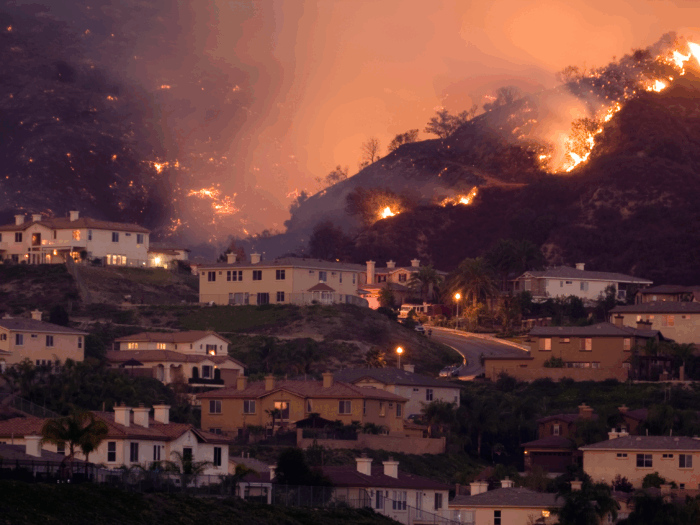
Insured losses from natural catastrophes reached $107 billion in 2025, marking the sixth consecutive year above the $100 billion threshold despite a 24% decline from 2024’s $141 billion, according to Swiss Re Institute.
The 2025 loss total was dominated by two primary perils: wildfires and severe convective storms, according to Swiss Re.
The Los Angeles wildfires in the first quarter became the costliest wildfire event in global history, generating $40 billion in insured losses alone. This unprecedented destruction resulted from a dangerous combination of extended hot, dry weather conditions and powerful winds colliding with increased development in wildland-urban interface zones where residential properties meet fire-prone landscapes, the reinsurer said.
Severe convective storms contributed an additional $50 billion to global insured losses, making 2025 the third costliest year on record for this peril after 2023 and 2024. The U.S. experienced intense tornado outbreaks in March and May, driving above-average tornado and wind reports, though hail remained near normal levels. In Europe, notable hailstorms struck in May and June, but losses stayed limited because the most severe activity hit areas with lower concentrations of valuable property.
Meanwhile, the Atlantic hurricane season proved unusually benign for insurers despite significant storm activity, Swiss Re said. Hurricane Melissa, which struck Jamaica in October as a Category-5 storm with winds near 185 mph, became the season’s costliest event with estimated insured losses up to $2.5 billion. However, for the first time in a decade, none of the season’s 13 named storms made landfall on the U.S. coast, keeping hurricane-related insured losses relatively low.
Growing Exposure Amplifies Loss Potential
The persistent upward trajectory in natural catastrophe losses reflects fundamental changes in risk exposure rather than temporary anomalies, according to the report. The U.S. alone accounted for 83% of global insured losses at $89 billion, driven primarily by expansion of high-value residential assets into hazardous areas and increased asset values in storm-prone regions.
“We are observing a steady rise in losses from severe convective storms,” said Balz Grollimund, Swiss Re’s head catastrophe perils. “Urbanization in hazard-prone areas, rising asset values, higher construction costs and factors such as aging roofs have made these storms a key peril for insurers.”
The challenge with severe convective storms lies in their cumulative impact, the report noted. While individual events rarely produce catastrophic insured losses, their frequency combined with rising property values and repair costs creates substantial aggregate exposure that requires insurers to adopt a more comprehensive approach to underwriting and risk management.
Prevention and Preparedness Take Center Stage
The continuing pattern of elevated losses underscores the critical need for enhanced risk mitigation strategies.
Jérôme Jean Haegeli, Swiss Re’s group chief economist, emphasized that “strengthening prevention, protection and preparedness is essential to protect lives and property,” with reinsurers serving dual roles as both financial shock absorbers and supporters of resilient, risk-informed public policy and private investment.
The effectiveness of such preparedness was demonstrated in July when an 8.8 magnitude earthquake struck off Russia’s eastern coast near the Kamchatka Peninsula, becoming the sixth-largest recorded earthquake since 1900.
The Pacific Tsunami Warning System successfully coordinated early warnings that protected at-risk populations through evacuations and alerts, while city planning reforms based on previous events minimized destruction to Russian coastal communities. The response highlighted how early warning systems and adaptive infrastructure planning can dramatically reduce loss of life and property damage.
Southeast Asia experienced severe flooding in November affecting Vietnam, Thailand and Indonesia, where multiple cyclonic systems interacting with an intensified monsoon under La Niña conditions created devastating combinations of rain, landslides and flash floods across the region.
View the report here. &