Newsletters
 Risk Central
 Digital Edition
Drivers Report Worsening Road Conditions as Distraction, Aggression and Recklessness Climb
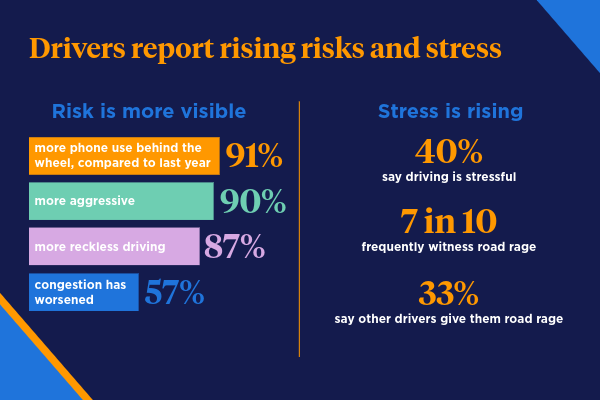
Nine in 10 consumers say other drivers are looking at their phones more often than they were 12 months ago, while 90% describe fellow motorists as more aggressive and 87% call them more reckless, according to the 2026 Nationwide Agency Forward Driving Behaviors Survey.
Commercial drivers echoed those sentiments with even sharper year-over-year increases — 77% said passenger vehicle operators are more distracted, a 10-percentage-point jump from 2025, and 74% said those drivers do not operate safely around commercial vehicles, up 15 points from the prior year.
The survey, fielded in January 2026, drew responses from 1,005 general consumers, 400 parents of teen drivers and 400 commercial drivers who operate a vehicle as a core job responsibility.
“Driving no longer feels as predictable or routine as it once did,” said Mark McGhiey, commercial risk management leader at Nationwide. “Many describe a road environment with more distractions, more tension and less trust in the people around them. These conditions are particularly concerning for company drivers as many worry about the threat of accidents, injuries and the ripple effects on future employment opportunities.”
Source: Nationwide
Stress, Road Rage and Their Implications for Loss Frequency
The deteriorating driving environment is taking a psychological toll that could translate into higher claims activity, Nationwide said. Forty percent of consumers said driving is stressful, and a third reported that other drivers give them road rage. Among commercial drivers, the numbers were starker: 47% said they are often stressed behind the wheel, 43% reported frequent frustration and 27% said they feel enraged while working.
The primary triggers for road rage among consumers included tailgating (38%), failure to use turn signals (32%) and aggressive speeding or weaving through traffic (32%), the survey found. Commercial drivers pointed to distracted driving and aggressive speeding (each at 29%) along with being cut off (27%) as top catalysts for their anger on the job.
Poor weather, distracted drivers on the road and traffic congestion ranked as the most concerning situations for commercial drivers, cited by 53%, 50% and 47%, respectively. Six in 10 expressed concern about aggressive drivers causing an accident, and 55% worried about being involved in a crash that could affect future employment opportunities, according to the report.
Despite two-thirds of commercial drivers saying their employer treats driver training as a top priority, three-quarters said they would still be interested in a defensive driving course offered by their employer or the employer’s auto insurer — a potential risk mitigation lever for fleet managers and their insurance partners.
Teen Drivers and Micromobility Add Layers of Exposure
Concern about teen drivers remains acute, according to the report. Only 12% of consumers rated teens’ driving as very good or excellent, and even parents gave that rating to fewer than half of their own children. Eighty-four percent of consumers and 85% of parents agreed that teens today are more distracted than other age groups, and roughly seven in 10 in each group said teens are less safe than previous generations, the survey found.
The rise of micromobility vehicles is compounding the risk picture, Nationwide said. Teens are far more likely than the general population to own or operate e-bikes (28% vs. 17%) and electric scooters (38% vs. 12%). Meanwhile, 86% of consumers and 82% of commercial drivers expressed concern about safety risks associated with these vehicles. Large majorities across all audiences agreed that insurance policies should evolve to provide clearer coverage for micromobility on public roads and that communities need better infrastructure to support safe use.
Autonomous Vehicle Concerns Signal Emerging Liability Questions
Autonomous vehicles present another area of uncertainty for risk professionals, the survey found. Only 32% of consumers said they are comfortable with the idea of fully autonomous vehicles on roads within five years, compared with 59% of commercial drivers. Still, most respondents across all groups said the technology needs significant improvement before mainstream deployment.
Liability questions loom large. Among consumers, 41% said the vehicle manufacturer should bear responsibility when an autonomous vehicle causes an accident, while 29% pointed to the human driver. Commercial drivers were less decisive — 29% assigned liability to the manufacturer and 27% to the insurance company. Notably, only 60% of commercial drivers expressed confidence that their company’s auto insurance would cover an accident involving an autonomous or semi-autonomous vehicle, the report found.
Meanwhile, 75% of commercial drivers said they are concerned about fully autonomous commercial fleets sharing the road, and 52% worry their jobs will eventually be replaced by the technology.
Obtain the full report here. &