Newsletters
 Risk Central
 Digital Edition
Sponsored: Liberty Mutual Insurance
7 Construction Technology and Risk Management Questions for Amy Gross of Liberty Mutual
In August 2026, Risk & Insurance caught up with Amy Gross, General Manager, North America Construction, Global Risk Solutions, Liberty Mutual. What follows is a transcript of that discussion, edited for length and clarity.
Risk & Insurance: In what aspects of construction risk management is AI having the most positive impact?
Amy Gross: AI is already having a positive impact in several practical areas of construction risk management. The biggest shift is that it helps move the industry from a reactive to a more proactive model. Historically, we identified issues after an inspection, a near miss, or — worst case — after a loss. Now AI can help detect conditions earlier, prioritize the highest-risk exposures, and support intervention before an event occurs.
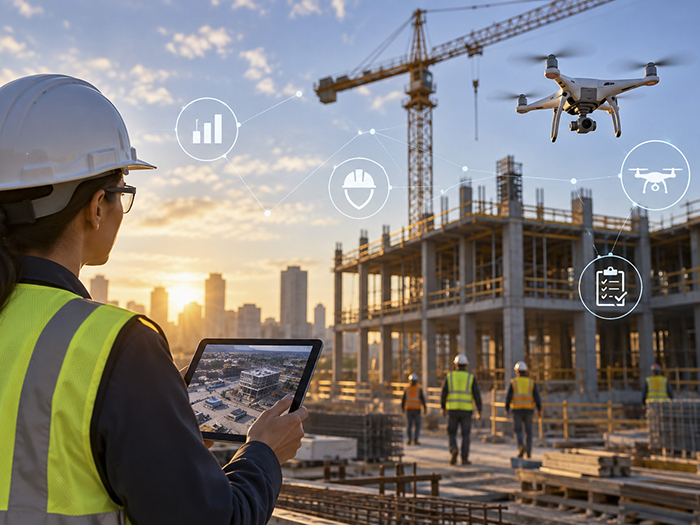
A clear example is job site safety and hazard recognition. AI-enabled computer vision can help identify unsafe conditions such as fall exposures, equipment interaction risks, unauthorized access, mismanaged or missing PPE, or other hazards that may not be caught consistently through manual observation alone. We’re seeing value from real-time monitoring, cameras, wearables, drones, robotics, and sensors that generate continuous field data, giving safety teams earlier visibility into developing risks and allowing them to respond more quickly.
AI can also support quality control and construction defect prevention. Imagery, digital twins, and AI-supported inspections can help identify installation issues, deviations from specs, or incomplete work earlier in the project lifecycle.
The key point is that AI is not replacing the basics of construction risk management. Strong pre-planning, hazard recognition, field supervision, quality control, and claims documentation still matter. AI simply makes those fundamentals more scalable, more consistent, and timelier by turning fragmented job site information into actionable insight.
R&I: How are trends in data analytics improving loss control and risk mitigation in construction?

Amy Gross, General Manager, North America Construction, Global Risk Solutions, Liberty Mutual
AG: Data analytics is improving loss control by helping construction firms connect information that has historically lived in separate places. Job site observations, incident history, schedules, work activity, weather, inspections, and operational data can together reveal patterns that point to increased risk.
The real value is that it’s predictive. If analytics can show that certain projects, tasks, trades, or conditions are trending toward higher risk, firms can allocate resources earlier. That may mean adding safety oversight, adjusting sequencing, addressing quality concerns, or reinforcing controls before a loss occurs.
Data also helps when a claim does happen. Better capture of photos, videos, site monitoring, and digital records can help establish what happened, what controls were in place, and what evidence exists to support the best possible outcome after a loss.
R&I: How are drones being used in assessing safety and risk on construction sites?
AG: Drones are probably more common today in property inspections, but they have meaningful applications in construction as well. One of the biggest benefits is access. Drones can help observe areas that are more difficult, expensive, or unsafe for people to reach directly — for example, roofs, facades, upper floors, or restricted-access areas where entry may be limited because of fall protection requirements or because only certain trades are permitted in that space.
They can also help monitor site progress, support scheduling decisions, and contribute to digital twin models that may later be useful for owner-operators. From a risk management standpoint, the value is improved visibility. Drones can help identify quality issues, safety concerns, or project conditions that may otherwise be harder to see in real time.
That said, drones need to be managed thoughtfully. A drone safety program is critical to ensure they are operated safely, consistently, and in compliance with applicable requirements. Drone technology can be very helpful, but it needs the right governance around it.
R&I: What digital platforms are construction firms using, and are they having any measurable impact on operations and risk management?
AG: Construction firms are using a wide range of digital platforms today — from construction and project management systems to dedicated environmental, health, and safety (EHS) platforms. What’s notable is that these tools are increasingly integrating AI and analytics, which allows firms to look across productivity, operations, quality, and safety in a much more connected way.
The most important development is the move toward shared data ecosystems. Instead of having contracts, audit forms, job site observations, schedules, safety records, and quality documentation live in silos, firms can bring that information together and use AI to extract insights from all of it.
It can help general contractors select lower-risk subcontractors, keep work on schedule, manage resources more effectively, and surface concerns before they become larger issues. And that matters for risk. Delayed or rushed work, overtime, poor communication, and quality issues can all create downstream safety and claims concerns. If technology can help firms anticipate and manage those pressures earlier, it improves both the operational and the risk outcome.
R&I: What risks does the use of AI bring up for construction firms?
AG: AI creates meaningful opportunities, but it also introduces new risks that construction firms need to manage carefully. One area is privacy and workforce monitoring. Wearables, cameras, biometrics, location tracking, and job site monitoring tools can collect sensitive information about workers and site activity. Firms need to be thoughtful about what data they collect, how it’s used, who has access to it, and — most importantly — how it’s protected.
Another area is intellectual property. Construction firms have proprietary engineering drawings, designs, models, and project documents. If an AI system is trained on or generates outputs from that information, firms need to understand the ownership, confidentiality, and usage implications.
There are also professional judgment concerns. If an AI recommendation contains an error, specifies incompatible materials, or supports a faulty design or construction decision, the result could be a project delay, property damage, a safety issue, or a construction defect.
Bias is another consideration, particularly if AI is used in workforce allocation, hiring, subcontractor selection, or contract or performance evaluation. If the underlying data is biased, the output can be biased too.
The bottom line is that AI should be viewed as a decision support tool, not a replacement for qualified professional judgment. The most successful firms will combine AI capabilities with strong governance, cybersecurity, human oversight, and validation processes.
R&I: How are technological advancements leading to a better claims resolution process for insureds?
AG: Technology can support a better claims resolution process, particularly when it comes to identifying severity early. It can help organize information more efficiently and free up time for strategy and evaluation of the actual claim.
One example is the use of early severity models. These tools can identify claims with higher severity potential and alert a claims handler and manager earlier in the process for review. That allows for earlier involvement by complex claim managers, which helps determine the right handling strategy and establish an action plan.
Technology can also help with the evaluation itself. Tools that organize and analyze demand packages can reduce the administrative burden on our adjusters and make it easier to assess large amounts of information efficiently. That matters because claims resolution is not just about speed — it’s about quality of outcome.
As AI continues to develop, it has the potential to accelerate the review of large documents, including construction contracts — which can be especially valuable in construction claims, where project documentation and timelines are critical.
R&I: With all this technology in play, what emerging or growing cyber risks should construction firms and their risk management partners be cognizant of?
AG: As construction becomes more connected, cyber risk becomes much more operational, and this is an important focus area for all construction firms. Cyber risk is not just about email systems or back-office data. It can involve project data, building information models, connected equipment, job site technology, robotics, worker data, and AI-enabled tools.
One concern is the compromise of project data or building information models. If critical project information is altered, stolen, or made unavailable, that can disrupt operations, create delays, and potentially affect project delivery.
Another concern is unauthorized access to connected job site technologies. As firms use cameras, sensors, robotics, access control systems, and worker monitoring tools, they’re collecting far more operational and workforce data than they ever had. That raises both cybersecurity and privacy issues. Biometrics used to access job sites are a good example — that information must be protected very carefully.
There’s also risk around manipulation of AI-generated recommendations. If a system is compromised or the data feeding it is unreliable, the output could lead to poor decisions. In a construction context, that could create safety, quality, delay, or defect issues.
We also can’t ignore third-party risk. Construction projects involve owners, general contractors, subcontractors, vendors, consultants, technology providers, and suppliers. A vulnerability anywhere in that ecosystem can create exposure for the entire project.
So, the message for firms is that cyber needs to be part of construction risk management, not separate from it. As technology becomes more embedded in how work gets done, cybersecurity, privacy, vendor oversight, and incident response all become critical to project resilience.
Cyber coverage from carriers is going to become more important for construction firms — and not just for the coverage itself. If there’s a breach or a claim, carriers can help navigate it and bring the right experts to dive in, which is especially valuable for construction firms that may not have the tools to handle it on their own. Partnering with a carrier through all of this is really important.
To learn more, please visit https://business.libertymutual.com/industries/construction/


This article was produced by the R&I Brand Studio, a unit of the advertising department of Risk & Insurance, in collaboration with Liberty Mutual Insurance. The editorial staff of Risk & Insurance had no role in its preparation.