Newsletters
 Risk Central
 Digital Edition
Chemical Safety Risks Persist Across U.S. Workplaces Despite Decades of Oversight
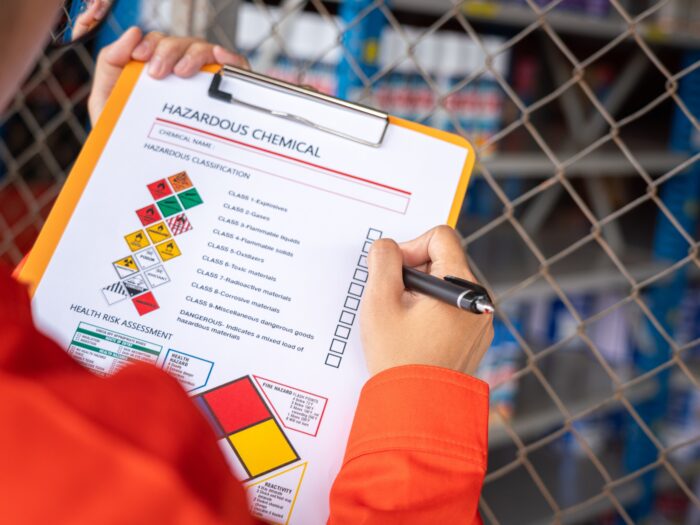
Nearly 37,000 workers have been denied access to proper chemical safety information over a five-year period, representing a significant gap in workplace protection even as regulatory oversight has expanded dramatically since the 1980s, according to an analysis of federal safety data by TraceOne.
Across the United States, hazard communication violations remain concentrated in specific geographic areas and industrial sectors, the report said .OSHA documented 36,984 violations between 2021 and 2025, translating to 5.6 violations for every 100,000 workers nationwide.
topped the nation with 4,370 total violations — or 39.0 per 100,000 workers — followed by Tennessee with 3,159 violations and Michigan with 2,113 violations. When adjusted for workforce size, the pattern shifts slightly: Alaska recorded the highest rate at 44.7 violations per 100,000 workers, with Maryland and Delaware rounding out the top three.
Manufacturing and construction dominate the violation landscape, collectively accounting for more than half of all citations, TraceOne said. Manufacturing facilities generated 10,021 violations while construction sites produced 8,678 violations during the five-year analysis period.
The remaining violations were distributed across accommodation and food services, retail trade, and public administration, among other sectors. Industries with minimal chemical exposure — such as finance, insurance, and information technology — reported far fewer infractions.
Compliance Gaps in High-Risk Industries
The concentration of violations in manufacturing and construction reveals distinct compliance challenges within each sector, according to TraceOne. Despite construction accounting for 42.8% of all OSHA inspections, only 2.5% of construction inspections uncovered hazard communication deficiencies — one of the lowest rates among major industries.
Manufacturing presents a different picture: while inspectors conducted fewer than half the inspections compared to construction, 8.8% of manufacturing inspections identified violations. This disparity suggests that manufacturing facilities face more acute compliance difficulties even under comparable scrutiny.
The most frequent violations involve missing or outdated Safety Data Sheets (SDS), the documents required to inform workers about chemical hazards and proper handling procedures, the report noted. Without accessible and current documentation, employees lack critical information necessary to protect themselves from respiratory illness, chemical burns, and fire or explosion hazards.
Progress and Persistent Challenges
The trajectory of hazard communication enforcement demonstrates substantial progress over four decades, TraceOne said. Violations peaked at 37,134 in 1989, shortly after OSHA’s Hazard Communication Standard took full effect. Since that peak, citations have declined 83.5%, with only 6,130 recorded in 2025.
Yet the persistence of thousands of annual violations underscores how compliance gaps continue to affect workers at smaller and mid-sized employers. Organizations without sophisticated compliance infrastructure struggle to maintain accurate hazard information across multiple work sites, leaving employees vulnerable to chemical exposures.
For risk management and insurance professionals, these ongoing violations represent significant exposure — both in terms of workplace injury claims and regulatory penalties that can accumulate rapidly across multiple facilities or violations.
The geographic and sectoral concentration of violations suggests that targeted interventions in manufacturing — particularly in states like Maryland, Tennessee, and Michigan — could yield substantial improvements in worker safety, according to TraceOne.
View the report here. &